
The Undisputed Leviathan
When we try to picture the most enormous creatures to ever inhabit our planet, our minds naturally drift to prehistoric times and the colossal dinosaurs that shook the earth. But the truth is far more incredible: the largest animal known to have ever existed in the history of Earth is swimming in our oceans right now.
The Blue Whale (Balaenoptera musculus) defies comprehension when it comes to sheer scale. Measuring up to a staggering 30 meters (100 feet) in length, a fully grown female can weigh an incomprehensible 180 tonnes. To put that into perspective, that is the equivalent weight of about 33 African elephants, or a fully loaded Boeing 757 airplane. Everything about this marine mammal is record-breaking. Its heart alone is roughly the size of a classic Volkswagen Beetle car, pumping blood through major arteries that are so wide a human toddler could theoretically crawl through them. Even its tongue weighs as much as an adult elephant!
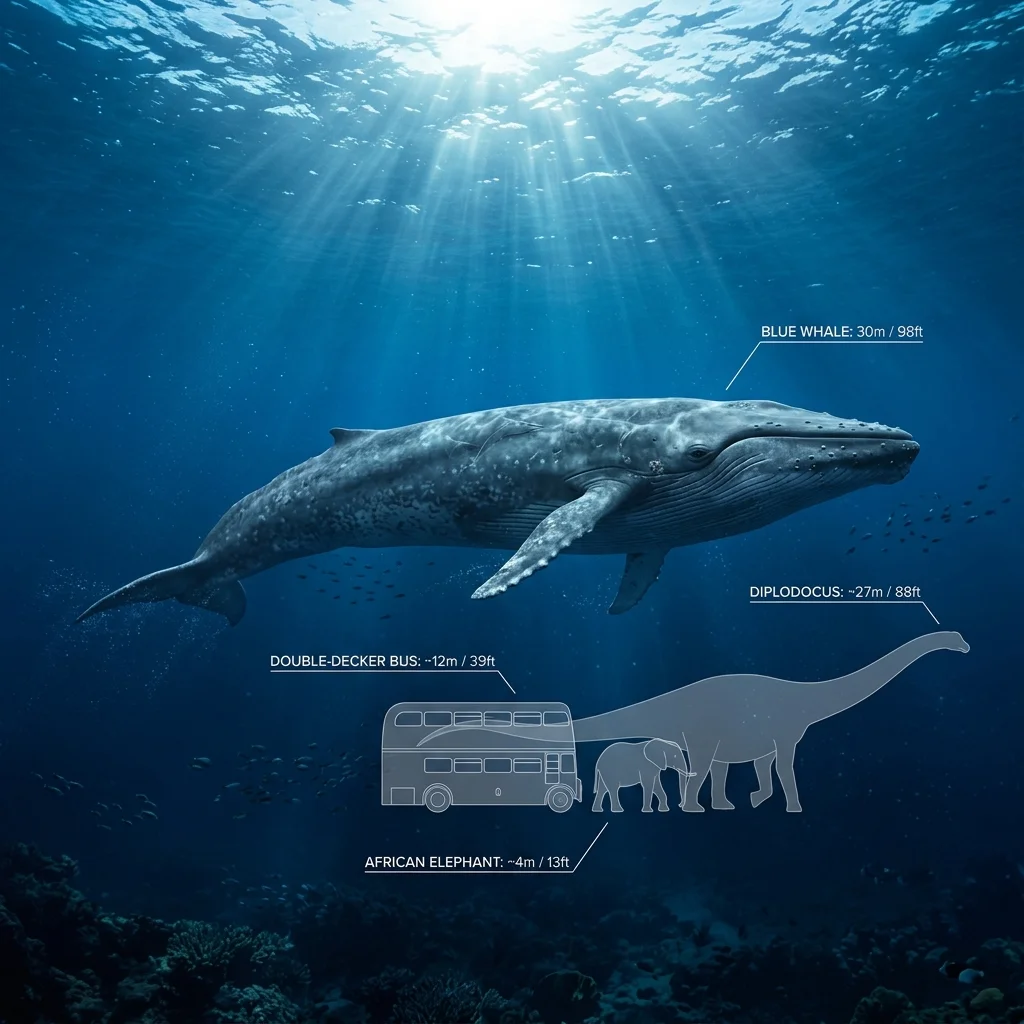 Scale diagram comparing a Blue Whale to a Bus, Elephant, and Dinosaur
The Gentle Giant's Feast
You might assume that an animal of this unprecedented, monstrous size would need to hunt massive prey, like giant squid or large sharks. Paradoxically, the Blue Whale sustains its massive bulk by eating some of the smallest animals in the ocean: tiny, shrimp-like crustaceans called krill.
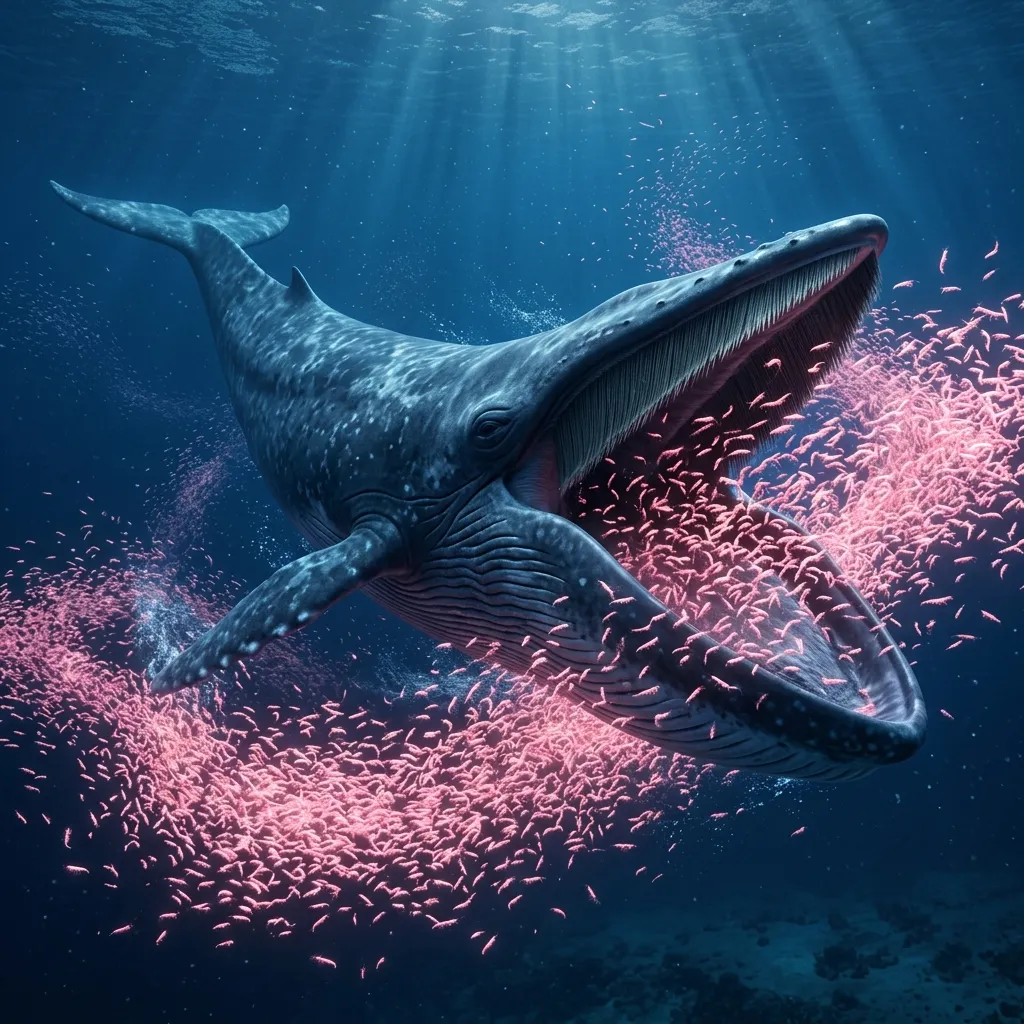
To get enough calories, a Blue Whale must consume roughly 4 tonnes of krill every single day during its peak feeding season. It does this through a magnificent, energy-intensive process called lunge feeding. Spotting a dense swarm of krill, the whale accelerates rapidly toward it, unhinging and opening its massive jaws to nearly a 90-degree angle. As it lunges forward, the deep pleats running down its throat expand simultaneously like a giant underwater parachute, allowing the whale to take in an unimaginably massive gulp of water and food. It then uses its massive tongue to force the water back out through hundreds of overlapping, bristle-like baleen plates hanging from its upper jaw, trapping millions of krill inside to be swallowed whole.
The Ocean's Deepest Song
Beyond their size, Blue Whales are also the loudest animals on the planet. Their deep, pulsing vocalizations can reach an earth-shattering 188 decibels—measurably louder than a jet engine at takeoff. Because these low-frequency moans and pulses travel exceptionally well underwater, a Blue Whale can effectively communicate with others of its kind up to 1,600 kilometers (1,000 miles) away. They are the true, solitary leviathans, singing lonely, echoing songs across the vastness of the world's oceans.