Cheating the Reaper
Virtually every complex living biological organism on Earth is forced to follow a strict, one-way, inescapable path: Birth, Youth, Old Age, and eventually, Death. The Immortal Jellyfish (Turritopsis dohrnii) is the only known creature on the planet that has successfully found a biological loophole to cheat the reaper.
When this remarkably tiny, bell-shaped jellyfish (which is smaller than your pinky fingernail) gets critically sick, heavily injured by a predator, or simply becomes too old to function efficiently, it doesn't give up and die. Instead, it slowly sinks down to the dark ocean floor and literally transforms its adult body entirely back into a newborn baby.
The Superpower of Transdifferentiation
To achieve this incredible feat of biological time travel, the jellyfish uses an extraordinarily rare superpower known as transdifferentiation.
This complex mechanism allows its fully mature, specialized adult cells to completely shed their current identity and rewrite themselves into entirely new types of cells. For example, a specialized adult muscle cell can magically revert its programming and become a nerve cell, or an aging skin cell can transform itself into a brand new reproductive cell.
Here is exactly how this incredible reset cycle works:
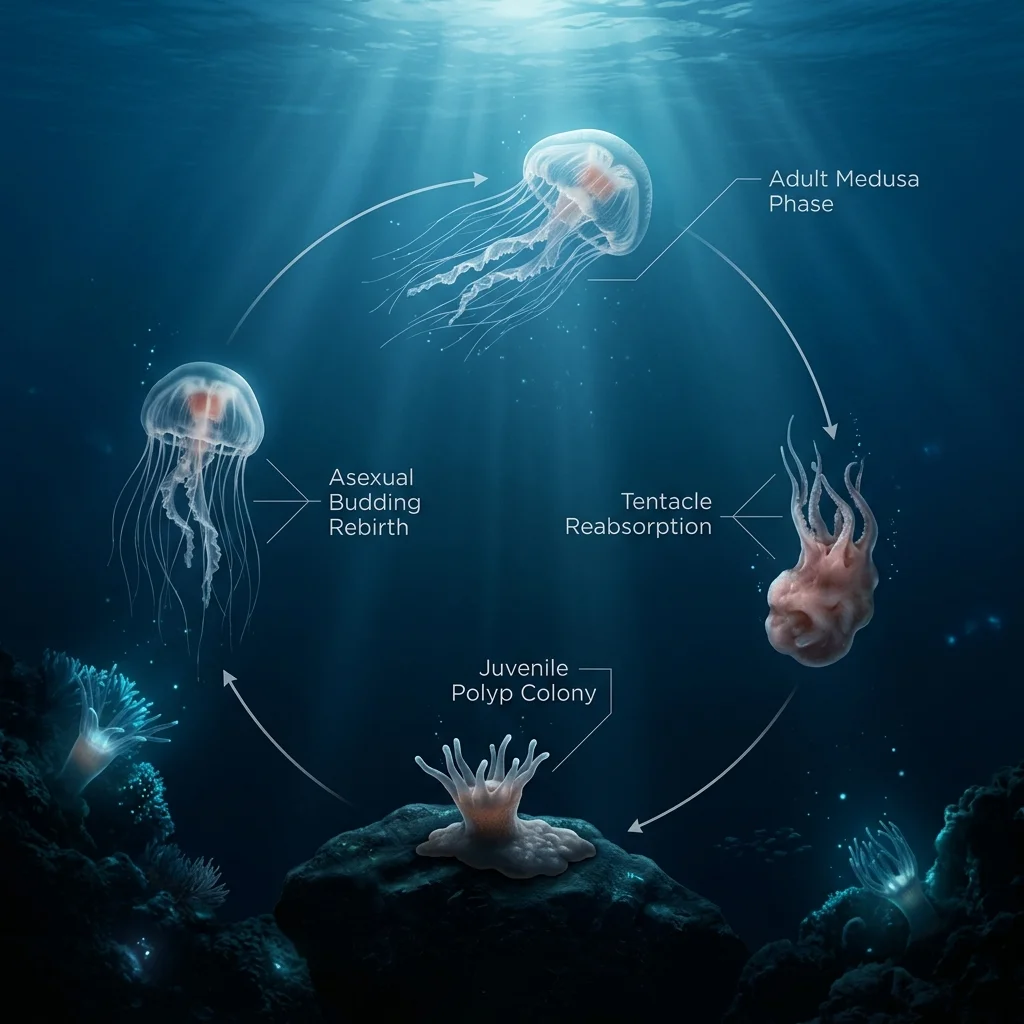
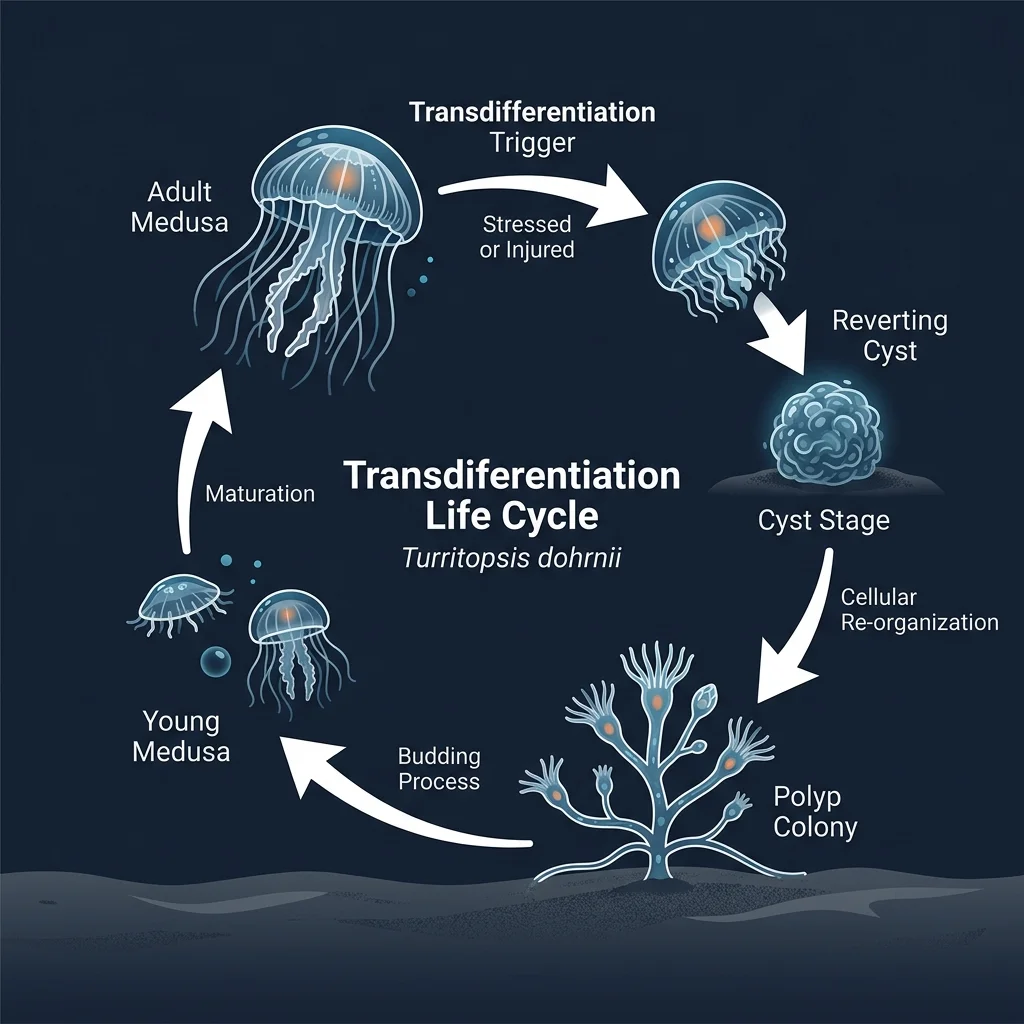
- The Medusa Phase (Adult): The creature lives as a typical, free-swimming adult jellyfish, hunting tiny plankton in the water column.
- The Crisis Trigger: Facing brutal starvation, traumatic physical injury, or extreme aging, the jellyfish actively triggers its emergency protocol.
- The Regression: The jellyfish stops swimming, fully absorbs its own stinging tentacles into its bell, and completely regresses back into a formless, fleshy blob of unspecialized tissue.
- The Fast-Forward Polyp (Baby): This blob sinks, firmly attaches itself to a rock or a passing ship's hull, and morphs back into a juvenile polyp colony—the exact same physical form it took when it was first born.
- The Exact Clone Rebirth: The polyp rapidly buds off dozens of brand new, genetically identical adult jellyfish, fully resetting the clock.
Imagine an ancient, dying butterfly deliberately absorbing its own wings, transforming completely back into a young caterpillar, and starting its life entirely over. That is exactly what this tiny ocean dweller does to survive.
Are They Truly Immortal?
Biologically speaking? Yes. There is absolutely no known genetic or cellular limit to how many times a single Turritopsis dohrnii can trigger this incredible reset cycle. Left in a perfectly safe laboratory tank, they could theoretically live forever.
In practice, in the harsh wild ocean? No. They are tiny, completely soft-bodied, and lack any serious defensive mechanisms. While they can cheat old age, they cannot cheat a hungry sea turtle's mouth. They are routinely eaten by fish, crushed by waves, or swept onto dry beaches. They are biologically immortal, but they are far from invincible.
Unlocking Human Medical Potential
Because of this unique loophole, scientists are aggressively studying the Turritopsis dohrnii on a genetic level, desperately hoping to understand exactly how it perfectly reprograms its adult cells. If scientists could learn to apply even a fraction of that cellular transdifferentiation to modern human medicine, the implications would be staggering—potentially allowing doctors to flawlessly regenerate badly damaged hearts, replace severed spinal cords, or perfectly repair complex brain tissue after a devastating stroke.