
The Snap
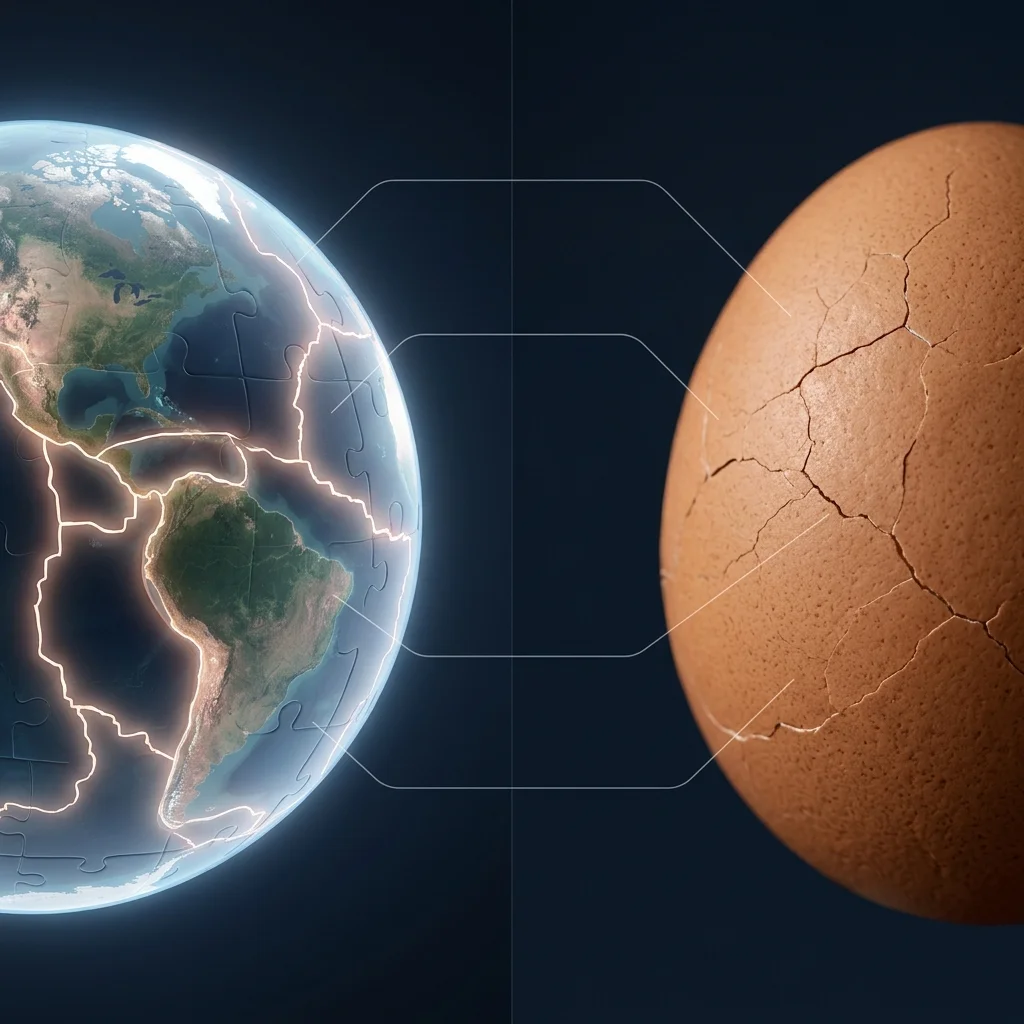
The ground beneath your feet feels solid. It isn't. It is an illusion. You are actually standing on a giant raft made of rock (a Tectonic Plate) that is floating on a sea of hot, gooey magma (The Mantle). And you aren't the only raft. The Earth's crust is broken into about 7 massive puzzle pieces. These pieces are constantly moving. They drift at about the same speed your fingernails grow (2-5 cm per year). Usually, they slide past each other smoothly. But sometimes, they get stuck. The rough edges of the rock lock together. Friction holds them in place. But the plate keeps moving. The rock bends. And bends. The pressure builds up for hundreds of years like a stretched rubber band. Then, suddenly... SNAP. The rock breaks. Centuries of stored energy are released in 10 seconds. This is an Earthquake.
The Elastic Rebound
Imagine holding a plastic ruler. You bend it a little. It snaps back straight. You bend it a lot. It snaps back harder. You bend it too far... CRACK. It breaks in half, and the two ends vibrate violently in your hands. This is exactly what happens to the Earth's crust. It is called Elastic Rebound Theory. When the rock snaps deep underground (The Hypocenter), it sends out shockwaves that travel through the planet like ripples in a pond. The point directly above the snap, on the surface where we live, is the Epicenter.
P-Waves and S-Waves
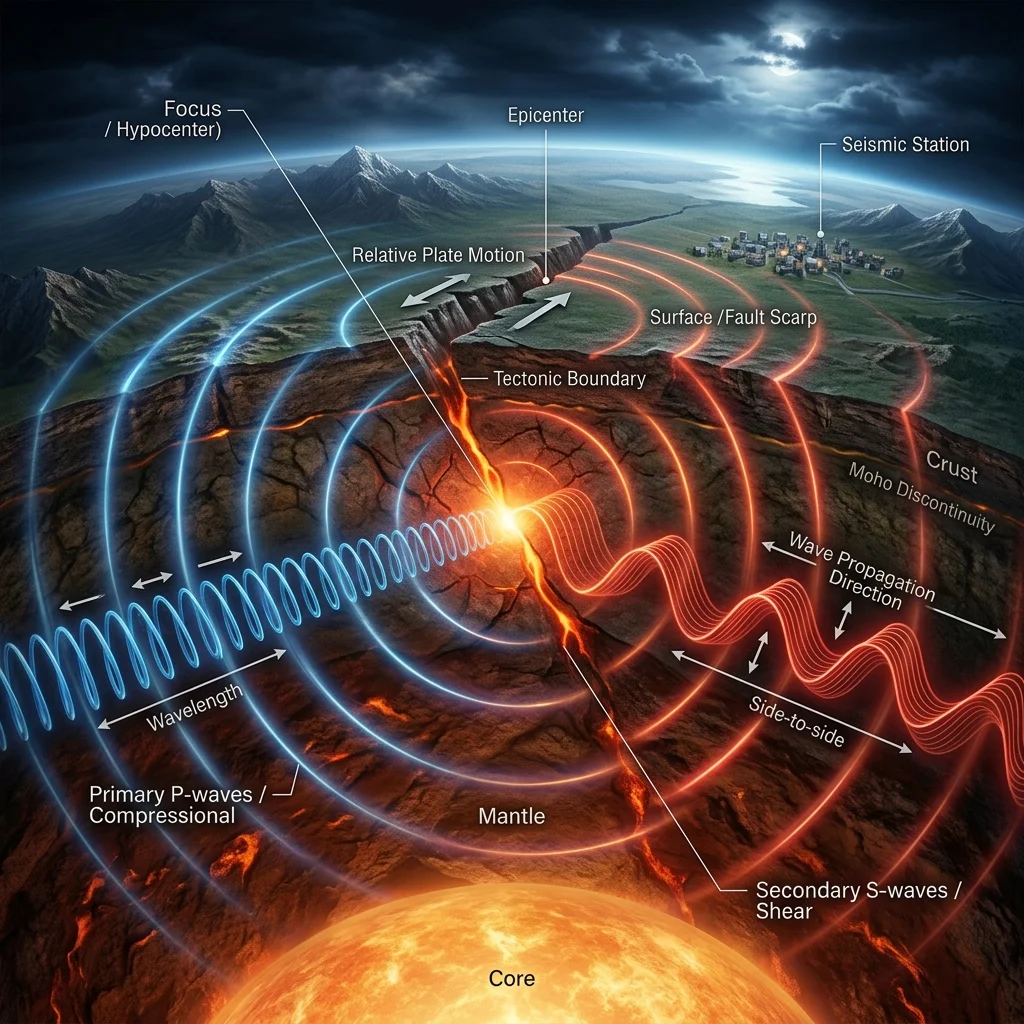
An earthquake isn't just one shake. It is a sequence. If you are ever in a big one, you will feel two distinct types of movement.
- The P-Wave (Primary): This arrives first. It travels fast (6 km/s). It feels like a sudden jolt or a punch up from the ground. It is a sound wave moving through rock (Compression Wave). It is startling, but usually doesn't destroy buildings because houses handle up-and-down forces well.
- The S-Wave (Secondary): This arrives seconds later. It travels slower (3 km/s). It is a "Shear Wave." It moves the ground side-to-side like a snake. This is the killer. Houses are not designed to wiggle sideways. This shears the bolts, topples walls, and collapses roofs. Animals can feel the P-Wave before humans do. That is why dogs often bark 10 seconds before the "Big One" (S-Wave) hits. They aren't psychic; they just felt the warning shot.
Liquefaction: When Earth Turns to Water
Can the Earth swallow a city? No. Faults don't open up into giant pits. But something stranger happens. Liquefaction. If an earthquake hits wet, sandy soil (like in San Francisco or Japan), the shaking shakes the water molecules between the sand grains. Suddenly, the solid ground loses its friction and structure. It behaves exactly like a liquid. It turns into instant quicksand. Cars sink into the road. Entire apartment buildings tilt over and sink into the mud, perfectly intact. When the shaking stops, the ground hardens again instantly, trapping everything in concrete. This is why building on "Reclaimed Land" (landfill) is so dangerous in quake zones.
The Ring of Fire
Where is the safest place to live? Antarctica, Australia, or the interior of Canada. Where is the most dangerous? The Ring of Fire. It is a giant horseshoe shape that wraps around the Pacific Ocean (from New Zealand, up to Japan, across to Alaska, and down California and Chile). This is the edge of the massive Pacific Plate. 90% of the world's earthquakes happen here. It is a collision zone where the floor of the ocean is diving under the continents (Subduction), melting, and fueling volcanoes and earthquakes constantly.
Richter Scale is Dead
You hear "Richter Scale" on the news. Scientists hate that term. The Richter Scale was invented in the 1930s for small California quakes close to the sensor. It breaks when measuring giant ones. Today, we use the Moment Magnitude Scale (Mw). It measures the total Energy released (Area of Fault × Slip Distance). The scale is Logarithmic. A 7.0 is not "a little stronger" than a 6.0. It is 32 times stronger in terms of energy.
- Mw 6.0: Strong. Damage to poorly built houses.
- Mw 7.0: Major. Serious damage.
- Mw 9.0: Catastrophic. Like 20,000 nuclear bombs going off at once. (Japan 2011, Chile 1960).
Fast Facts
- Moonquakes: The Earth isn't the only shaker. The Moon has quakes too! But they aren't from tectonic plates (the Moon is solid cold rock). They are caused by the Earth's gravity squeezing the Moon like a stress ball (Tidal Forces). They can last for an hour because the dry Moon rock rings like a bell, unlike Earth's mushy wet rock which dampens vibration.
- The Core: We only know what the center of the Earth looks like because of earthquakes. Scientists measured how long it took P-Waves to travel through the planet. They noticed the waves bounced off something dense in the middle. That is how we discovered the Solid Iron Inner Core and the Liquid Outer Core.
- Short Days: The 2011 Japan Earthquake was so powerful it actually shifted the Earth's axis by 10 cm and made the day 1.8 microseconds shorter. Conservation of Angular Momentum sped up the planet's spin!
- Strange Lights: Before big quakes, people sometimes report "Earthquake Lights" (EQL)—glowing blue orbs floating in the sky. It is thought to be caused by the immense pressure on quartz rocks generating static electricity (Piezoelectricity) that shoots out of the ground and ionizes the air.