
The Deepest Scar on Earth
Imagine taking the biggest mountain on the planet, Mount Everest, and dropping it base-first into the ocean. Even with Everest completely submerged, you would still need to dive another 2 kilometers (1.2 miles) straight down before you finally hit the bottom.
This impossibly deep abyss is the Mariana Trench, a massive, crescent-shaped scar carved into the Earth's crust located in the western Pacific Ocean. Formed by the violent collision of two massive tectonic plates, this trench is the deepest realm on our planet. Its absolute lowest point, appropriately named Challenger Deep, plunges a staggering 10,935 meters (35,876 feet) beneath the waves. It is an alien world that is completely, eternally devoid of sunlight.
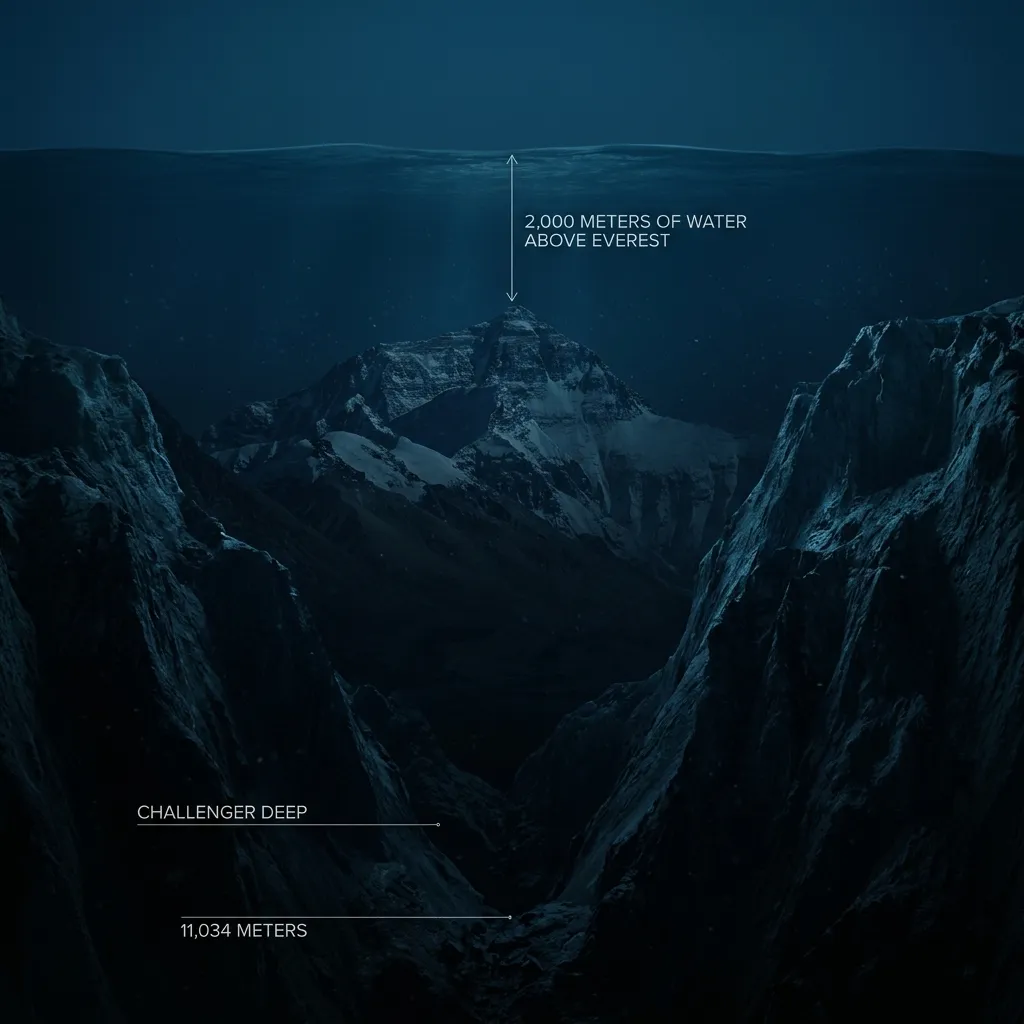 Scale diagram showing Mount Everest inside the Mariana Trench
The Crushing Weight of Water
Down in Challenger Deep, the environmental conditions are almost beyond human comprehension. The water temperature hovers just a few degrees above freezing, but the most dangerous factor is the sheer weight of the ocean above.
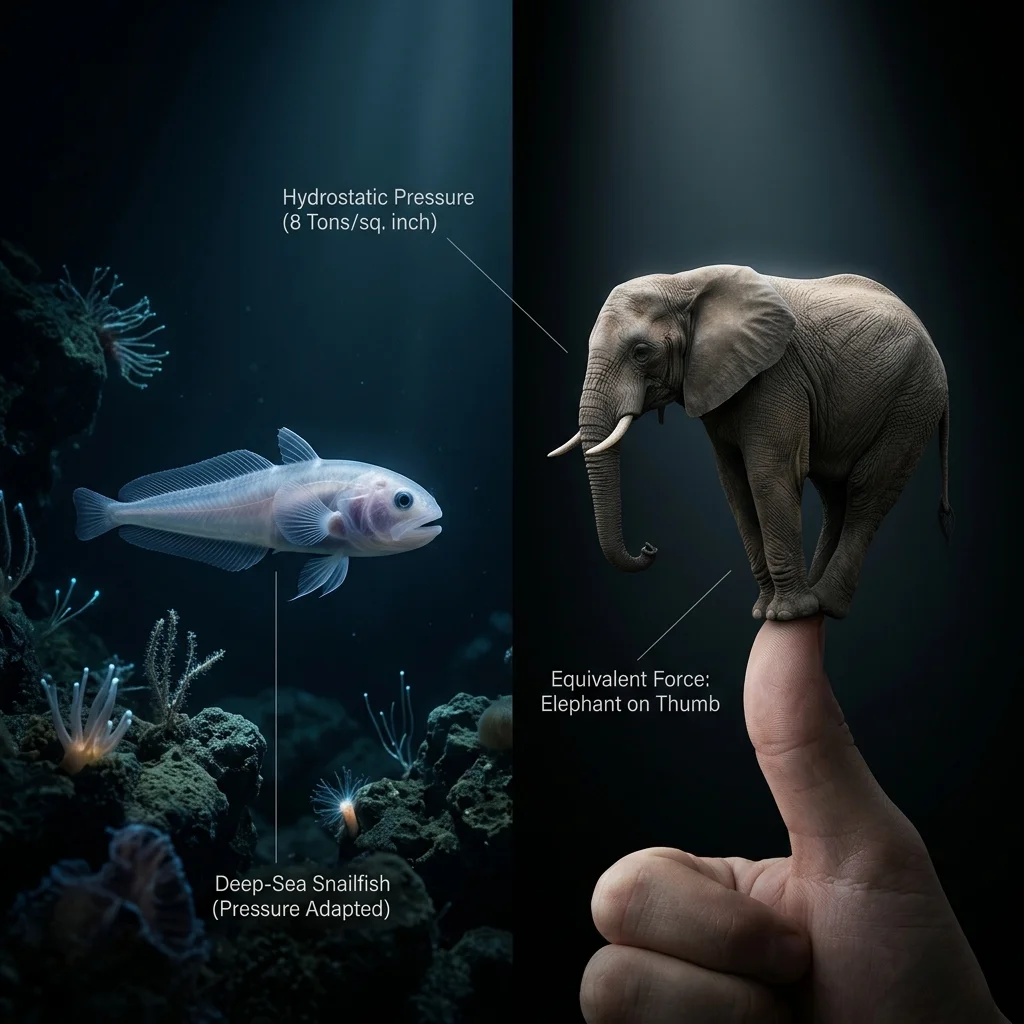
The hydrostatic pressure at that depth exceeds an unimaginable 8 tons per square inch. To put that into perspective, it is the equivalent of having a fully grown adult elephant standing balanced entirely on your thumb. Under this tremendous force, the water itself is physically compressed, becoming significantly denser than the water found at the surface. Any standard submarine—and certainly human lungs—would be crushed and implode instantly under the immense strain.
Life in the Abyss
For decades, scientists firmly believed that this crushing, freezing, pitch-black void was entirely devoid of life. They were beautifully wrong. Life in the trench is simply built differently.
- Xenophyophores: Giant, single-celled amoebas that have grown to the size of a baseball absorb nutrients from the muddy floor.
- Amphipods: Strange, shrimp-like scavengers casually thrive at depths that would instantly liquefy most surface animals.
- The Snailfish: Holding the record for the deepest-dwelling fish, these translucent, ghostly creatures lack the air bladders that would normally cause a fish to explode. Instead, they produce specialized proteins that chemically reinforce their cells from the inside out, preventing them from collapsing under the massive pressure.
A Sobering Discovery
Yet, even this unfathomable depth isn't entirely disconnected from the surface world. When deep-sea submersibles finally reached the absolute bottom of Challenger Deep, the most remote and inaccessible place on Earth, they found a heartbreaking sign of humanity: a plastic grocery bag. It serves as a stark, chilling reminder that every corner of our blue marble is deeply intertwined.