
Optical Illusions: Your Brain is Lying
The Glitch
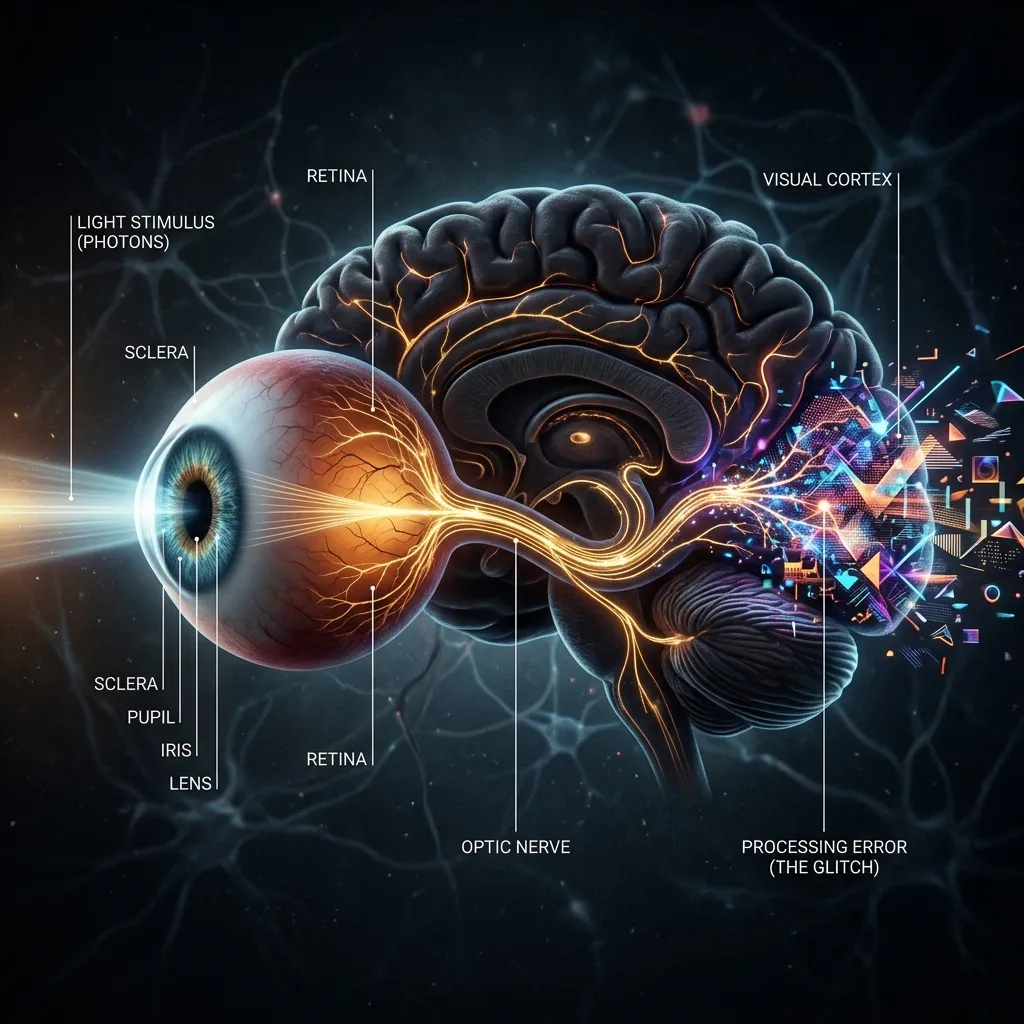
Everything you see is fake. Your eyes are not cameras. They are muddy, wet biological sensors that send noisy electrical spikes to the brain. The brain's job is to take that mess and make a prediction about what is out there. It doesn't show you "reality"; it shows you a Useful Hallucination. Optical Illusions are glitches that happen when the brain's prediction software gets confused. They prove that you don't see with your eyes; you see with your brain.
The Checkerboard Shadow
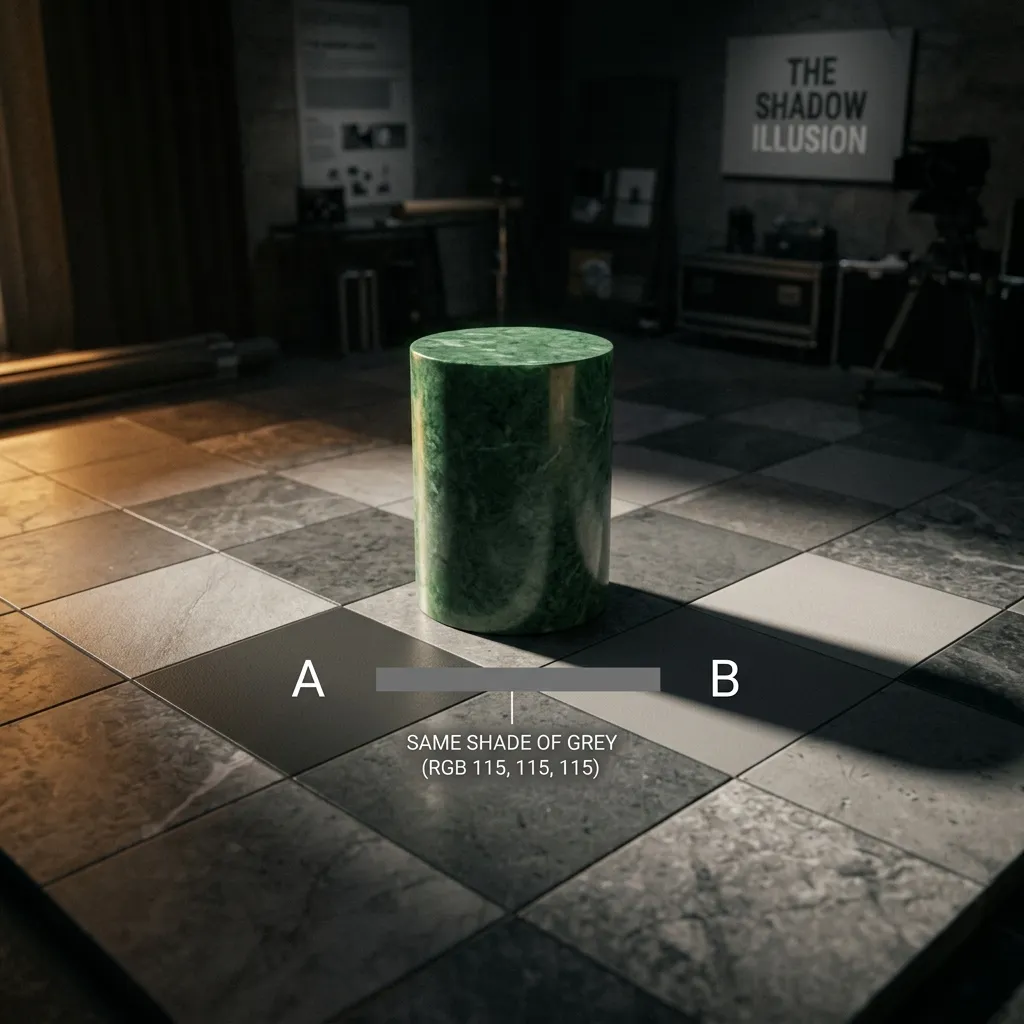
The most famous illusion in science is the Adelson's Checkerboard Shadow. Look at the picture. Square A is dark. Square B is light. But if you use a color dropper tool in Photoshop, you will find they are the EXACT SAME shade of grey. (Cover the middle with your finger if you don't believe me). Why? Because your brain sees the shadow. It calculates: "Shadows make things look darker. If Square B looks grey even though it is in a shadow, it must actually be bright white in reality." Your brain "Brightness Corrects" the image in real-time. It lies to you about the color (Pixel B) to tell you the truth about the object (It's a white square). If your brain didn't do this, you would be confused every time a cloud passed over the sun. Your brain cares more about constancy than accuracy.
The Dress That Broke the Internet
Remember #TheDress? In 2015, a photo of a dress tore the internet apart. Was it Blue/Black or White/Gold? This wasn't a prank. It was a failure of Color Constancy. The photo was taken in terrible lighting. The light in the room was ambiguous.
- Team White/Gold: Their brains subconsciously assumed the dress was in a Blue Shadow (like near a window). They mentally subtracted the blue tint, leaving White and Gold.
- Team Blue/Black: Their brains subconsciously assumed the dress was under Yellow Artificial Light. They mentally subtracted the yellow tint, leaving Blue and Black. It revealed a shocking truth: 50% of humans process color fundamentally differently than the other 50%, and we never knew it until that photo. We all live in slightly different realities.
The Moon Illusion
Have you ever noticed the Moon looks GIGANTIC when it is rising near the horizon? But hours later, high in the sky, it looks tiny? If you measure it with a ruler held at arm's length, it is the exact same size (0.5 degrees wide). Why does it shrink? This is the Ponzo Illusion. Your brain assumes the sky is a flattened dome. It thinks the horizon is "further away" than the top of the sky. Because the moon takes up the same space on your retina but "feels" further away at the horizon, your brain concludes: "If it's that far away and still looks big, it must be MASSIVE." It magnifies the moon in your mind to make sense of the distance. The giant moon is a hallucination.
The Ames Room
Have you ever seen a movie (like Lord of the Rings) where a person walks across a room and seemingly shrinks to the size of a Hobbit? They are likely using an Ames Room. From the front, it looks like a normal square room. But it is a trap. The floor is slanted. The back wall is crooked. One corner is much further away from the camera than the other. Because your brain assumes all rooms are square boxes, it cannot accept that the geometry is warped. Instead, it accepts something even crazier: "That person must be rapidly shrinking." Your brain chooses to violate the laws of biology rather than the laws of architecture.
The McGurk Effect: Hearing with Eyes
Illusions aren't just for eyes. Watch a video of a man saying "Ba-Ba-Ba." Now, keep the audio "Ba-Ba-Ba," but change the video so his lips move like "Ga-Ga-Ga." What do you hear? You will hear "Da-Da-Da." Your brain receives conflicting data (Eyes say G, Ears say B). It panics. It splits the difference and hallucinates a completely new sound (D). This proves that you don't just "hear" with your ears. You hear with your eyes too.
Fast Facts
- The Blind Spot: You have a hole in your vision where the optic nerve connects to your eye. There are no receptors there. Why don't you see a black dot? Because your brain uses the Content-Aware Fill tool (like Photoshop) to copy-paste the surrounding texture into the hole. It guesses what should be there.
- Pareidolia: Why do we see faces in clouds? Because recognizing a face is the most important survival skill we have. Our brain is triggered to see eyes and mouths everywhere. It is better to see a tiger that isn't there, than to miss one that is.
- Saccadic Masking: Move your eyes to look at a clock. You never see your eyes moving in the mirror. Why? Your brain turns off the camera while your eyes are swiveling so you don't get motion sickness. You are blind for about 40 minutes every day just from moving your eyes.
Diagram Prompts
- Checkerboard Illusion: Adelson's Checkerboard Shadow Illusion. A cylinder casting a shadow over a checkerboard. Square A (Black) and Square B (White in shadow) are connected by a grey bar to show they are the exact same color. Label: "Your Brain Is Lying."
- The Ames Room: Top-down blueprint of a trapezoidal room. A camera looking through a peephole. Two people standing in corners: One looks Giant (Close), One looks Tiny (Far). Label: "Forced Perspective."
- McGurk Effect: A face split in half. Left Half: Lips saying "Ga". Ear: Hearing "Ba". Brain: Thought bubble saying "Da?". Label: "Sensory Confusion."