
The Rock Cycle: Earth's Recycling
Rocks are Not Forever
Rocks feel permanent. But every rock you hold in your hand was once red-hot lava, and once sand on a beach, and will one day be lava again. This endless recycling of the Earth's crust is called the Rock Cycle. There are 3 Families of Rock, and they are constantly turning into each other.
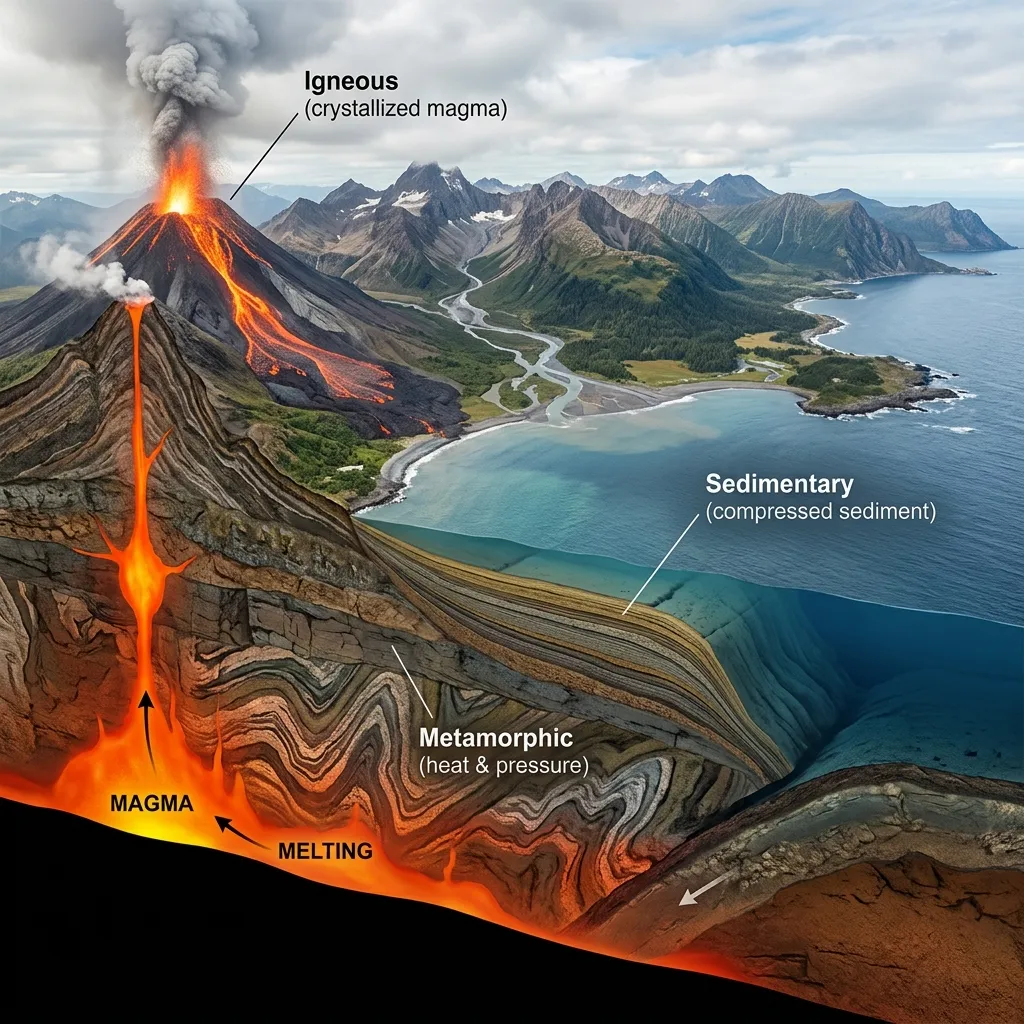
1. Igneous (Born of Fire)
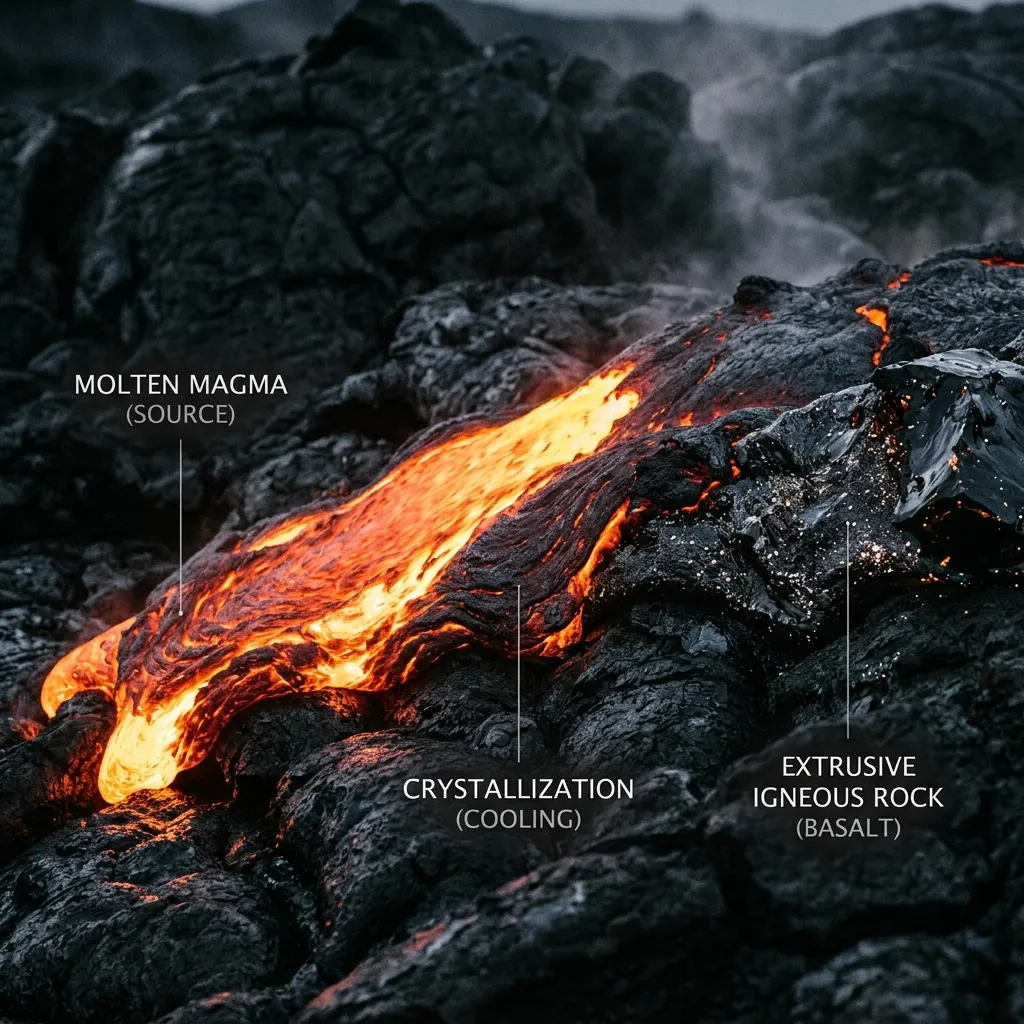
Ignis means Fire. When hot magma or lava cools down, it freezes into rock.
- Basalt: Lava that cooled fast on the surface (Black). It makes up the ocean floor.
- Granite: Magma that cooled slowly deep underground (Speckled). It makes up the continents.
2. Sedimentary (The Sandwich)
Born of Weather. Rain and wind grind mountains into dust (sand). Rivers carry this sand to the ocean, where it settles in layers. Over millions of years, the weight of the water presses down, gluing the sand back into stone.
- Fossils: This is the only rock where you find fossils. (You can't find a dinosaur in lava!).
- Limestone: This rock is actually made of ghosts. It is 100% made of crushed sea shells and coral skeletons from ancient oceans.
3. Metamorphic (The Changeling)
Born of Pressure. If you take a rock and bury it deep underground (but not deep enough to melt), the intense heat and crushing weight COOK it. It doesn't melt; it gets squishy and changes (morphs).
- Limestone cooks into -> Marble (Statues).
- Coal cooks into -> Diamonds (The hardest rock of all).
Science vs. Fiction: Digging to China
Could you dig a hole through the Earth? No. We have barely scratched the skin. The deepest hole ever drilled is the Kola Superdeep Borehole in Russia. It is only 7.5 miles deep. The center of Earth is 4,000 miles down. Why did we stop? Because at 7 miles, the rock became so hot (356°F) that it acted like plastic. The drill bit couldn't cut it; the hole just oozed shut. It was like trying to drill into soup.
The Clock in the Rock
How do we know the Earth is 4.5 Billion years old? Rocks. Specifically, a tiny crystal called Zircon. Zircons are incredibly tough. They survive being melted, crushed, and eroded. When a Zircon crystal forms, it traps Uranium inside it. It refuses to trap Lead. So, at the moment of birth, a Zircon has 100% Uranium and 0% Lead. Uranium is radioactive. It slowly decays into Lead at a perfect, steady beat (Half-life). By measuring the ratio of Uranium to Lead in a Zircon, uses can calculate exactly when that rock was born. It is a built-in atomic stopwatch. The oldest Zircon found (in Australia) is 4.4 Billion years old. It is a piece of the original crust of the baby Earth.
Fast Facts
- Obsidian: Lava that cooled INSTANTLY (like falling into water). No crystals could form. It is natural black glass, with edges sharper than a surgeon's scalpel. Ancient humans used it for arrowheads.
- Pumice: A rock that floats! It cooled from frothy, bubbly lava so fast that it trapped gas bubbles inside. It is lighter than water. Sailors sometimes see huge rafts of pumice floating in the ocean after a volcano erupts.
- Recycling: The atoms in your granite kitchen counter might have been a T-Rex bone 100 million years ago, recycled three times since then.
Diagram Prompts
- Rock Cycle Loop: Circular Flowchart. 1. Volcano (Magma cooling to Igneous). 2. Rain/Wind (Eroding rock to Sand). 3. Ocean Layer (Sand turning to Sedimentary). 4. Underground Heat (Cooking to Metamorphic). 5. Melting (Back to Magma). Label: "The Infinite Loop."
- Igneous vs Sedimentary: Split view. Left: A block of Granite (Speckled crystals). Label: "Born of Fire." Right: A block of Sandstone (Distinct layers with a fossil inside). Label: "Born of Water."
- Metamorphic Pressure: Cartoon. A piece of Coal being squeezed by two giant rocky hands. Sweat flying off the coal. It transforms into a Diamond. Label: "Pressure Makes Diamonds."