
The Water Cycle: The Recycling Machine
The Recycling Machine
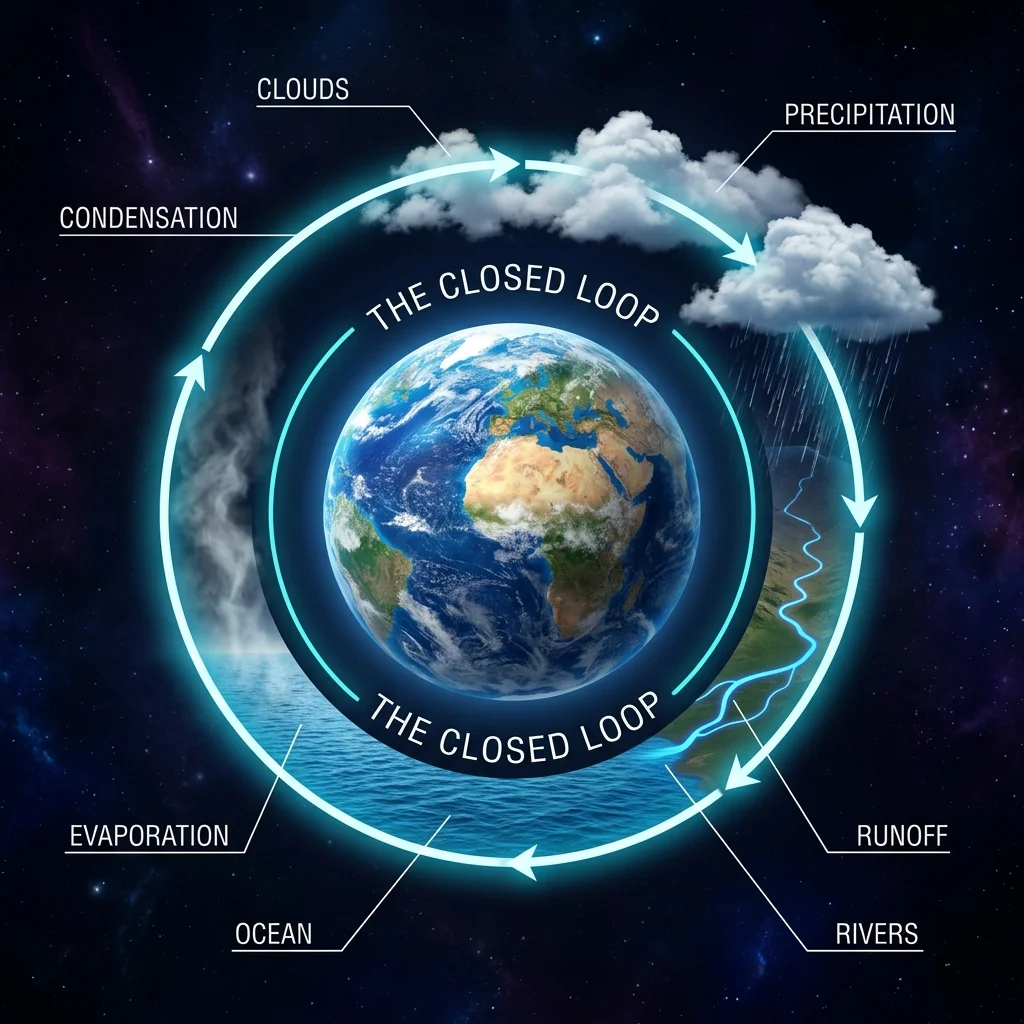
Pour yourself a glass of water. Drink it. You just drank dinosaur pee. I am serious. There is no "New Water" on Earth. The Earth is a closed system. We have the exact same amount of water today as we did 4 billion years ago. It just keeps going in circles. It changes form—Liquid, Gas (Vapor), Solid (Ice)—but it never leaves. This is the Water Cycle. It is the engine that keeps all life alive.
The 4 Steps
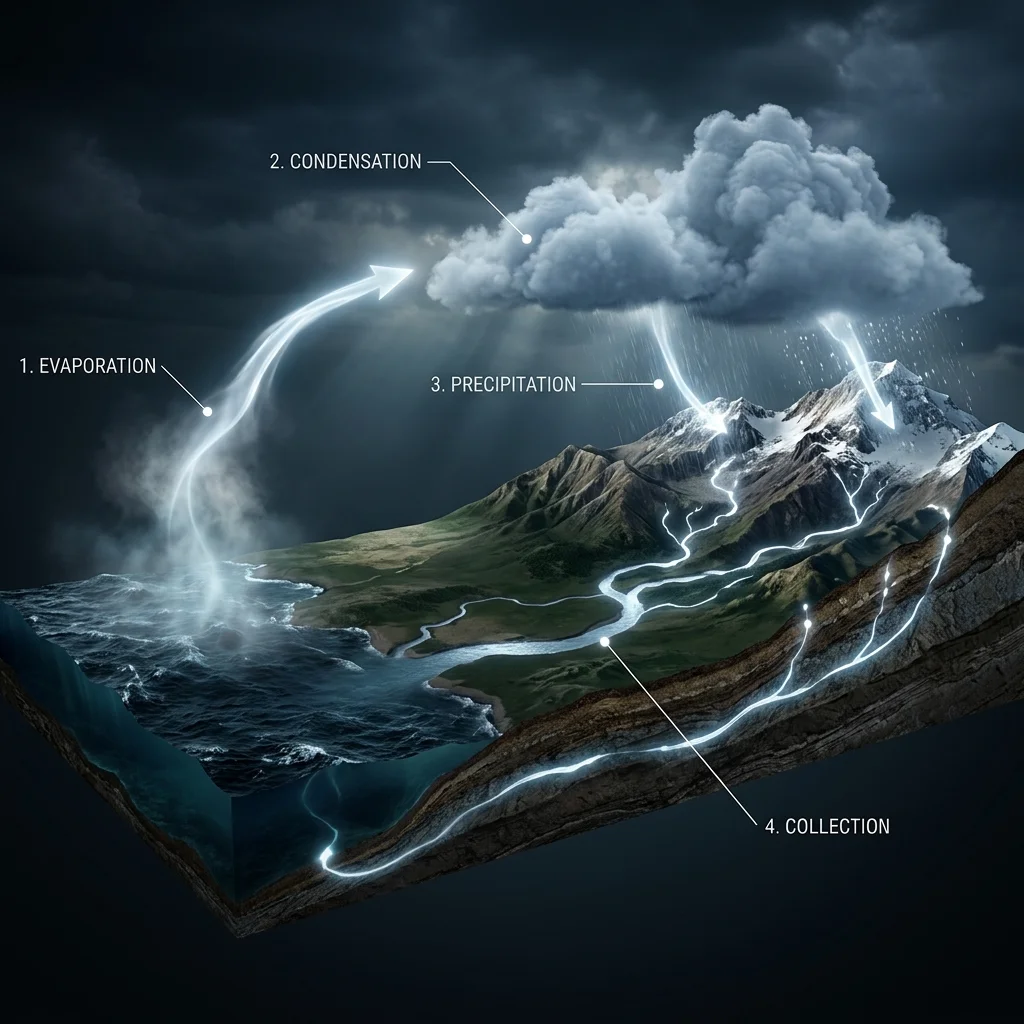
- Evaporation (The Lift): The sun heats the ocean. Water turns into invisible gas (vapor) and rises. This is nature's distillation system. It leaves the salt behind (the ocean is salty, but rain is fresh).
- Condensation (The Cloud): The vapor rises to the cold sky. It turns back into tiny liquid droplets. Clouds form.
- Precipitation (The Fall): The droplets get heavy. Gravity pulls them down as Rain, Snow, or Hail.
- Collection (The Flow): The rain flows into rivers, lakes, and oceans. Or it soaks into the ground.
Transpiration: Trees Sweat Too
The ocean isn't the only thing submitting vapor. Plants do it too. A single large Oak tree releases 40,000 gallons of water into the air every year. This is Transpiration. Plants drink water from the soil and breathe it out through leaves. In the Amazon Rainforest, the trees release so much water that they create their own "Flying Rivers"—massive clouds that travel across South America and rain on farmers in Brazil. Without the forest, the rain stops.
Groundwater: The Hidden Ocean
Not all rain goes to the river. Much of it soaks into the dirt. It sinks down until it hits solid rock. This underground sponge of wet rock is called an Aquifer. This is Groundwater. It moves incredibly slowly (inches per year). It can stay underground for 10,000 years before bubbling up in a spring. When you dig a well, you are tapping into this ancient, hidden reserve.
Fossil Water
We think water is renewable (it rains every year). But some water is not. Deep under the Sahara Desert, there are massive aquifers filled with Fossil Water. This water rained down 10,000 years ago when the desert was a jungle. It is sealed in rock. It does not refill. We are currently pumping it out to water crops. When it is gone, it is gone forever. It is "Water Mining," and it is just as finite as oil.
Fast Facts
- Residence Time: How long does a water drop stay in one place?
- In the Atmosphere: 9 days.
- In a River: 2 weeks.
- In the Ocean: 3,000 years.
- In a Glacier: 100,000 years.
- The Goldilocks Zone: Earth is the only planet we know of with liquid water on the surface. Mars has Ice. Venus has Steam (and acid rain). Earth is the "Triple Point" planet where water can exist as Ice, Liquid, and Gas simultaneously.
- Comets: Where did the water come from originally? Scientists think it was delivered by Comets (dirty snowballs) crashing into Earth billions of years ago.
Diagram Prompts
- The Loop: Circular diagram. Ocean -> Evaporation (Vapor) -> Clouds (Condensation) -> Rain (Precipitation) -> Mountains -> Rivers -> Ocean. Label: "The Closed Loop."
- Transpiration: A large tree. Blue arrows sucking water up from roots. Blue vapor clouds puffing out from the leaves into the sky. Label: "Trees Make Clouds."
- Aquifer: Cross-section of the ground. Top: Grass/Soil. Middle: Sponge-like Rock saturated with blue water (Aquifer). Bottom: Solid Bedrock (Impermeable). A well dug down into the blue layer. Label: "The Hidden Ocean."