
The Living Architecture
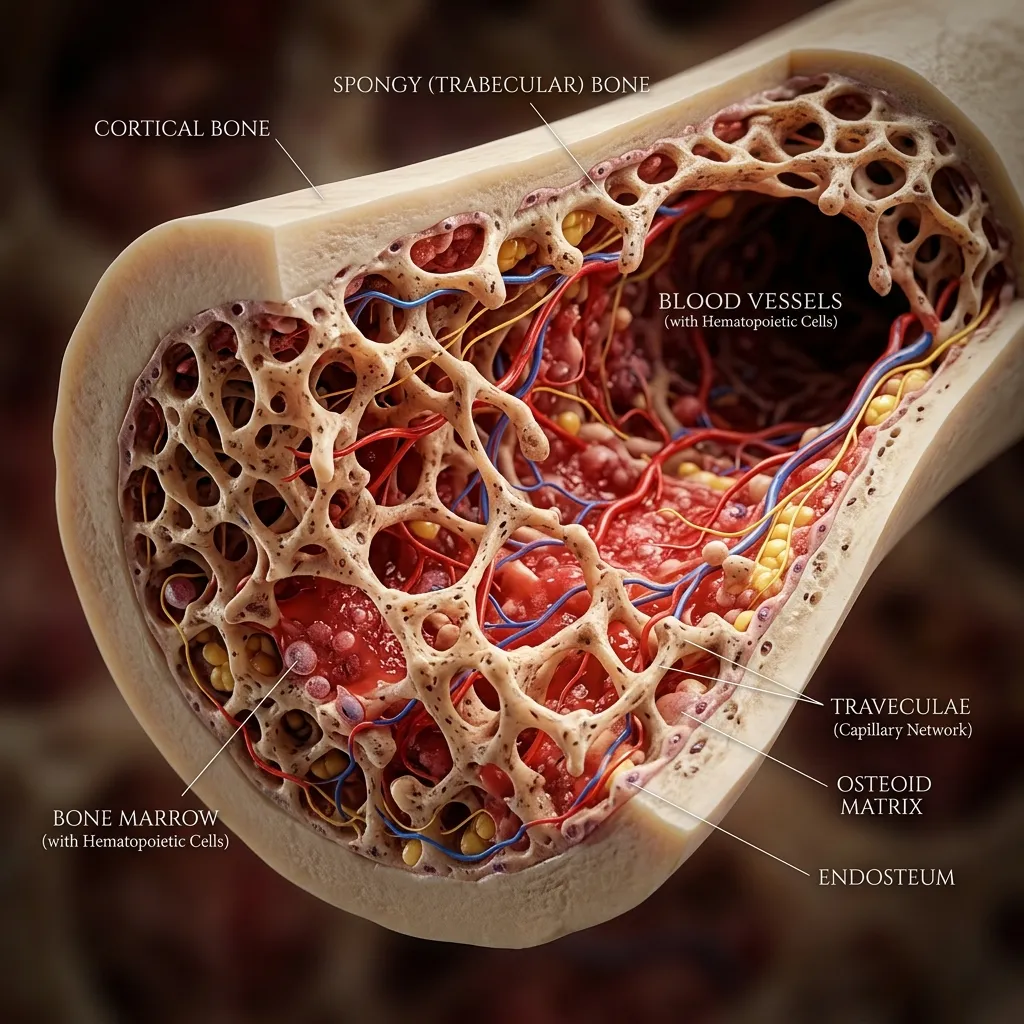
When observed in a museum, a skeleton appears as dry, white, rock-like scaffolding. However, a living skeleton is entirely different. Inside the human body, bones are a vibrant pink, thoroughly infused with fluids, and very much alive.
A bone is a complex organ, much like the heart or lungs. It is interlaced with intricate networks of blood vessels and highly sensitive nerves—which is why fracturing a bone registers as intense pain. The skeleton is an evolutionary masterpiece of materials science, functioning as a composite material made of two primary ingredients:
- Hydroxyapatite: A crystal lattice constructed primarily from calcium and phosphorus, lending the bone its profound compressive strength and hardness.
- Collagen: A structural protein mesh interwoven through these crystals. It provides tensile strength, allowing the bone to flex slightly rather than snap under pressure.
Without collagen, our skeleton would be as brittle as glass. Without calcium, it would be as flexible as rubber. Together, they form structural columns capable of supporting incredible physical stress.
The Eiffel Tower in Your Leg
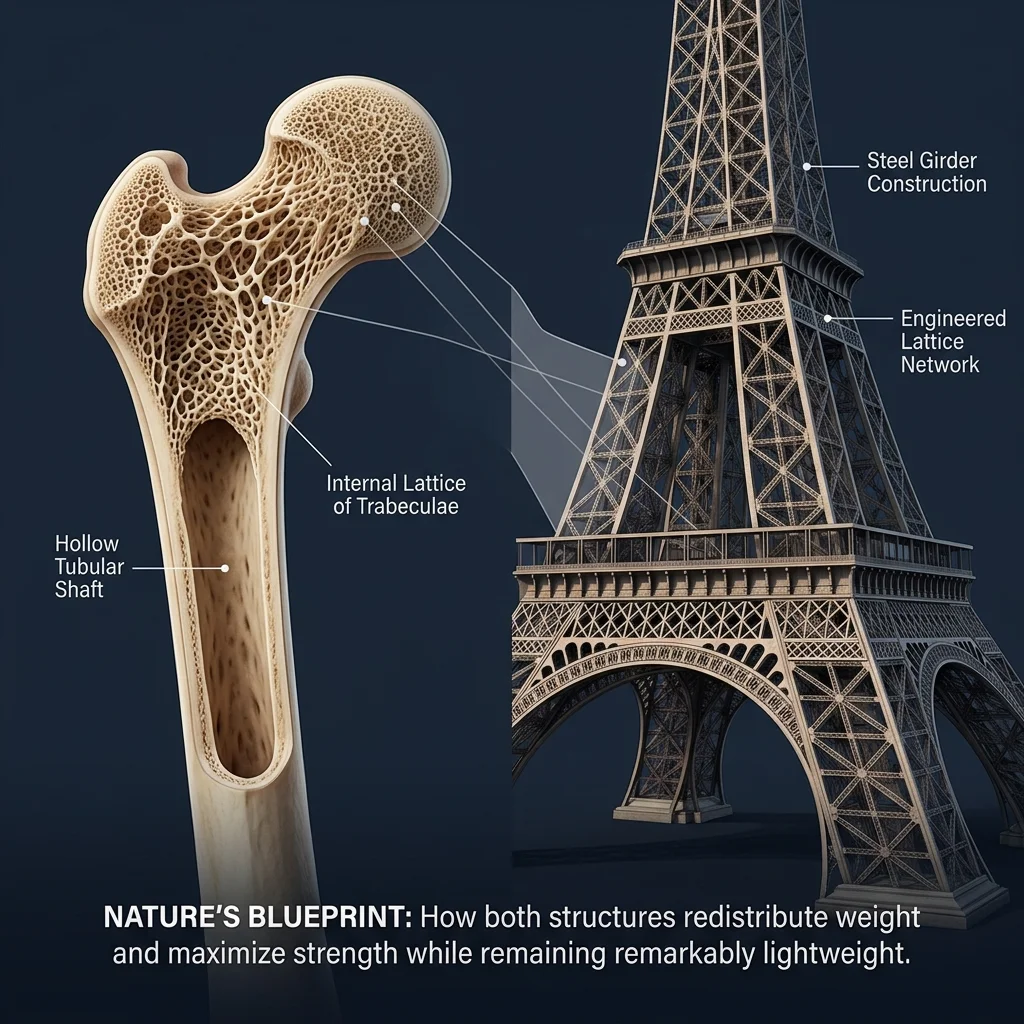
Designing a structure that is both exceptionally powerful and lightweight is an arduous engineering challenge. If the human skeleton were solid throughout, it would be far too heavy for the body to move efficiently.
Nature's solution is spongy bone. The upper section of the femur (your thigh bone), for instance, is not solid. Instead, it forms a complex, honeycomb-like lattice of microscopic struts known as trabeculae. These structures are not randomly formed; each strut naturally aligns itself against the exact lines of mechanical stress where gravity and physical impact challenge the body.
In the late 19th century, Gustave Eiffel and his team of engineers studied the internal architecture of the human femur to understand how to support a monumental structure with minimal material. Consequently, the Eiffel Tower was designed mirroring the same principles as the human thigh bone.
The Constant Construction Site
Your skeleton is far from permanent; your body recycles and replaces almost your entire skeletal frame every decade. This happens through an ongoing, microscopic process of deconstruction and rebuilding:
- Osteoclasts: These specialized cells traverse the bone matrix, secreting powerful enzymes and acids that gently dissolve old, stressed, or fractured bone tissue.
- Osteoblasts: Operating in sequence, these cellular architects follow the osteoclasts and synthesize completely fresh bone matrix to replace the lost matter.
This process is governed by Wolff's Law: the principle that bone adapts to the loads under which it is placed. For example, a professional tennis player will often develop bones in their racquet arm that are significantly denser than the surrounding skeleton, as the body actively senses the mechanical stress and reinforces its infrastructure.
Conversely, when astronauts live in a zero-gravity environment, the skeleton senses an absence of stress. The osteoclasts begin to dismantle the bone architecture—leading to a steady loss of bone density—as the body efficiently decides it no longer requires such a heavy framework.
The Healing Process
When a bone fractures, the body initiates a precise and sophisticated emergency response:
- Hematoma (Day 1): Blood rushes into the fracture site, forming a dense clot to stabilize the environment and prevent further bleeding.
- Soft Callus (Week 1): Specialized cells weave a temporary, cartilage-based scaffold around the broken ends, binding them loosely.
- Hard Callus (Week 3): Osteoblasts arrive in large numbers, rapidly mineralizing the cartilage scaffold and converting it into woven bone.
- Remodeling (Up to a Year): Over the next several months, osteoclasts carefully refine and reshape the new bone mass until it matches the original contours. Often, the repaired section becomes structurally stronger than it was before the injury.
The Blood Factory
Bones serve a secondary, yet equally vital, purpose beyond physical support: they operate as biological factories. Guarded deep within the protective, spongy interior of larger bones lies the red bone marrow.
This marrow functions as the manufacturing hub for your circulatory and immune systems. Every human red blood cell—responsible for carrying oxygen to every corner of your body—and precisely formulated white blood cells—tasked with neutralizing invading bacteria and viruses—are produced in these skeletal factories. In essence, the skeleton serves as the literal headquarters for human immunity.
The Ulnar Nerve Phenomenon
Most people are familiar with the jarring sensation of hitting their "funny bone." However, the anatomy involved is neither humorous nor a bone.
The phenomenon occurs when striking the ulnar nerve, a major nerve stretching from the neck to the fingertips. As it passes through the elbow, it rests within a shallow, exposed groove against the bone, lacking the muscular padding that typically shields major nerves. An impact to this unprotected area forcefully compresses the nerve against the skeletal structure beneath, causing a sudden barrage of confusing, static-like signals to register in the brain.
Fast Facts
- The Unattached Bone: Almost every bone in the human body articulates with another, with one notable exception. The hyoid bone is a small, horseshoe-shaped structure in the throat that floats entirely free, stabilized purely by muscular tension. It is essential for swallowing, speech, and tongue articulation.
- Skeletal Evolution in Individuals: Infants are born with approximately 300 separate bone segments. A baby's skull, for instance, consists of multiple unfused plates designed to overlap during birth. Through early development, these segments gradually fuse together, leaving a typical adult with a total of 206 consolidated bones.
- The Smallest Anchor: Located deep within the human ear is the stapes (or stirrup). Roughly the size of a grain of rice, it is the smallest bone in the body and plays an absolutely critical role in translating sound vibrations directly to the inner ear.