
Infinity & ZeroDRAFT
Explore the mind-bending extremes of the number line. Discover how the concepts of zero and infinity represent the ultimate states of 'nothingness' and 'everythingness,' and how they challenge our understanding of the universe.
Infinity & Zero: The Monsters of Math
The Numbers That Break the Universe
1, 2, 3... Numbers seem solid. They count apples. They count dollars. But there are two "numbers" that break everything. Zero ($0$) and Infinity ($\infty$). They are opposites. Zero is the Void (Nothing). Infinity is the Boundless (Everything). For thousands of years, these two concepts were the "monsters under the bed" of mathematics. The ancient Greeks were terrified of them and refused to use them. It took humanity centuries to tame them, and they still cause our computers to crash and our physics to melt down.
The Invention of Nothing (Zero)
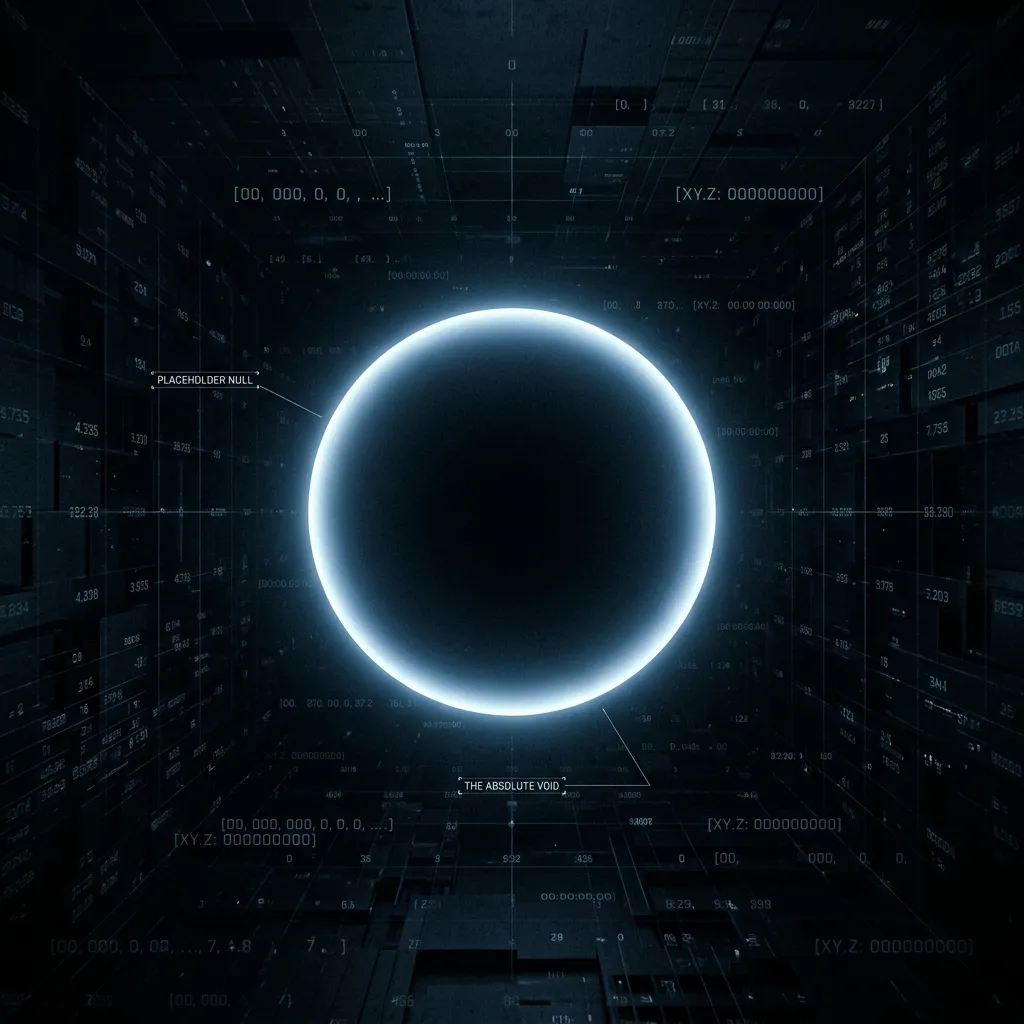
You think Zero is obvious? It isn't. Roman Numerals have no zero. Try to write "0" in Roman. You can't. It is just a blank space. But a blank space is dangerous in math. Is "1 1" a hundred and one? Or eleven? Or one thousand and one? In 628 AD, an Indian mathematician named Brahmagupta changed the world. He treated "Nothing" as a "Something." He gave it a name (Sunya) and a symbol (a dot, which became a circle). Suddenly, math exploded.
- The Power: Zero allowed Algebra, Calculus, and the Binary Code (0s and 1s) that runs your phone. It turned math from a tool for counting cows into a language of logic.
- The Danger: Zero has a dark side. Division by Zero. If you have 1 cookie and share it with 0 friends... how many cookies does each friend get? The question is nonsense. If you ask a computer to do it, it crashes. If you ask the universe to do it (like at the center of a Black Hole), the laws of physics tear apart.
The Monster: Infinity
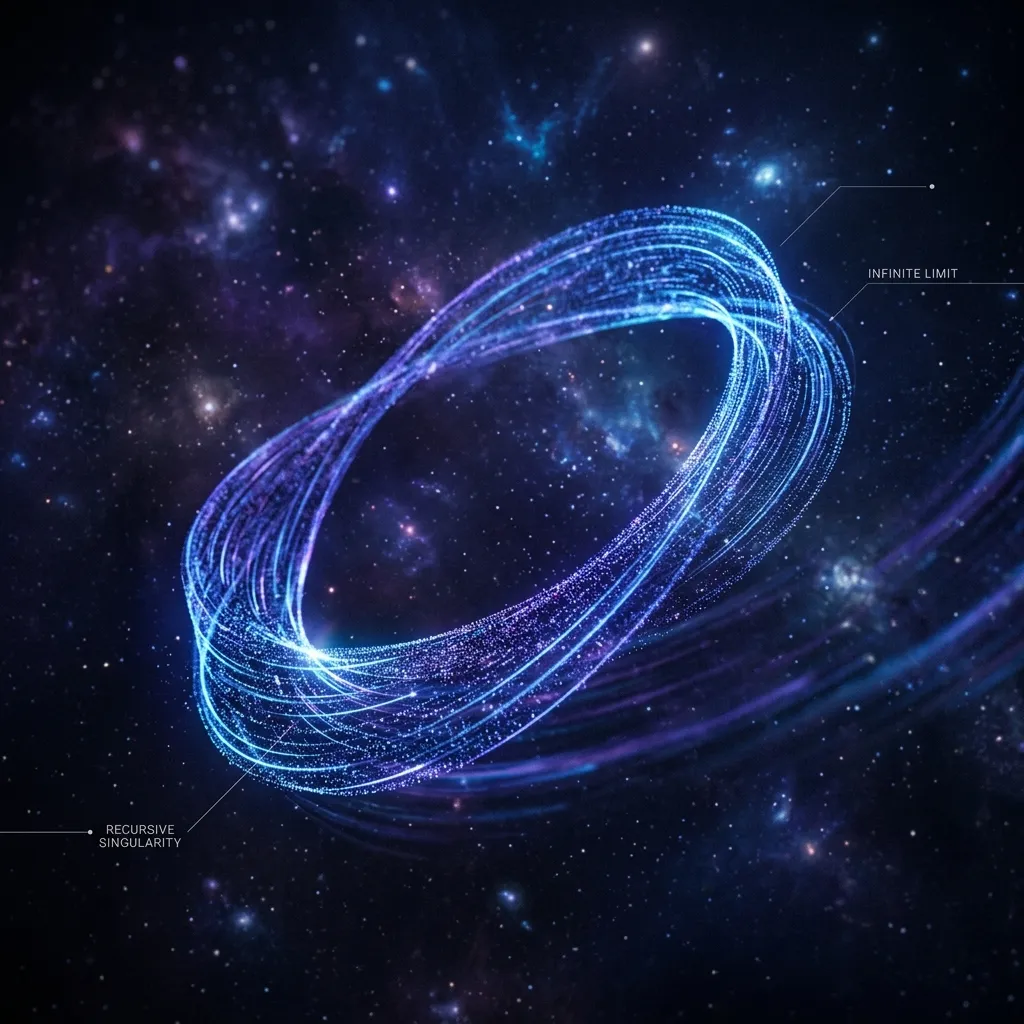
Infinity is not a big number. You cannot count to it. It is a Concept. It means "Endless." And it creates headaches. To illustrate how weird it is, German mathematician David Hilbert proposed a paradox: Hilbert's Hotel.
- Imagine a hotel with Infinite Rooms.
- Every room is full. No vacancy.
- A new guest arrives. Can you fit him in?
- Yes. You tell the guest in Room 1 to move to Room 2. Guest 2 moves to Room 3. Everyone moves up one ($n \rightarrow n+1$).
- Room 1 is now empty. The new guest moves in.
- The Result: You just added 1 to Infinity, and everyone still has a room. Theoretically, you could add an Infinite Bus of new guests by moving everyone to the Even numbered rooms ($2, 4, 6...$), leaving all Odd rooms empty. Math Break: $\infty + 1 = \infty$. The normal rules of logic do not apply here.
Zeno's Paradox: The Arrow
An ancient Greek named Zeno tried to prove that movement is impossible. He argued:
- To walk to the door, first you must go halfway.
- Then you must go half of the remaining distance.
- Then half of that.
- And half of that. You have to take an Infinite number of steps ($1/2 + 1/4 + 1/8...$). How can you do infinite things in a finite amount of time? Therefore, you never reach the door. For 2,000 years, nobody could prove him wrong. Then Isaac Newton invented Calculus. Calculus is the art of adding up infinite tiny slices to get a finite answer. It proved that an infinite sum of shrinking numbers can equal a whole number (The Limit). You can reach the door.
Fractals: The Infinite Coastline
How long is the coastline of Great Britain? It is a trick question.
- If you measure with a 100km ruler, you get 2,800km.
- If you measure with a 1m ruler (tracing every cove), you get a bigger number.
- If you measure with a molecular ruler (tracing every sand grain), the length goes to Infinity. This is a Fractal. A fractal is a shape with a Finite Area but an Infinite Perimeter. Nature loves fractals. Your lungs are fractals. They fit inside your chest (finite), but if you unfolded the branching airways, their surface area would cover a tennis court. It is nature's way of packing "infinity" into a small box to maximize efficiency.
The Singularity: The Big Bang
13.8 Billion years ago, the universe began. It started as a Singularity. All the matter, energy, and time in the cosmos was squashed into a point smaller than an atom. It had Zero Size and Infinite Heat. Then, it expanded. We are literally living inside the explosion of a mathematical paradox. The universe is the result of Zero becoming Infinity. This is why math is the language of nature; reality itself was born from a math problem.
Fast Facts
- Black Holes: Where do Zero and Infinity meet in real life? The heart of a Black Hole. The "Singularity" is a point of Infinite Density and Zero Volume. Physics breaks down here because the equations try to divide by zero.
- Googol: A Googol is a $1$ followed by $100$ zeros. It is a massive number (more than particles in the universe). But it is Finite. It is not Infinity. Infinity is not just "big"; it is "never-ending." (Google named themselves after this number, but misspelled it).
- Absolute Zero: $-459.67^\circ\text{F}$ ($0\text{ Kelvin}$). This is the temperature where atoms stop moving completely. It is the "floor" of the universe. We can get close (billionths of a degree), but quantum mechanics prevents us from ever reaching perfect zero.
Diagram Prompts
- Hilbert's Hotel: A tall hotel skyscraper disappearing into the clouds. A bus arrives with a sign "Infinite Passengers." The Doorman holds a megaphone: "Everyone move to Room N + 1!" showing guests shifting right. Label: "Infinity + 1 = Infinity."
- Fractal Lungs: A diagram of human lungs. Zoom in to a Bronchiole branching. Zoom in again to Alveoli sacs. Show the pattern repeating. Label: "Infinite Surface Area in Finite Space."
- Zeno's Paradox: A cartoon of a runner trying to reach a finish line. The path is divided into 1/2, then 1/4, then 1/8. The runner looks frustrated. Label: "Infinite Steps?"