
Prime Numbers: The Atoms of Math
The Atoms of Math
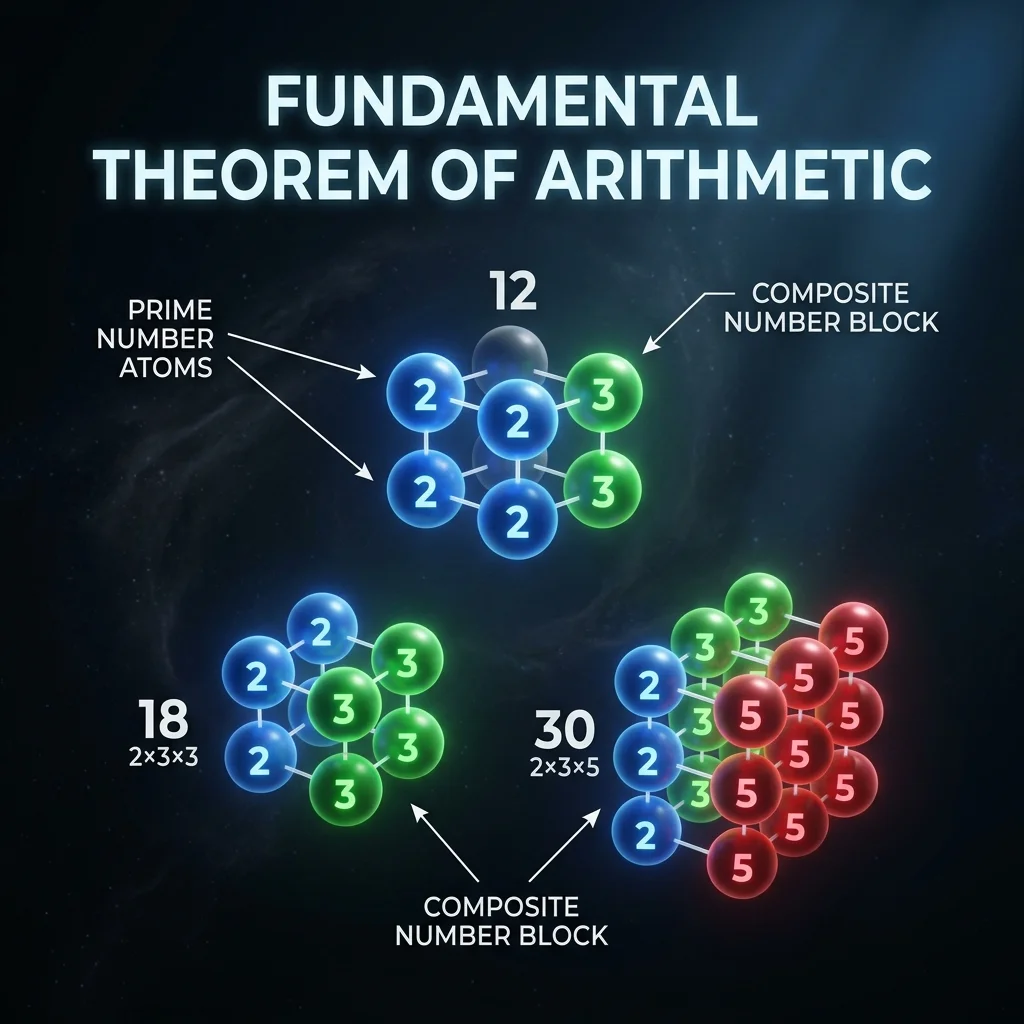
Imagine numbers are like Lego castles. Most numbers, like 12, can be broken apart into smaller pieces (2 x 2 x 3). These are called Composite Numbers. But some numbers are solid blocks. They cannot be broken. They cannot be divided. 2. 3. 5. 7. 11. 13. These are Prime Numbers. They can only be divided by 1 and themselves. They are the atoms of mathematics. Just as every chemical in the universe is built from a specific combination of atoms (Water = H2O), every number in the universe is built by multiplying a specific combination of primes. This is called the Fundamental Theorem of Arithmetic. If you find a new Prime Number, you have discovered a new element of the mathematical universe.
The Cicada Code
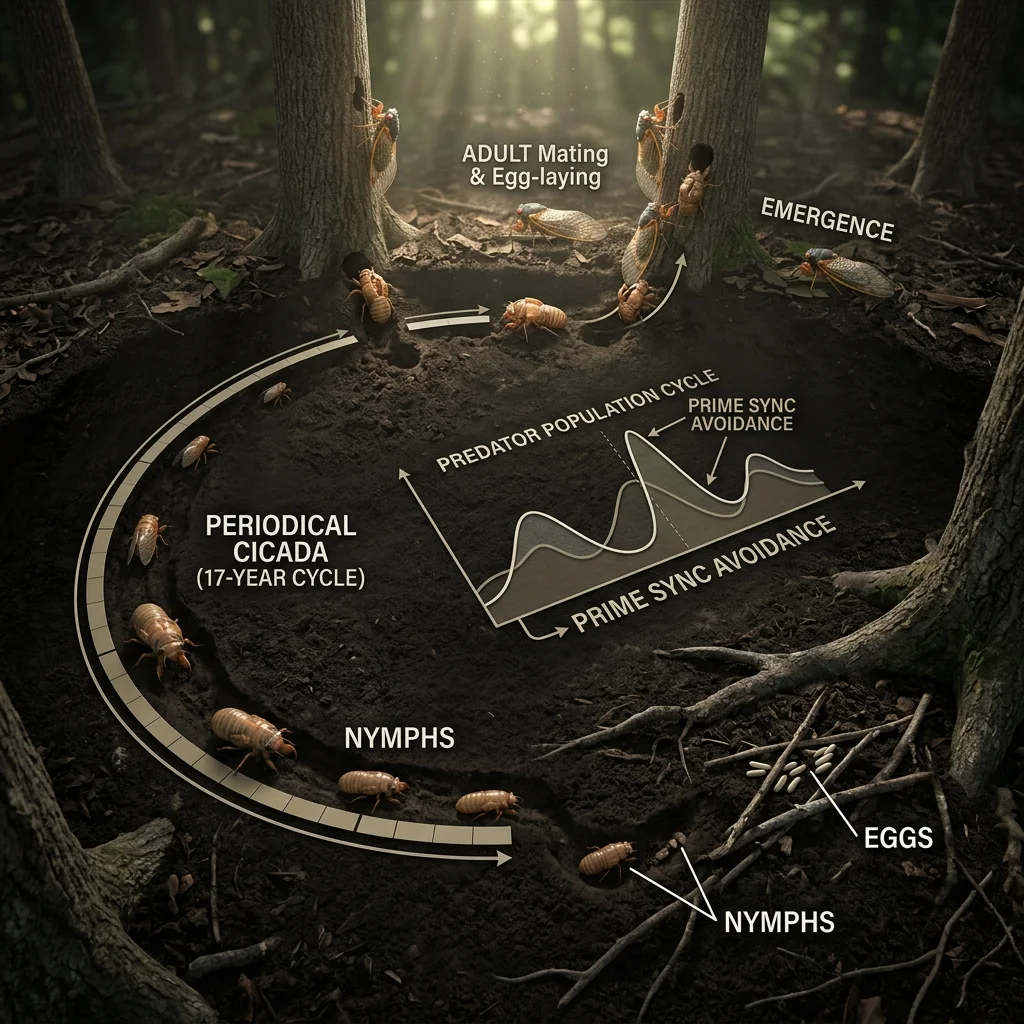
Nature figured out prime numbers millions of years before humans did. In North America, there is a species of insect called the Periodical Cicada. They live underground like vampires for years, sucking sap from tree roots. Then, they all emerge on the same night to breed. But they don't come out every year. Brood X emerges strictly every 17 years. Other broods emerge every 13 years. Why? Because 13 and 17 are prime numbers. Imagine a predator (like a bird) has a population boom every 4 years. If cicadas came out every 12 years, the 4-year predator would catch them every 3rd cycle (12 divided by 4 is 3). But 17 is prime. A 4-year predator will only sync up with a 17-year cicada once every 68 years (4 x 17). By using a prime number cycle, the cicadas ensure they almost never sync up with their enemies. Evolution used Number Theory to survive.
The Security Guard: RSA
Here is a secret: The entire internet runs on Prime Numbers. Every time you send a credit card number to Amazon, or log into your bank, your data is locked using a system called RSA Encryption. RSA relies on a simple fact: It is easy to multiply two giant prime numbers together. But it is incredibly hard to take the result and break it back apart. If I give you the number 323, can you find the two primes that made it? (It takes you a while to find 17 x 19, right?) Now imagine a number that is 600 digits long. Even a supercomputer would take billions of years to factor it back into its two original primes. That "Hard Math" is the only thing standing between hackers and your bank account. To break the internet, you would just need to find a fast way to factor prime numbers. (Luckily, no one has found it... yet).
The Loneliness of Primes
The further you count, the rarer primes become.
- Between 1 and 100, there are 25 primes.
- Between 1 and 1,000,000, they are much more spread out. Mathematicians call this "The thinning of the primes." It is like flying into deep space. The stars get further apart. But no matter how far you go, you never run out. Euclid proved 2,300 years ago that there are Infinite Primes. However, sometimes we find "Twin Primes"—two primes that are right next to each other, like 11 and 13, or 41 and 43. Recently, we found massive twin primes with thousands of digits. It is weirdly comforting to know that even in the infinite dark of numbers, some primes still have a neighbor.
Contact: The Universal Language
In the movie Contact, aliens send a message to Earth. It isn't in English or Chinese. It is a sequence of pulses: 2... 3... 5... 7... 11... Why? Because prime numbers are the only thing in the universe that cannot be generated by natural phenomena (like pulsars or crystals). Pulsars beep in steady rhythms. Crystals grow in patterns. But nothing in nature counts in primes except intelligence. If we ever hear a signal from space counting primes, we will know for a fact: We are not alone.
Fast Facts
- Mersenne Primes: We actively hunt for monster primes. The largest known prime number has over 24 million digits. If you printed it out, the book would be 8,000 pages long. It was found by a volunteer computer network called GIMPS.
- The Lonely 2: The number 2 is the weirdest prime. It is the only even prime number. All other millions of infinite primes are odd. Why? Because any other even number can be divided by 2, so it can't be prime!
- Goldbach's Conjecture: Every even integer greater than 2 is the sum of two primes. (Example: 8 = 3 + 5. 10 = 3 + 7). We have tested this up to 4 quintillion and it always works, but no one has ever been able to prove it is true for all numbers. It remains one of the biggest unsolved mysteries in math.
Diagram Prompts
- Prime Molecule: Visual Metaphor. A chemical beaker called "12". It is being poured out and separating into "Atoms" labeled 2, 2, and 3. Label: "Composition of Numbers."
- Cicada Wheel: Two gears spinning. Gear A: 4 teeth (Predator). Gear B: 17 teeth (Cicada). Show that the teeth only line up once every 68 turns. Label: "Prime Survival."
- RSA Lock: A Digital Safe. The Key is made of two pieces: A Prime Number (17) and a Prime Number (19). The Safe combination is 323. A Hacker trying to guess the numbers, sweating. Label: "The Math of Privacy."