
Probability: The Science of Maybe
The Math of Maybe
Life is messy. Will it rain tomorrow? Will the Coin land on heads? Will you win the lottery? Probability is the math of measuring uncertainty. It assigns a number between 0 (Impossible) and 1 (Certain) to every event in the universe. Humans are terrible at this. We rely on "gut feelings," "luck," and "karma." Math relies on cold, hard fractions. Flipping a coin is 0.5 (50%). Rolling a six on a die is 0.16 (16%). But where it gets weird is when our brains scream "That's impossible!" and the math says "Actually, it's virtually guaranteed."

The Gambler's Fallacy
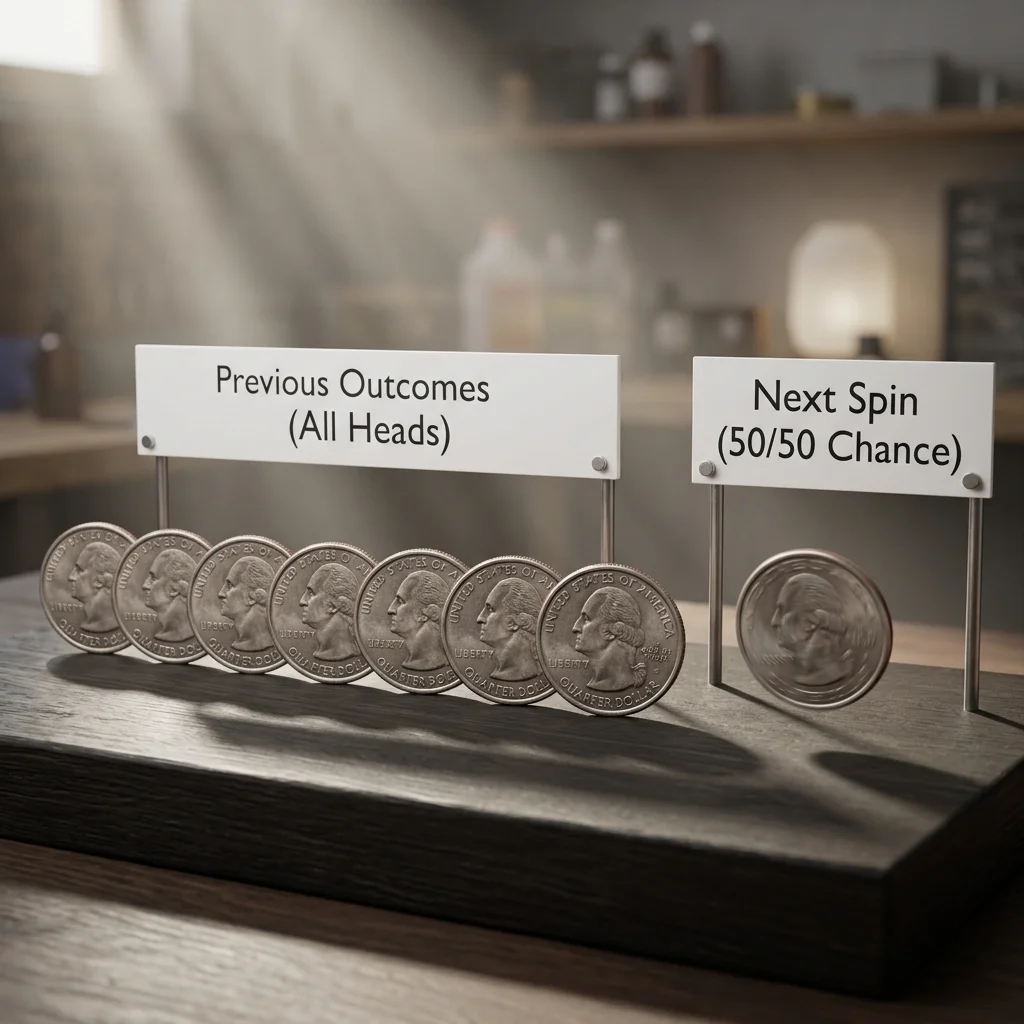
Imagine you are at a casino. The Roulette wheel has landed on Red 10 times in a row. You place a huge bet on Black. "Black is due!" you shout. "It has to change eventually!" You lose. This is the Gambler's Fallacy. The wheel has no memory. The universe doesn't care what happened 5 minutes ago. Each spin is an independent event. The odds of Red are always 50/50, even if it has rolled Red a thousand times in a row. Thinking that the past controls the future is how casinos get rich.
The Monty Hall Problem
This math problem is so confusing that it tricked Nobel Prize winners. You are on a game show. There are 3 doors.
- Behind one is a Ferrari.
- Behind the other two are Goats. You pick Door 1. The host (Monty), who knows what is behind the doors, opens Door 3 to reveal a Goat. He asks: "Do you want to switch to Door 2?" Most people say: "No, it's 50/50 now. I'll stick with my gut." Wrong. Math proves you should always switch. If you stay, you have a 1/3 chance of winning. If you switch, you have a 2/3 chance. Why? Because when you first picked Door 1, you had a 66% chance of being wrong (picking a goat). Since Monty eliminated one goat for you, switching effectively lets you bet on both of the other doors at once. It feels like magic, but computer simulations prove switching wins twice as often.
The Birthday Paradox
How many people do you need in a room to have a 50% chance that two of them share the same birthday? Most people guess 183 (half the days in a year). The answer is 23. With just 23 people, there are 253 possible pairs (Person A vs Person B, Person A vs Person C, etc.). The math ramps up exponentially fast. By the time you have 75 people in a room, there is a 99.9% chance two share a birthday. Next time you are at a party, try it. You will win the bet almost every time.
Benford's Law (Tax Fraud)
Here is a trick police use to catch criminals. Look at a list of real-world numbers (lengths of rivers, city populations, or electric bills). The first digit of those numbers will be "1" about 30% of the time. The digit "9" will appear only 5% of the time. This is called Benford's Law. Nature loves small numbers (because things have to grow through 1 and 2 before they get to 9). If you cheat on your taxes and invent random numbers, your brain naturally picks 1s and 9s equally. The IRS runs an algorithm on your tax return. If your numbers don't follow the Benford Curve, they know you faked them. Math is tracking you.
Quantum Probability (Schrodinger's Cat)
In the normal world, a coin is either Heads or Tails. But in the atomic world (Quantum Mechanics), things get weird. A particle can be Heads AND Tails at the same time. This is called Superposition. Erwin Schrodinger explained this with a famous thought experiment. Imagine a cat in a box with a poison vial that has a 50% chance of breaking. Until you open the box to look, math says the cat is Both Dead and Alive at the same time. It exists as a probability wave. Only when you look (Observation) does the universe force the cat to pick a state. It sounds insane, but this math is the reason your smartphone works.
Fast Facts
- Infinite Monkeys: If you give a monkey a typewriter and infinite time, it will eventually type the complete works of Shakespeare by accident. (It will mostly type "jsfkhaskjf" though). This is a way of saying: "If probability is non-zero, given enough time, it will happen."
- Lightning: Your odds of being struck by lightning in your lifetime are about 1 in 15,000. Your odds of winning the Powerball lottery are 1 in 292 million. You are more likely to be struck by lightning while being eaten by a shark than winning the lottery.
Diagram Prompts
- Monty Hall: 3 Doors in a lineup. Door 1: Closed (User Finger pointing at it). Door 3: Open (Goat showing). Door 2: Closed (GLOWING with magic energy). Text: "Switching doubles your odds." Label: "The Counter-Intuitive Choice."
- Birthday Web: A room of 23 stick figure people. Lines connecting every single person to every other person (a dense web). A starburst where two lines meet. Label: "Exponential Pairs."
- Benford's Curve: A Bar Chart. X-Axis: Digits 1 to 9. Y-Axis: Frequency. The bar for "1" is huge (30%). The bar for "9" is tiny (5%). A "Fake Data" line showing a flat distribution. Label: "The Fingerprint of Nature."