
The Liquid Shield
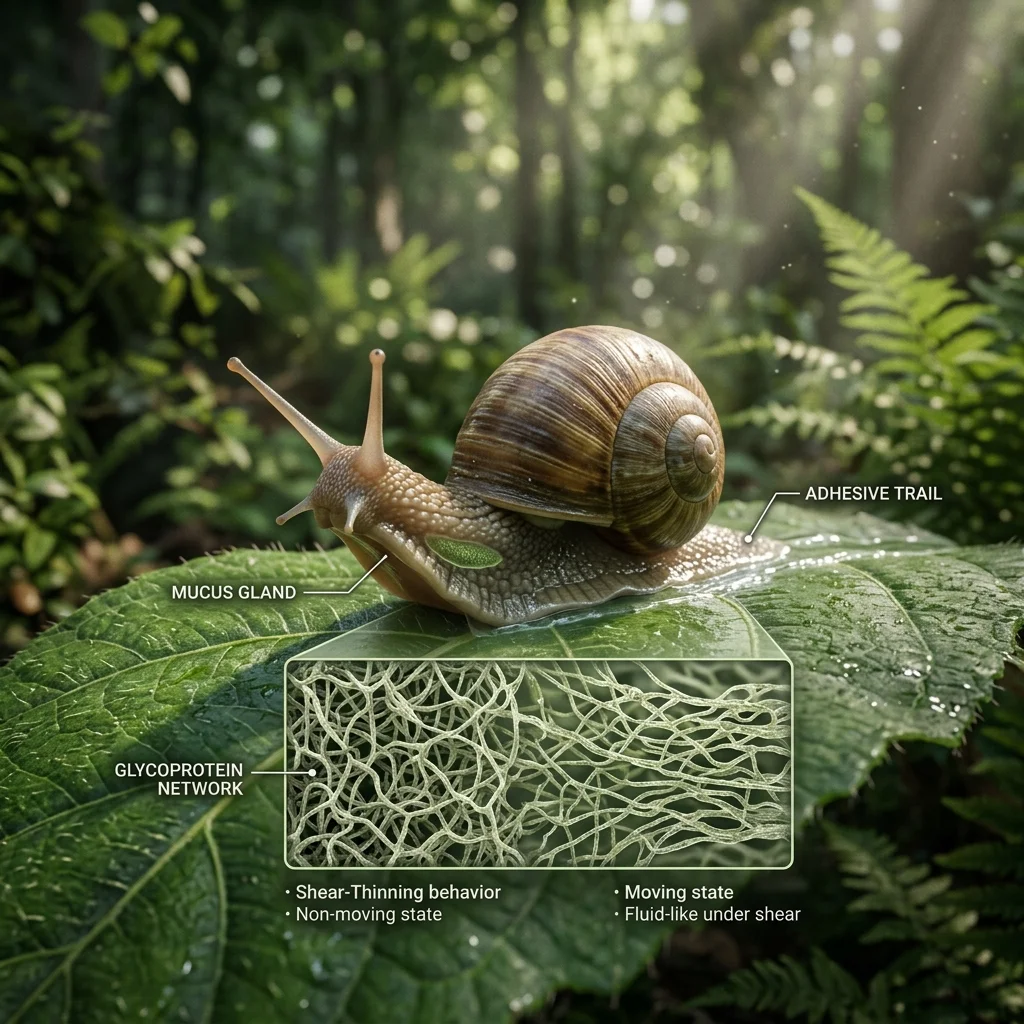
It sounds like a magic trick. Take a garden snail and place it on the sharp edge of a razor blade. It won't get cut. It will calmly slide across the metal, unharmed. How? The answer is Slime. But this isn't just snot. It is a high-tech "Smart Material" that humans are trying to copy.
Non-Newtonian Physics
Snail mucus is a Non-Newtonian Fluid (specifically, it is "Thixotropic"). This means it changes its thickness based on pressure.
- At Rest: It is a solid gel. It acts like glue, holding the snail onto a leaf (or a razor blade) so it doesn't fall off.
- Moving: When the snail pushes its muscles against it, the slime instantly turns into a runny liquid lubricant. This allows the snail to "Hydroplane" over rough surfaces. It never actually touches the ground (or the blade). It floats on a nanometer-thick carpet of liquid. The moment the snail stops moving, the liquid instantly hardens back into glue.
Molecular Engineering
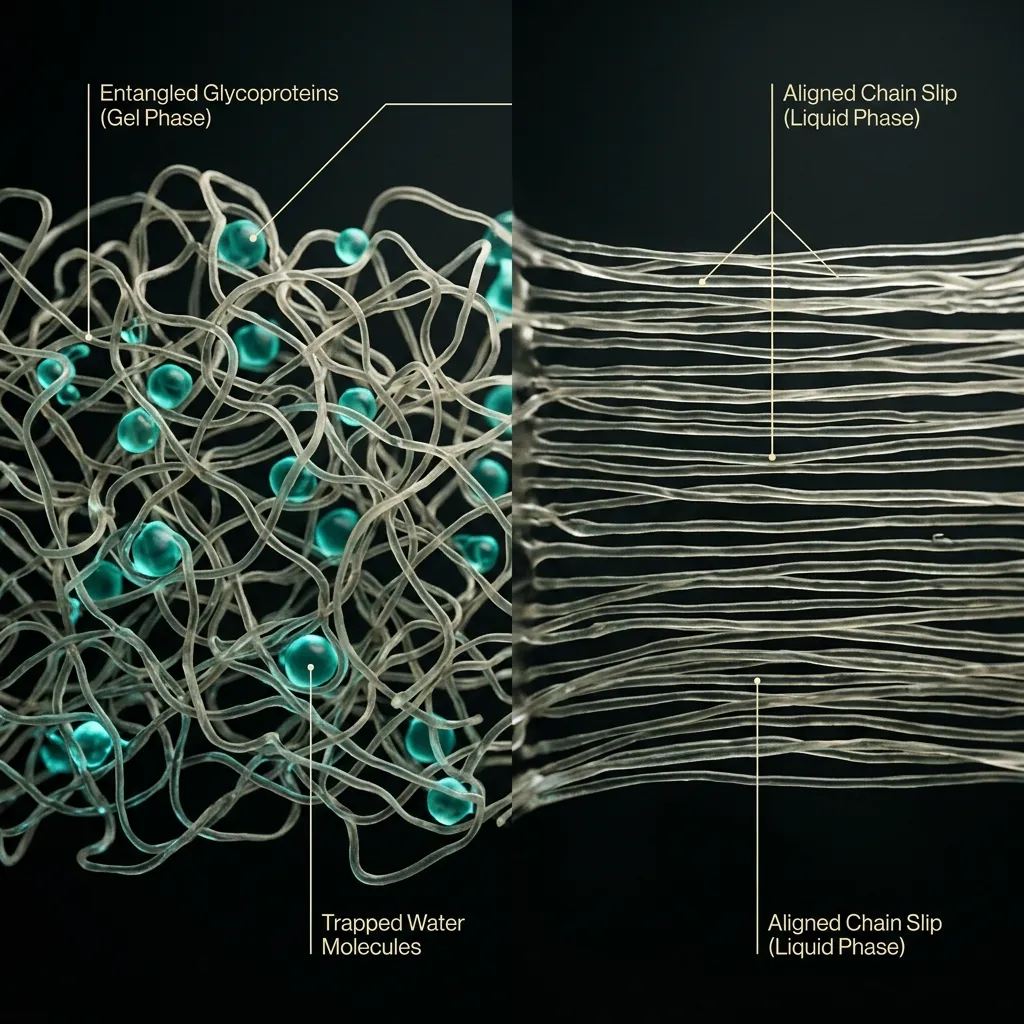
What is this stuff made of? It is 95% water. The magic comes from the other 5%: Glycoproteins. These are giant molecules made of protein chains wrapped in sugar. Imagine a bowl of spaghetti. When the bowl sits still, the noodles tangle together. You can't pull one out easily (Solid). But if you stir the bowl vigorously, the noodles align with the flow and slide past each other (Liquid). Snail mucus works the same way. The proteins seek each other out and cross-link to form a "Network." This network is strong enough to bridge the gap over a razor blade's edge, preventing the sharp steel from ever penetrating the water layer to reach the skin.
The Two-Slime System
Snails actually make two different kinds of slime at the same time:
- The Foot Slime: This is the sticky/slippery traction fluid we just talked about.
- The Body Slime: The slime on its back is different. It is hygroscopic (water-attracting). It pulls moisture out of the air to keep the snail from drying out in the sun. It is a portable life-support suit.
The Iron Snail
Garden snails possess delicate shells. But deep in the ocean, near volcanic vents, lives the Scaly-Foot Snail (Chrysomallon squamiferum). It lives in boiling black water full of sulfur and metal. It doesn't just slime. It builds Armor. It pulls iron sulfide (Fool's Gold) out of the water and uses it to plate its shell. It is the only animal on Earth with a skeleton made of iron. It is literally magnetic. If you stick a magnet to it, you can pick it up. US Military researchers are studying it to design stronger tank armor.
Medical Super-Glue
Doctors are obsessed with snail slime. Why? Because standard medical glue (superglue) is toxic and brittle. Band-aids slip off when they get wet. But snail slime:
- Sticks to wet surfaces (like a bleeding heart or lung).
- Is flexible (stretches with the body).
- Is biodegradable. Scientists at Harvard recently created a "Tough Adhesive" inspired by the Dusky Arion slug. It can patch a hole in a beating pig heart while blood is pumping through it. It is so strong that to peel it off, you would have to rip the tissue itself. Future surgeries might use "Slug Tape" instead of stitches.
Cosmetic Craze
If you look at expensive Korean skincare products, you will see "Snail Mucin" on the label. Does it work? Maybe. The slime is rich in Hyaluronic Acid and Copper Peptides.
- Hyaluronic Acid: A master moisturizer. It holds 1,000 times its weight in water.
- Copper Peptides: Signals to the skin to regenerate collagen and fix damage. Snails evolved this to heal themselves quickly when they scrape their bellies on rocks. Applying it to your face mimics that "Rapid Repair" signal, potentially reducing wrinkles and acne scars. (And don't worry, they don't squash the snails. They just let them crawl around on a mesh net in a dark room and collect the drips. It's a "Snail Spa").
Fast Facts
- Speed: A Garden Snail moves at 0.03 mph. It would take 33 hours to crawl one mile.
- Teeth: Snails have a tongue called a "Radula" that is covered in 14,000 microscopic teeth. They use it like a file to rasp away leaves (and even limestone rock to get calcium for their shells).
- Sleep: Snails can sleep for 3 years! If the weather is too dry, they seal themselves inside their shell with a dried mucus door (Epiphragm) and hibernate until it rains.