
Are We Alone?
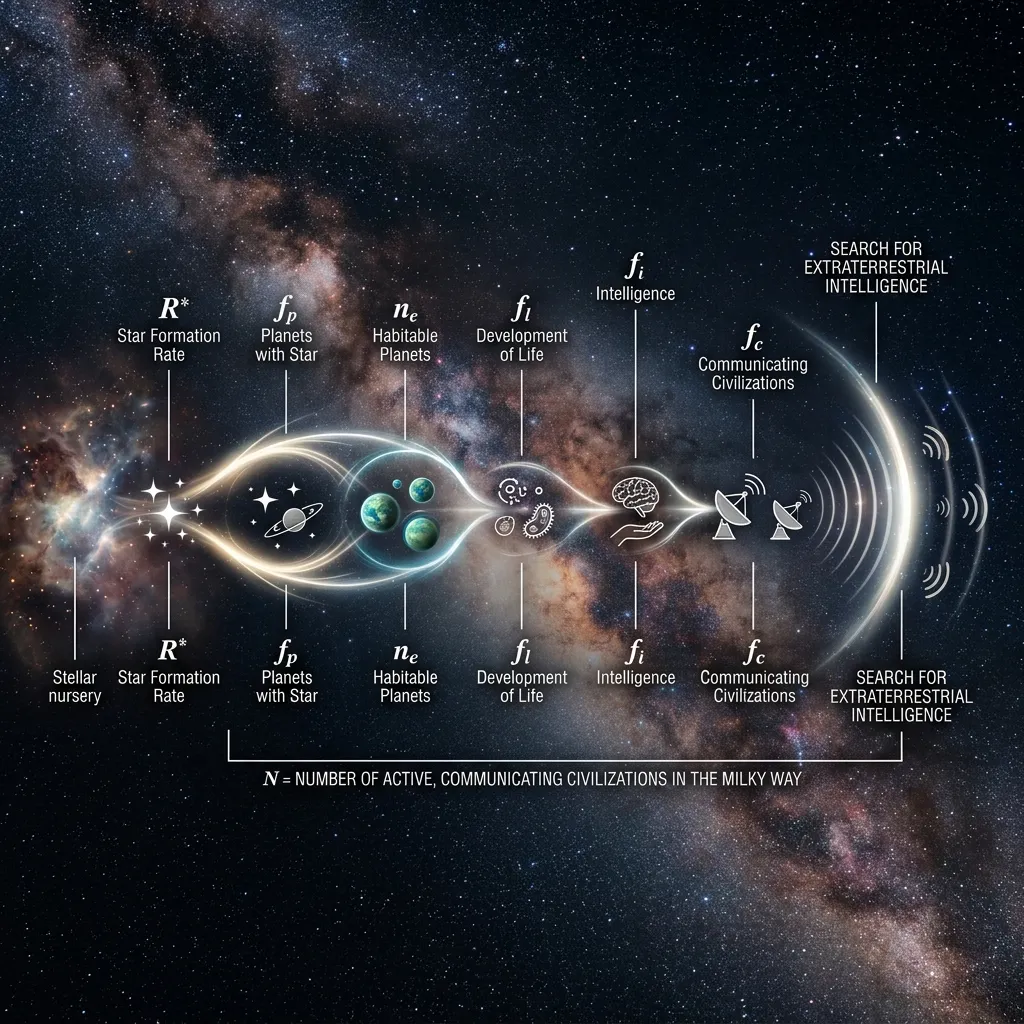 A stylized infographic of the Drake Equation. 7 variables shown as icons: Stars -> Planets -> Earths -> Life -> Intelligence -> Tech -> Time. Show the funnel narrowing down to one question mark.
Space is big. Impossible to comprehend big. Imagine a grain of sand. That is Earth. Now imagine a beach. That is the Milky Way Galaxy (200 billion stars). Now imagine all the beaches on Earth combined. That is the visible Universe (billions of galaxies).
Almost every one of those stars has planets. Mathematically, it is nearly impossible that we are the only living things in this vast cosmic ocean. This logic drives the scientific search for Extraterrestrial Intelligence (SETI). We are not looking for little green men in flying saucers. We are looking for radio signals, laser pulses, or the chemical fingerprints of alien bacteria.
The Fermi Paradox: The Great Silence
In 1950, physicist Enrico Fermi looked at the math and asked a simple question: "Where is everybody?"
If the universe is billions of years old, and there are billions of planets, older civilizations should have spread across the galaxy by now. Even at slow speeds, a civilization could colonize the entire galaxy in a few million years. We should see their Dyson Spheres (giant solar panels around stars) or hear their radio broadcasts. But we see nothing. We hear nothing.
This is the Fermi Paradox. There are two main scary possibilities:
- We are early (The Rare Earth Hypothesis): Life is incredibly complicated and rare. Maybe we are the first civilization to ever wake up. The universe is a lonely, empty mansion, and we are the first ghost.
- They are dead (The Great Filter): There is a "Great Filter"—some hurdle that wipes out civilizations before they can travel the stars. Is it nuclear war? Climate change? Artificial Intelligence? If the filter is ahead of us, we are in trouble.
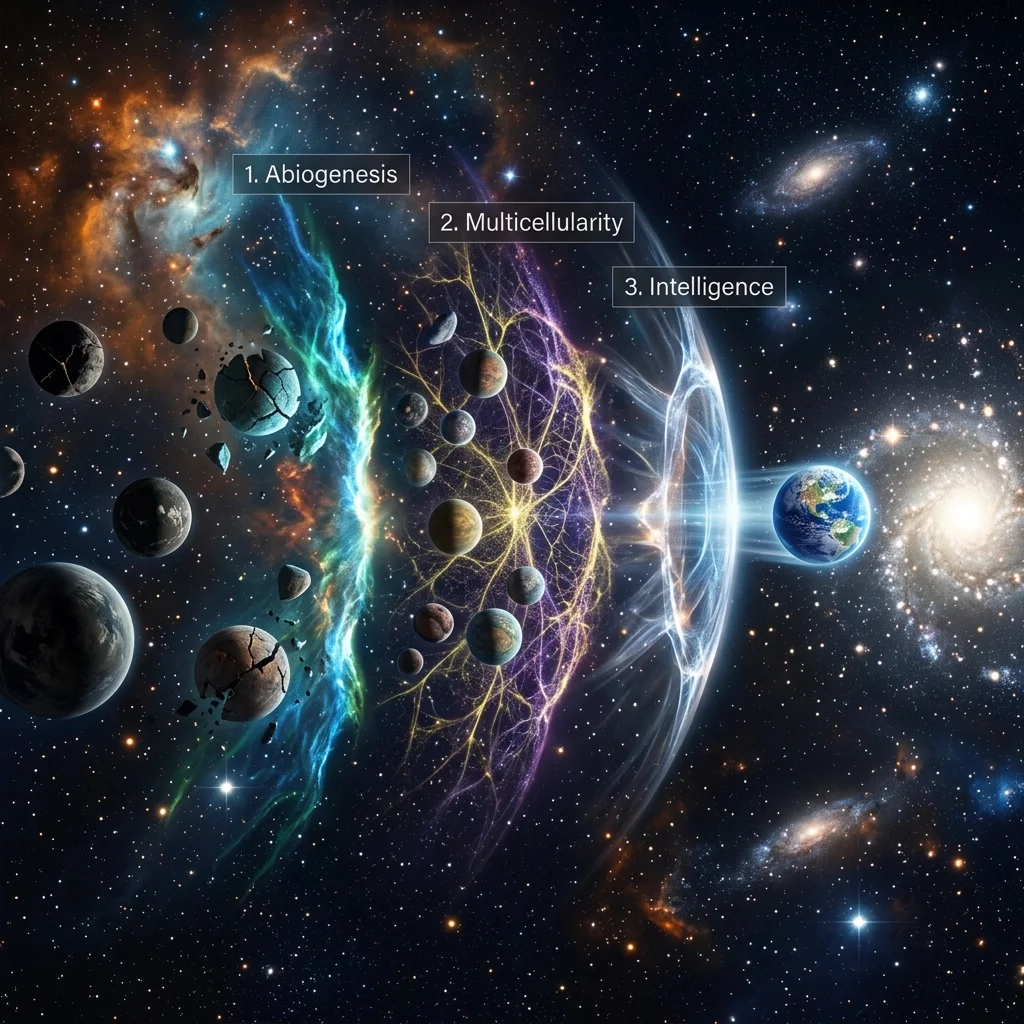 Visualizing "The Great Filter". A series of hurdles (Abiogenesis, Multicellularity, Intelligence). Many planets try to jump them, but most crash. Only one (Earth) is shown clearing the final hurdle towards the stars.
The Kardashev Scale: Types of Gods
If aliens do exist, how advanced could they be? In 1964, Nikolai Kardashev ranked civilizations by energy use:
- Type I (Planetary): Controls 100% of their planet's energy (weather, earthquakes, solar). Humanity is currently about a Type 0.7.
- Type II (Stellar): Controls 100% of their star's energy. They build a Dyson Sphere—a shell around their sun to capture every photon.
- Type III (Galactic): Controls 100% of their galaxy's energy. They traverse the stars like we cross the street. To them, we would be like ants.
The Drake Equation
In 1961, Frank Drake wrote an equation to organize our ignorance: N = R • fp • ne • fl • fi • fc • L*
It asks:
- How many stars are born per year?
- How many have planets?
- How many planets develop life?
- How many develop intelligence?
- How many build radios?
- L: How long do they survive?
That last variable "L" is the key. If civilizations only last 100 years before blowing themselves up, the galaxy is likely a graveyard of ruins. If they last millions of years, the galaxy should be buzzing.
The Dark Forest Theory
Why is everyone hiding? Some scientists propose the Dark Forest Theory. It suggests the universe is like a dark forest at night. Every civilization is an armed hunter stalking through the trees. If you find another life form, you can't know if they are friendly or hostile. The safest move is to shoot first. Therefore, all smart civilizations stay quiet. They hide their radio signals. When we broadcast "Hello!" into space, we might be like a baby crying in a forest full of wolves.
Neighbors? Life on Mars and Europa
We might find aliens right next door.
- Mars: Billions of years ago, Mars was warm and wet. NASA's Perseverance Rover is currently drilling into ancient riverbeds to look for fossilized bacteria.
- Europa (Jupiter's Moon): Under a 10-mile thick shell of ice, Europa has a global ocean of salty liquid water. It has twice as much water as all of Earth's oceans combined. If there are hydrothermal vents on the bottom, there could be alien fish or crabs swimming in the dark right now. The upcoming Europa Clipper mission aims to find out.
The Wow! Signal
We have been listening for 60 years. Mostly, it is silence. But on August 15, 1977, a radio telescope in Ohio picked up something impossible. It was a loud, continuous signal from the constellation Sagittarius. It matched the frequency of hydrogen (1420 MHz)—a universal "water hole" channel that aliens might use.
It lasted exactly 72 seconds. When astronomer Jerry Ehman saw the data, he circled it in red pen and wrote: "Wow!" We have listened to that spot thousands of times since. We never heard it again. Was it a secret spy satellite? A glitch? Or was it a lighthouse beam from a passing starship that swept over Earth for a brief moment?
Fast Facts
- Time Travel: Looking for aliens is looking back in the past. If we get a signal from 1,000 light-years away, it was sent 1,000 years ago. The sender might be long dead.
- Panspermia: The theory that life didn't start on Earth, but arrived here on a comet or meteor from Mars (or elsewhere). We might be the aliens.
- Technosignatures: Instead of radio, astronomers now look for "pollution." CFCs (used in fridges) don't exist in nature. If we see CFCs in an alien atmosphere, we know factories are running there.