
The Sky is Full of Money
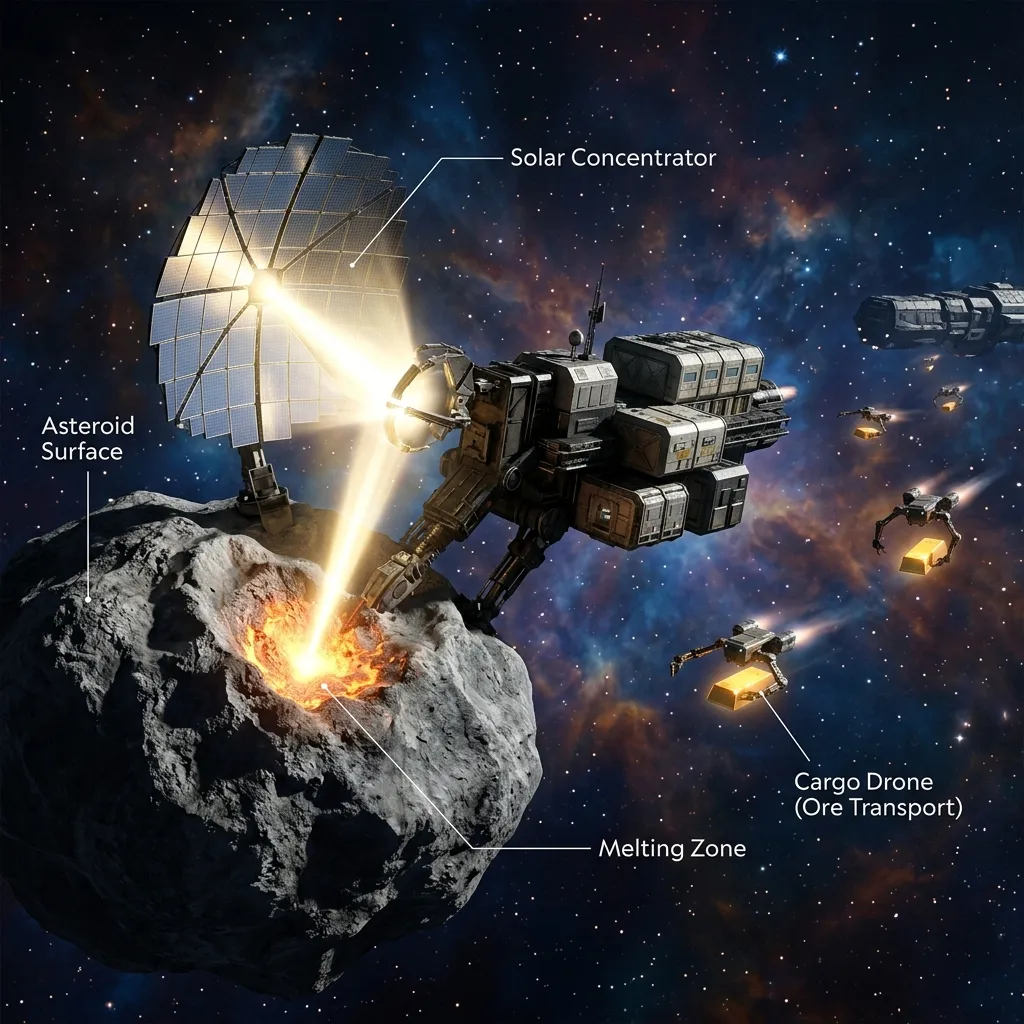 Futuristic concept art. A robotic mining ship anchored to a lumpy grey asteroid. A giant mirror focuses a beam of sunlight to melt the rock. Cargo drones are flying away with processed ingots of gold.
The Earth is running out of stuff. We have dug up all the easy gold, platinum, and "rare earth" metals from the crust. We are now digging mines that are 2 miles deep just to find enough materials to build your iPhone. But if you look up, the problem solves itself. Floating between Mars and Jupiter is the Asteroid Belt. It is a cosmic junkyard of debris left over from the formation of the solar system. Most of it is useless rock. But some of it is pure treasure. NASA is currently tracking an asteroid named 16 Psyche. It is 140 miles wide. Unlike most asteroids (which are ice or stone), Psyche seems to be the exposed core of a dead planet. It is made of solid Iron, Nickel, and Gold. The estimated value of the metal in this one rock? $10,000 Quadrillion. That is enough to give every single human being on Earth $1 Billion.
Water: The Real Gold
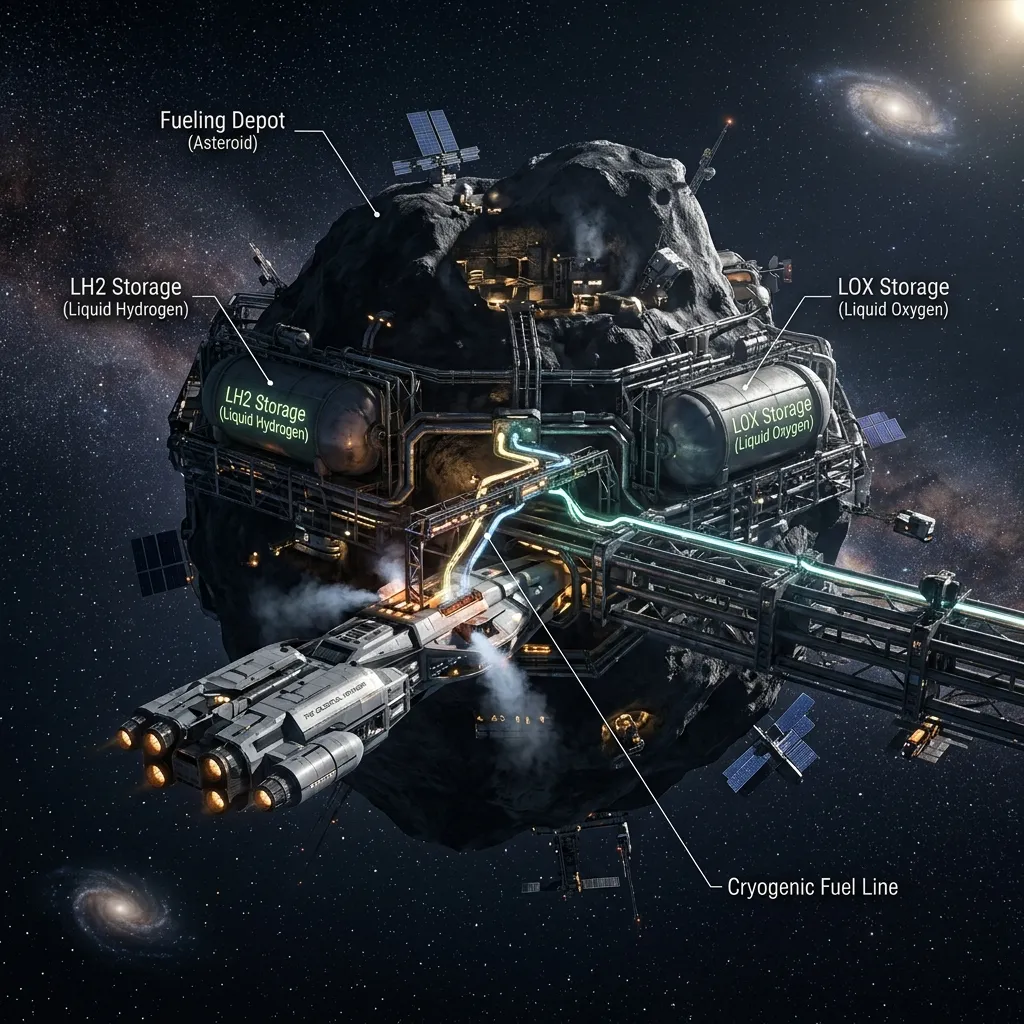
Gold is nice, but it isn't the most valuable thing in space. The most valuable resource is Water. Why? Because Water ($H_2O$) is Rocket Fuel. If you use solar panels to zap water with electricity (Electrolysis), you can split it into Hydrogen and Oxygen. Liquid Hydrogen is the most powerful rocket fuel we have. Liquid Oxygen allows it to burn. Right now, launching a bottle of water from Earth to space costs about $10,000 per pound because you have to fight Earth's massive gravity. But asteroids have almost no gravity. If we can find icy asteroids (called Carbonaceous Chondrites), we can mine the ice, melt it, and turn asteroids into Orbiting Gas Stations. Spacecraft could launch from Earth with empty tanks (light and cheap), stop at an asteroid to fill up, and then cruise to Mars. This is the key to becoming a multi-planetary species.
How Do We Mine It?
In movies like Armageddon, huge teams of roughnecks land on asteroids with drills and nukes. In reality, asteroid mining will be done by robots. Mining in zero-gravity is tricky. If you hit a rock with a pickaxe, the rock doesn't break—you fly backwards into space (Newton's Third Law). Here are the real plans:
- Optical Mining: Don't dig. Use giant, lightweight mirrors to focus the sun's rays into a laser-hot beam. Vaporize the asteroid's surface and suck up the gas.
- Magnetic Rakes: Since magnetic metals (Iron/Nickel) are loose dust on the surface, just fly over with a strong magnet and collect the dust like a vacuum cleaner.
- The Beehive: Release a swarm of thousands of tiny robots (size of a toaster) that latch onto the rock and "eat" it slowly, processing it inside their bodies.
The Danger: Space Law
This is a race. The USA, China, and Luxembourg (yes, the tiny country of Luxembourg) have passed laws making it legal for companies to own resources they mine in space. It is a new Gold Rush. But there is a catch. The "Outer Space Treaty" of 1967 says that no country can claim ownership of a celestial body (The Moon belongs to everyone). However, the new laws rely on a loophole: "I don't own the Ocean, but I own the Fish I caught." There is also a physical danger. To mine an asteroid efficiently, "Space Tugboats" might drag it closer to Earth (into Lunar Orbit). But if you mess up the math... you could accidentally drop a dinosaur-killing rock on New York City. "Space OSHA" is going to have a very stressful job.
The Risk: The Kessler Syndrome
Mining asteroids involves putting a lot of machinery into space. Space is already crowded with millions of pieces of dead satellites, rocket boosters, and paint flecks. In 1978, NASA scientist Donald Kessler predicted a nightmare scenario: The Kessler Syndrome.
- One collision creates debris.
- That debris hits other satellites, creating more debris.
- This starts a chain reaction (cascade) that destroys every satellite in orbit. If this happens, Earth would be trapped inside a cage of high-speed shrapnel. We wouldn't be able to leave the planet for hundreds of years. So, asteroid miners have to be incredibly careful not to litter!
Fast Facts
- Platinum: Platinum is crucial for electronics and green hydrogen fuel cells. It is ultra-rare on Earth. A single small 500-meter asteroid could contain more platinum than has ever been mined in the entire history of humanity.
- Planetary Defense: Developing mining technology is also developing a shield. The technology needed to move an asteroid for profit is the exact same technology needed to push a "Planet Killer" asteroid away from Earth to save us from extinction.
- Gravity: The gravity on a typical asteroid is so weak that you could jump off it and drift away into space forever. You would need to anchor your boots to the ground.