
The Day Without Yesterday
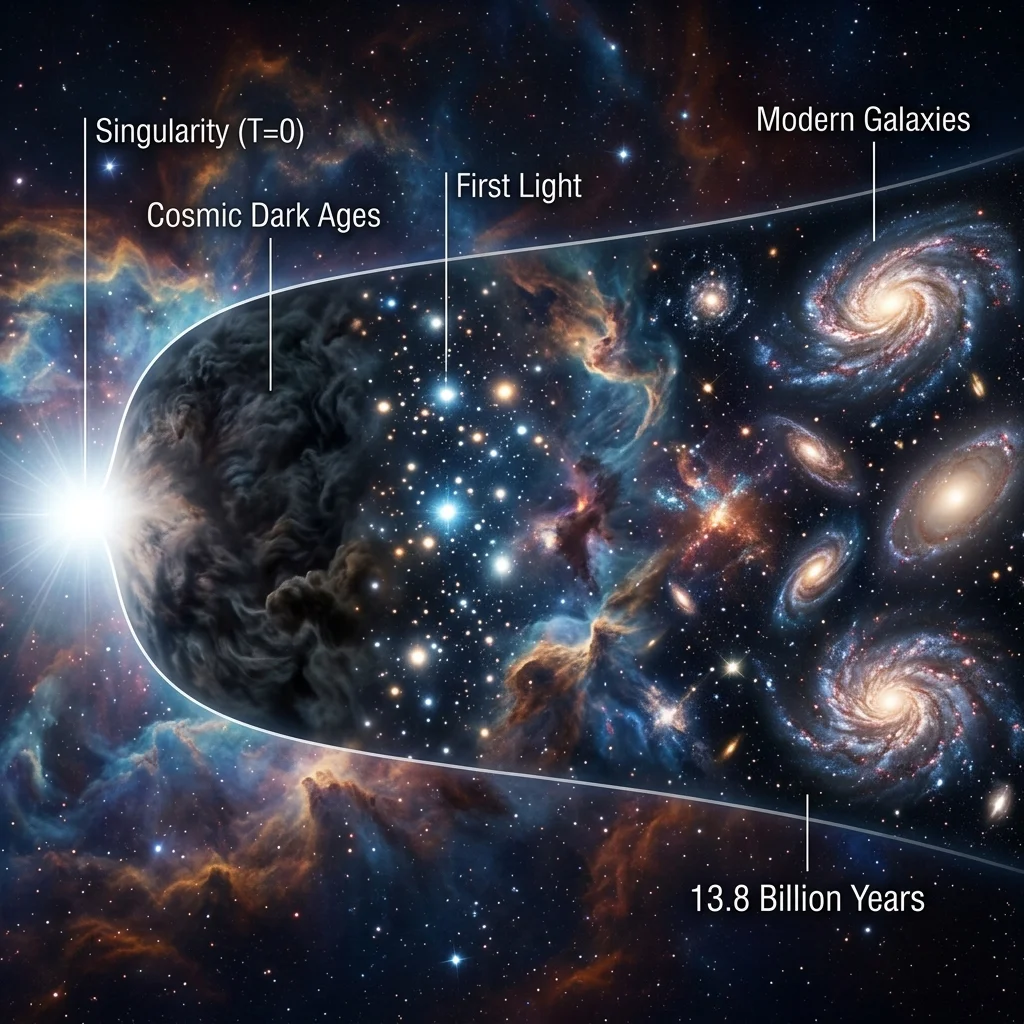 Timeline of the Universe. Left: A bright white singularity (T=0). Middle: Dark Ages (opaque fog). Right: First Stars igniting. Far Right: Modern Galaxies. Label: 13.8 Billion Years.
13.8 Billion years ago, the entire universe was the size of a peach. It contained every galaxy, every star, and every atom that exists today. It was a trillion degrees hot. Then, it expanded. We call it the Big Bang. But the name is a lie. It wasn't an explosion. An explosion happens inside a room. It pushes debris into empty space. But in the beginning, there was no room. There was no "outside." The Big Bang was an explosion OF space, not IN space. Space itself stretched out faster than the speed of light, carrying matter with it like raisins in a rising loaf of bread.
Expansion vs Explosion
How do we know this? In 1929, astronomer Edwin Hubble looked through a telescope and noticed something weird. Every galaxy he saw was moving away from us. And the farther away they were, the faster they were moving. Imagine drawing dots on a deflated balloon.
- Blow it up: As the rubber stretches, every dot moves away from every other dot.
- Reverse: If you run the movie backward, all the dots must have started at the same exact point. This point is the Singularity. Hubble discovered that the universe is not static; it is getting bigger every second.
The Doppler Effect: Redshift
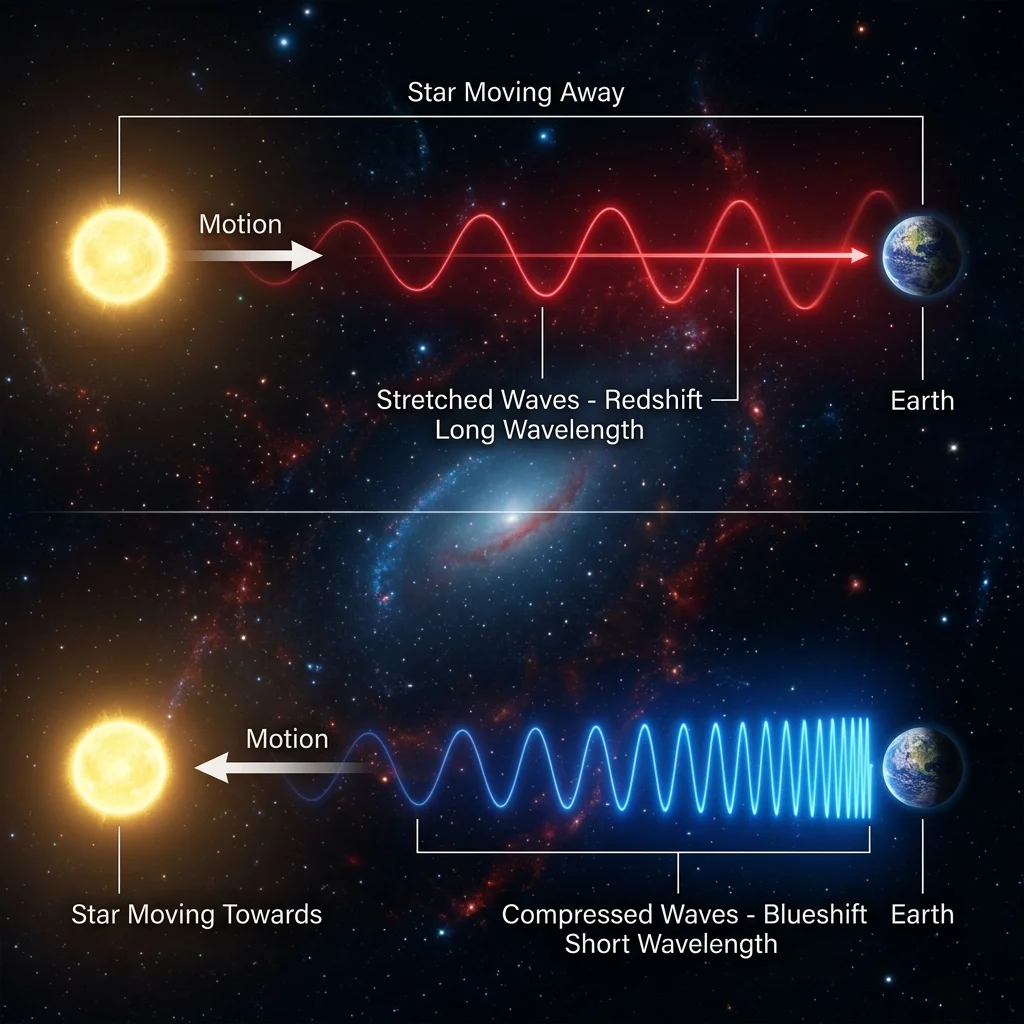
How did Hubble measure the speed of a galaxy? He used color. When an ambulance drives past you, the siren changes pitch (Weeee-Woooo).
- Approaching: The sound waves get squashed (High Pitch).
- Leaving: The sound waves get stretched (Low Pitch). Light behaves the same way.
- Approaching: Light waves get squashed (Blue Shift).
- Leaving: Light waves get stretched (Red Shift). When Hubble looked at the galaxies, they were all Red. This proved they were all running away from us.
The Afterglow: TV Static
The biggest proof isn't what we see; it's what we hear. The early universe was a blinding fog of hot plasma. Light was trapped. But 380,000 years after the bang, the universe cooled down enough for the fog to clear. That first flash of light is still traveling through the universe today. But because space has stretched so much over 13 billion years, that light wave has stretched out until it became invisible. It is now a Microwave. We call it the Cosmic Microwave Background (CMB). It is everywhere. It is hitting you right now. In fact, if you turn on an old analog TV to a dead channel, about 1% of the static "snow" you see is actually the CMB. You are literally watching the afterglow of the Big Bang on channel 3.
What Came Before?
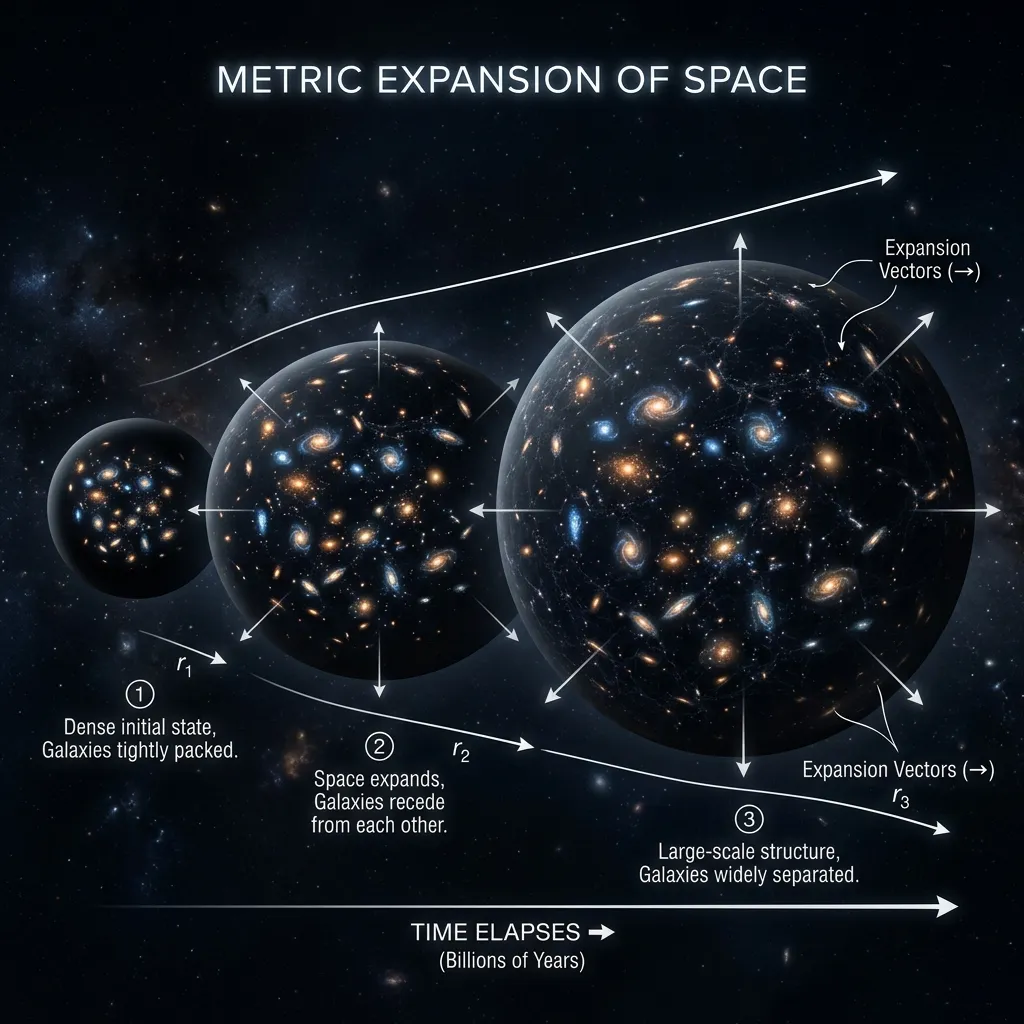 3 Balloons inflating. T=1, T=2, T=3. Dots on the surface (Galaxies) moving apart. Arrows show expansion. Label: Metric Expansion of Space.
People always ask: "What happened before the Big Bang?" The famous physicist Stephen Hawking had the best answer: "That is like asking what is North of the North Pole." It is a nonsense question. Time is a dimension, created by the universe. Before the Big Bang, "Time" did not exist. There was no "Before." The universe technically appeared out of nowhere, creating its own clock as it started.
The Cosmic Dark Ages
After the Big Bang, the universe wasn't instantly full of stars. For the first 400 million years, the universe was pitch black. There were no stars. No galaxies. No light. Just invisible clouds of Hydrogen gas floating in the dark. Eventually, gravity started to pull these clouds together. The pressure got higher and higher until... ignite. The first stars turned on. These weren't like our Sun. They were blue monsters, 100 times bigger than the Sun, and they burned fast and died young. But their explosions seeded the universe with the first heavy metals, making planets (and life) possible.
The Anti-Gravity Force
For decades, scientists thought gravity would eventually slow down the expansion of the universe. They thought the Big Bang was like throwing a ball in the air: it goes up, slows down, and eventually falls back down. But in 1998, they found the opposite. The universe isn't slowing down. It is speeding up. Something is pushing the galaxies apart faster and faster. We don't know what this "pushing force" is. It is invisible. We call it Dark Energy. It makes up 68% of the entire universe, and we have absolutely no idea what it is. It is the biggest mystery in modern physics.
Fast Facts
- Inflation: In the first fraction of a second ($10^{-32}$), the universe doubled in size 100 times. This is called Inflation. It grew from an atom to a grapefruit faster than light could travel. This didn't break the laws of physics because "space itself" can move faster than light; only objects inside space have a speed limit.
- The Big Freeze: How will it end? Most scientists think the universe will keep expanding forever. Eventually, the stars will run out of fuel. The galaxies will drift apart until they can't see each other. The universe will become a cold, dark, empty graveyard. This is called the Heat Death of the Universe.
- Star Ash: The Big Bang only made Hydrogen and Helium (and a tiny pinch of Lithium). It didn't make Carbon, Oxygen, or Gold. All the heavy elements in your body were cooked billions of years later inside the cores of exploding stars. You are not made of Big Bang dust; you are made of Star dust.