
Dirty SnowballsDRAFT
Trace the journey of the 'dirty snowballs' from the frozen edges of our solar system. Discover how these icy visitors develop spectacular glowing tails as they heat up during their high-speed pass near the Sun.
The Dirty Snowball
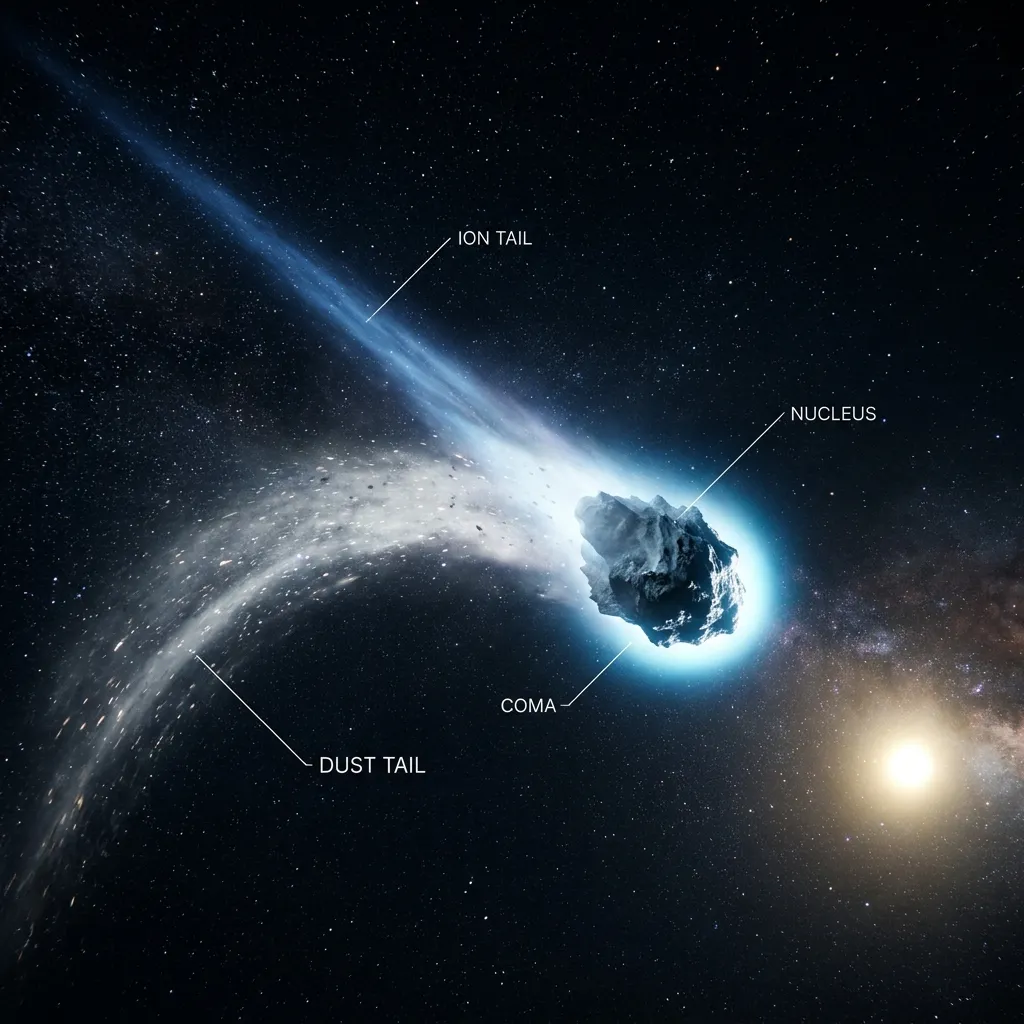
For thousands of years, Comets were the "Terror of Kings." They appeared out of nowhere—looking like "stars with long hair" (Greek Kometes)—and hung in the sky for weeks. People thought they were omens of doom. (King Harold of England lost the Battle of Hastings in 1066 right after Halley's Comet appeared). Today, we know they aren't ghosts. They are Time Capsules. Comets are dirty snowballs left over from the freezing dawn of our solar system, 4.5 billion years ago. They contain the original ingredients—water, carbon, amino acids—that may have seeded life on Earth.
Anatomy of a Comet
A comet spends most of its life as a frozen, dark rock in deep space. But when gravity nudges it toward the Sun, it wakes up.
- The Nucleus: The solid heart. It is a mix of rock, dust, and frozen gases (Dry Ice, Ammonia, Water Ice). It is usually darker than charcoal.
- The Coma: As it gets close to the Sun, the heat turns the ice instantly into gas (Sublimation). This creates a glowing atmosphere around the nucleus that can be larger than the planet Jupiter!
- The Tails: The Solar Wind slams into this cloud, blowing it backward into a tail that can stretch 100 million miles.
The Tale of Two Tails
Look closely at a photo of a comet (like Hale-Bopp). You will see two separate tails.
- The Ion Tail (Blue): This is made of electrically charged gas. It is super light. The Solar Wind blows it straight back with incredible force. It acts like a windsock—it always points directly away from the Sun, regardless of which way the comet is moving.
- The Dust Tail (White/Yellow): This is made of heavy dust grains and rocks. Because they are heavy, they lag behind the comet as it moves. This tail curves gently along the comet's path.
Origins: The Oort Cloud
Where do they come from? They live in the deep freeze.
- The Kuiper Belt: A ring of icy rocks just past Pluto. This is where "short-period" comets come from (orbiting every <200 years).
- The Oort Cloud: A theoretical giant bubble surrounding our entire solar system, almost a light-year away. It contains trillions of sleeping comets. Sometimes, a passing star nudges one, and it begins a 10,000-year fall toward the Sun.
Landing on a Comet (Rosetta)
In the movie Armageddon, they land on an asteroid. In 2014, humans actually did it. The Rosetta spacecraft chased Comet 67P for ten years. It dropped a tiny washing-machine-sized robot named Philae onto the surface. But there was a problem. The gravity on the comet was so weak (1/100,000th of Earth) that Philae didn't land... it bounced. It bounced 1 km high! It floated for hours before settling in a dark crevice. Despite the rough landing, it sniffed the comet's water. It found "Heavy Water" (Deuterium), which is different from Earth's water. This suggests that maybe comets didn't bring our oceans after all. The mystery continues.
The Great Bombardment
Look at the Moon. It is covered in craters. Look at Earth. It has oceans. Scientists think these two things are related. 4 billion years ago, the solar system was a shooting gallery ("The Late Heavy Bombardment"). Earth was smashed by millions of comets. Since comets are vast icebergs, they melted. Some theories suggest that comets delivered Trillions of tons of water to our dry planet, filling the basins to create the oceans we swim in today. You might be drinking melted comet juice right now.
The Suicide Divers: Sungrazers
Not all comets survive. The Kreutz Sungrazers are a family of comets that have a death wish. Their orbit takes them dangerously close to the Sun (within a few thousand miles of the surface). Most of them vaporize instantly. They are "Suicide Comets." We see them constantly with our solar satellites (SOHO). Sometimes, a giant Sungrazer survives the pass. When Comet Ikeya-Seki survived a solar dive in 1965, it became visible in broad daylight! It was brighter than the full moon. It had been stripped of its outer layers, glowing like a ghost before flying back into the dark.
Fast Facts
- Mark Twain: The famous author was born in 1835, the year Halley's Comet appeared. He famously predicted, "I came in with Halley's Comet, and I expect to go out with it." He died the very next day after the comet returned in 1910.
- The Perseids: Every August, Earth drives through the dusty trail left behind by Comet Swift-Tuttle. The dust burns up in our atmosphere, creating the famous Perseid Meteor Shower.
- Tunguska: In 1908, a mysterious explosion flattened 800 square miles of forest in Siberia. No crater was ever found. Scientists think it was a fragment of a comet that exploded in mid-air with the force of 1,000 atomic bombs.