
Gravity and Orbits: The Curvature of Reality
The Invisible Rubber Sheet
What is Gravity? For centuries, Isaac Newton described it as a force—a cosmic rope connecting the Apple to the Earth. He gave us the math to predict it, but he couldn't explain how it worked across empty space.
He was wrong. In 1915, Albert Einstein shattered our understanding of the universe with General Relativity. He proved that gravity isn't a force at all. It is a Curve.
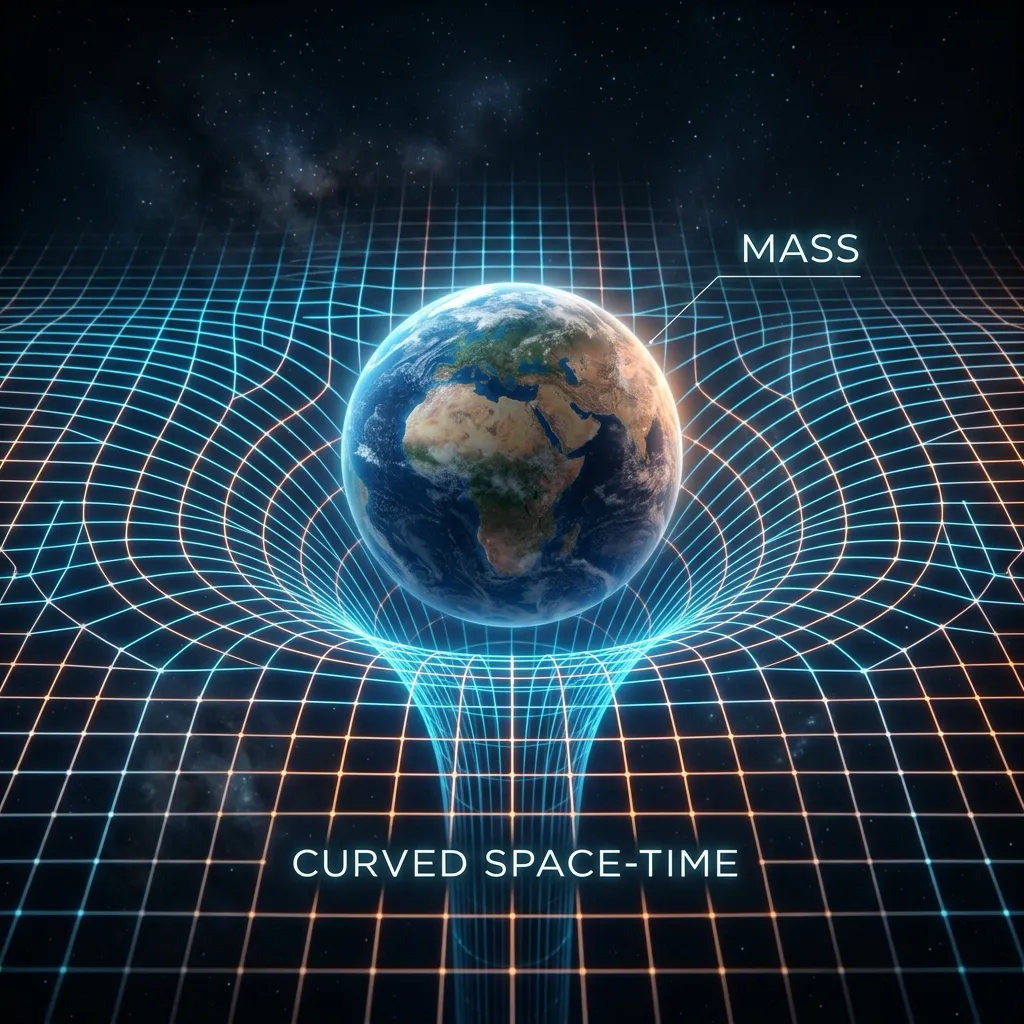
Imagine the universe as a giant, invisible trampoline called Spacetime.
- The Bowling Ball: If you place a heavy object like the Sun in the middle, the fabric curves down, creating a deep well.
- The Marble: If you roll a marble (Earth) past it, the marble doesn't travel in a straight line. It follows the curve of the fabric, circling the bowling ball. The marble "thinks" it is moving straight, but the space it is traveling through is bent. As the physicist John Wheeler famously said: "Matter tells Space how to curve. Space tells Matter how to move." That is gravity.
Falling Forever: The Secret of Orbit
The International Space Station (ISS) orbits 250 miles above our heads. Why do the astronauts inside float? Most people answer: "Because there is no gravity in space." This is completely false. At 250 miles up, Earth's gravity is still 90% as strong as it is on the ground. If you built a 250-mile high tower and stood on top, you would weigh almost exactly the same as you do now. If the ISS stopped moving, it would drop like a stone and crash into the ocean in about 45 minutes.
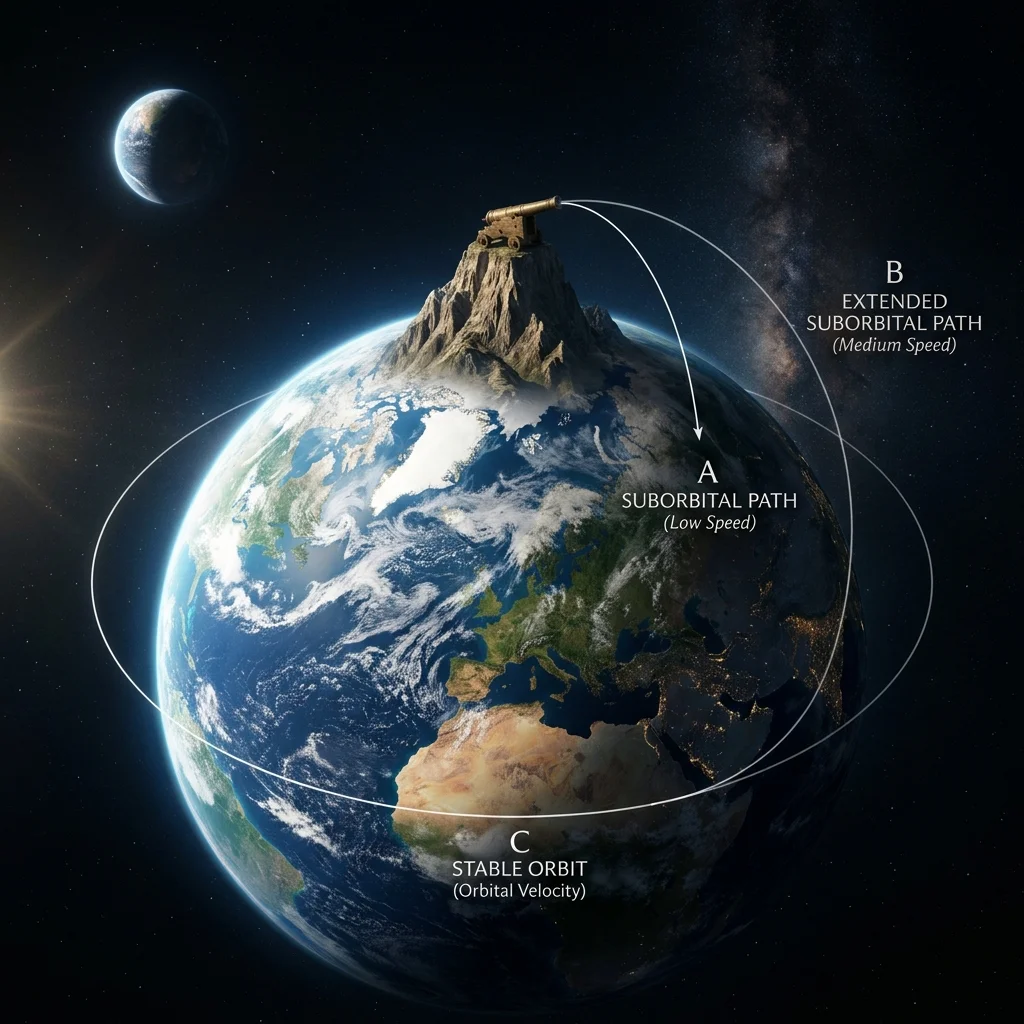
So why don't they fall? They are falling. Imagine firing a cannonball from a mountaintop. It follows a curve and hits the ground.
- Fire it faster: It flies further before hitting the ground.
- Fire it at 17,500 mph: This is the magic number (Orbital Velocity). At this speed, the cannonball falls toward Earth, but Earth is round. The surface curves away underneath the ball at the exact same rate that the ball falls. Orbit is simply falling and missing the ground forever. The astronauts feel weightless for the same reason you feel weightless when a rollercoaster drops—they are in a perpetual freefall that never leads to a crash.
The Noodle Effect: Tidal Forces
Gravity gets weaker the further away you are. This simple fact creates a weird stretching effect called Tidal Force.
- On Earth: The Moon pulls on the side of Earth facing it (oceans) harder than the side facing away. This difference stretches the oceans into an oval shape. As Earth spins inside this water oval, we experience high and low tides.
- Near a Black Hole: This force turns deadly. If you fell feet-first toward a black hole, the gravity at your feet would be millions of times stronger than the gravity at your head. This difference would stretch your body into a long, thin string of atoms, literally ripping you apart. Scientists have a strictly technical term for this horror: Spaghettification.
Escape Velocity: The Prison Break
Earth is a "gravity well"—a deep pit in spacetime. We live at the bottom. To leave, we have to climb out. But we can't climb; we have to run. To break free of Earth's orbit entirely and travel to Mars, you must reach Escape Velocity. That speed is 25,000 mph (Mach 33).
- The Energy Trap: If you launch a rocket at 24,000 mph, it will fly far out into space, pause, and eventually fall back down.
- The Tyranny of the Rocket Equation: Reaching Mach 33 is incredibly hard. This is why rockets are 90% fuel. We need massive tanks just to carry the fuel to lift the other fuel needed to get the tiny payload (10% of the ship) up to speed. Once you hit that magic number, though, you are free. You can coast to Pluto with your engines off.
Ripples in the Fabric
Einstein predicted one last strange thing. If gravity is a fabric, what happens if you slap it? If two massive objects (like Black Holes) crash into each other, they should create Gravitational Waves—ripples in space itself, moving at the speed of light. For 100 years, this was just a theory. Then, in 2015, the massive LIGO detector heard a "chirp." It was the sound of two black holes colliding 1.3 billion light-years away. The wave passed through Earth, stretching our entire planet (and your body) by a fraction of an atom's width before squeezing it back. We are no longer just looking at the universe; we are listening to the fabric of reality vibrate.
Parking Spots in Space
Gravity usually pulls things down. But is there a spot where gravity cancels out? Yes. These are called Lagrange Points. Imagine the Earth pulling a spaceship to the Left, and the Sun pulling it to the Right. At one specific point between them ($L_1$), the tug-of-war is a perfect tie. A spaceship parked there will hover forever, locked between the two giants. We park our most sensitive eyes, like the James Webb Space Telescope, at $L_2$ (a point behind the Earth). It is a "gravity parking lot" a million miles from home, allowing the telescope to stay in a fixed position relative to Earth without burning constant fuel.
Fast Facts
- The Vomit Comet: How do movies film zero-gravity scenes (like Apollo 13)? They use a plane that flies in a giant parabola—climbing to 30,000 feet and diving. For 25 seconds during the dive, everything inside falls at the same speed as the plane, creating true weightlessness.
- Lumpy Gravity: Earth isn't a perfect sphere; it's lumpy. Mountains have more mass (and gravity) than deep ocean trenches. You actually weigh slightly less in Sri Lanka (a low-gravity zone) than you do in Iceland.
- Time Travel: Gravity creates Time. According to relativity, the stronger the gravity, the slower time moves. Near a black hole, one hour could equal seven years on Earth (a plot point in Interstellar that is scientifically accurate).
Diagram Prompts
- The Spacetime Sheet: A 3D grid representing space as a rubber sheet. A heavy sun sits in the center, creating a deep funnel. A smaller Earth marble rolls along the upper curve of the funnel. A straight line (light beam) passing by bends as it follows the grid lines. Label: "Mass Curves Space".
- Newton's Cannon: A drawing of Earth from space with a tall mountain on top. A cannon fires three shots. Shot A (Slow) curves into the ground. Shot B (Fast) curves further but still hits. Shot C (Orbital Velocity) travels so fast that its curve matches the curve of the Earth perfectly, circling all the way around to hit the cannoner in the back.
- Tidal Force Diagram: A diagram of the Earth-Moon system. Arrows show the Moon's gravity pulling STRONGLY on the near side of Earth, MEDIUM on the center, and WEAKLY on the far side. The result is the Earth's oceans stretching into an oval shape (bulges on both sides).