
The Endless Storm
Imagine a roaring, violent hurricane so unimaginably massive that you could drop the entire planet Earth straight into its eye, with plenty of room to spare around the edges. Now, try to imagine that exact same apocalyptic storm spinning continuously for at least 350 years, and quite possibly for many centuries longer.
This terrifying display of atmospheric violence is the Great Red Spot of Jupiter, the most famous and longest-lasting storm in our entire solar system.
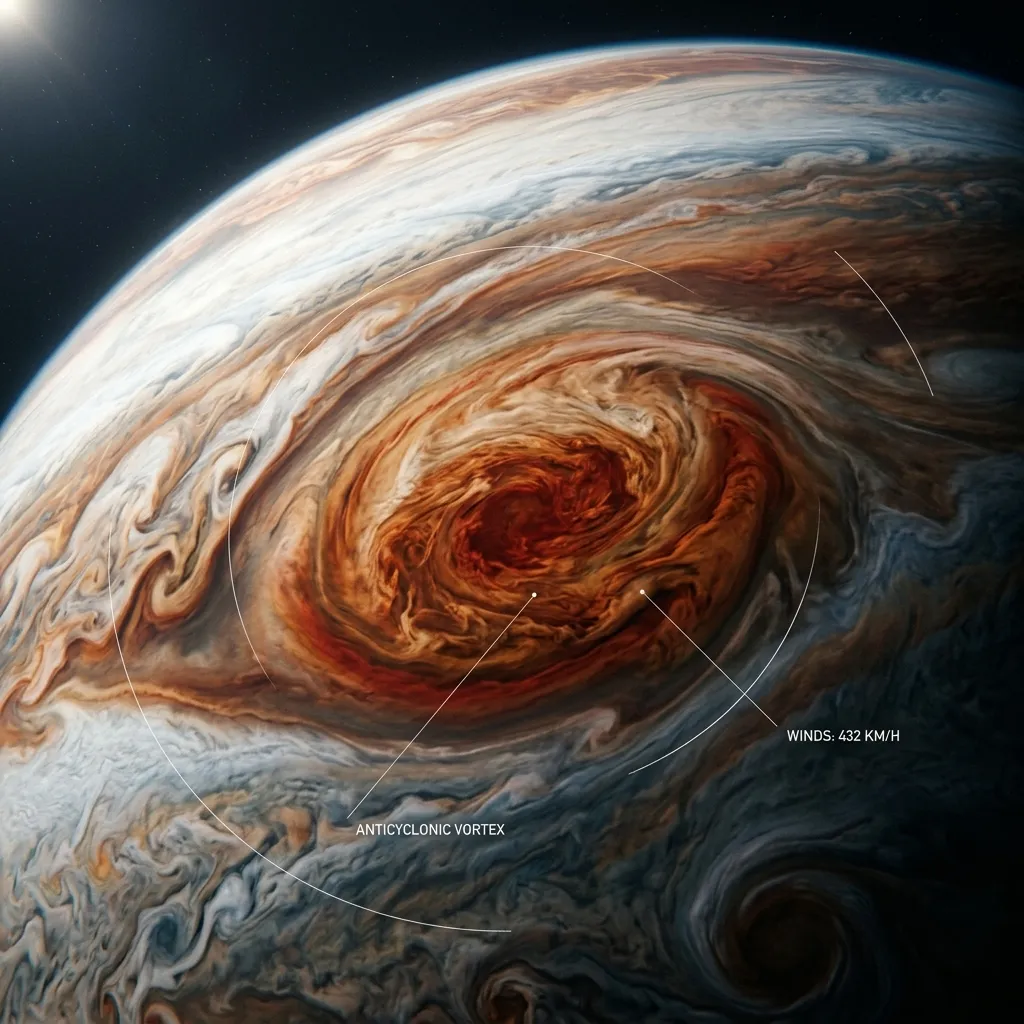
A Planetary Eye Without Land
Jupiter is fundamentally different from Earth; it is a gas giant. This means it lacks any rocky, solid surface to create friction and break up weather systems. Here on Earth, massive hurricanes rapidly lose their power and tear themselves apart as soon as they make landfall. On Jupiter, there is absolutely no land to hit. Left totally unchecked, these massive storms simply keep growing, merging, and spinning forcefully, fueled constantly by the sheer, staggering internal heat radiating from the planet's deep core.
The Great Red Spot operates as a high-pressure anticyclonic storm, furiously spinning counter-clockwise across the planet's southern hemisphere. What makes it genuinely terrifying is the wind. The sheer rotational speed at the storm's outer edge screams at speeds approaching 400 mph (640 km/h). That is easily more than twice as fast as the strongest, most destructive Category 5 hurricanes ever recorded on Earth.
Why the Deep Crimson?
Despite decades of intense observation by probes like Voyager and Juno, scientists are still hotly debating exactly why the spot burns with such a deep brick-red color.
- The Atmospheric Sunburn Theory: Most researchers believe that complex organic molecules (known as tholins) or traces of red phosphorus violently churning in the upper cloud layers are actively being "cooked" by the Sun's intense ultraviolet radiation, effectively giving the storm a chemical sunburn.
- The Skyscraper Altitude: The sheer vertical size of the Red Spot plays a role. The top of the storm towers an astonishing 8 km (5 miles) above the surrounding cloud deck. This extreme altitude exposes its unique chemicals to far more direct, unfiltered sunlight than the rest of the planet's weather bands.
A Storm in Decline?
<div className="grid grid-cols-1 md:grid-cols-2 gap-4 my-8"> <div className="bg-secondary/10 p-6 rounded-xl border border-border/50"> <h3 className="font-bold text-lg mb-2">Current Scale</h3> <p>While massive, it is currently about 1.3 times the total width of Earth.</p> 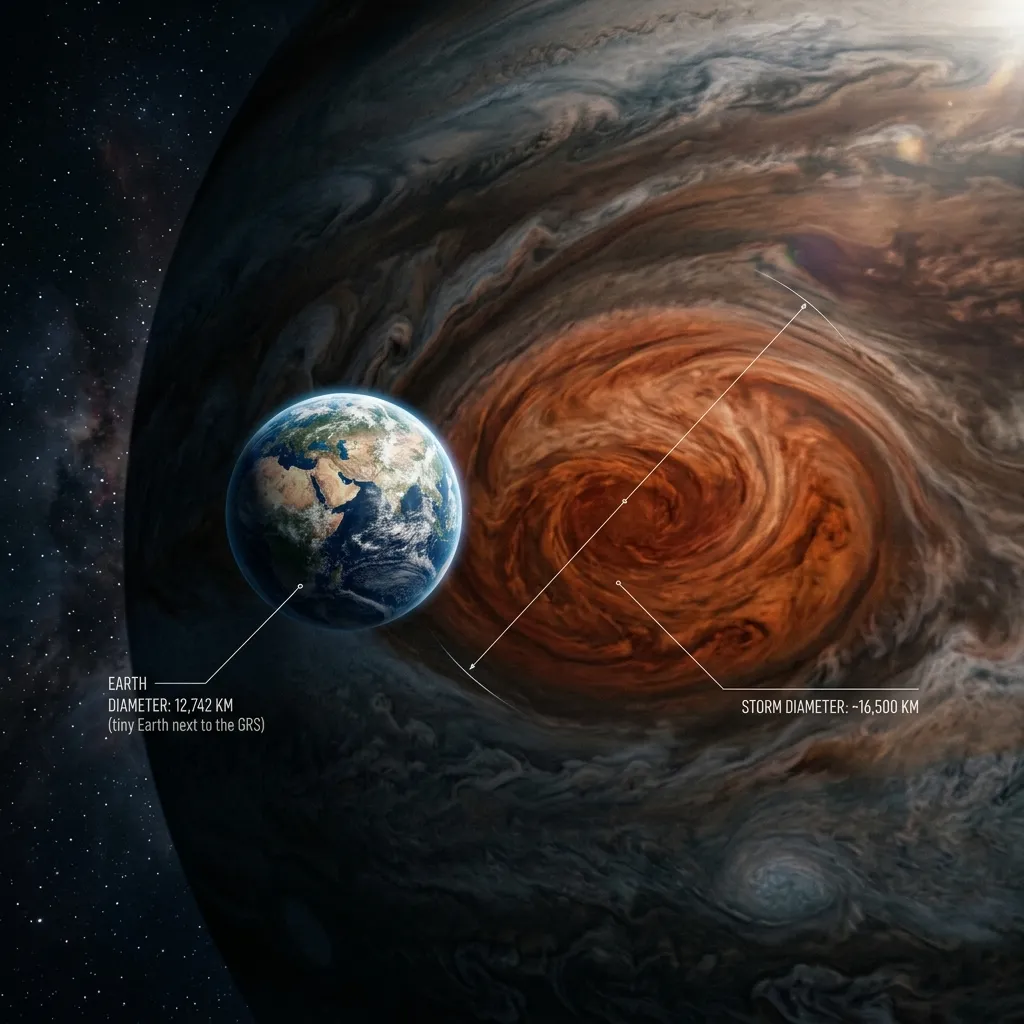 </div> <div className="bg-secondary/10 p-6 rounded-xl border border-border/50"> <h3 className="font-bold text-lg mb-2">Is It Shrinking?</h3> <p>Historical records show the spot has been steadily shrinking since the late 19th century. Scientists debate whether it will eventually disappear entirely or stabilize.</p> </div> </div>In recent years, astronomers have watched the spot dramatically change shape, rounding out from a long oval into a tighter circle, and even visibly shedding massive "flakes" of red clouds from its outer edges. Some experts predict this towering titan could completely dissipate within our lifetime, while others argue it is merely going through a long-term cyclical phase. For now, it stubbornly remains the watchful, angry eye of our outer solar system.