
Light Speed: The Cosmic Traffic Cop
The Speed Limit of Reality
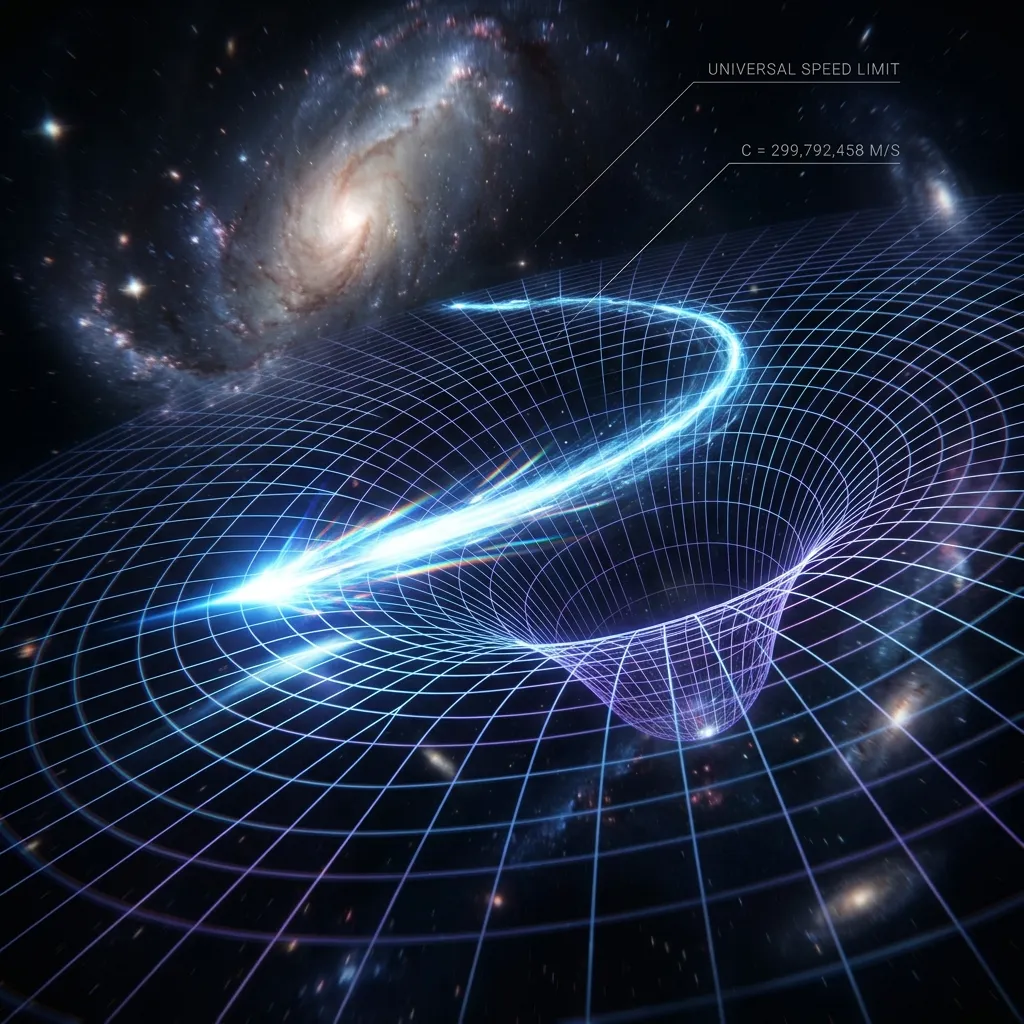
299,792,458 meters per second. That is the speed limit of the Universe. It is written as $c$ in physics equations ($E=mc^2$). Nothing—absolutely nothing—can break this law. Why? Because Albert Einstein discovered a weird rule in his Theory of Special Relativity: Speed creates Mass. The faster you go, the heavier you get.
- At 10% light speed, you get a tiny bit heavier.
- At 99% light speed, your spaceship would weigh as much as a planet.
- At 100% light speed, your mass becomes Infinite. To push infinite mass would require Infinite Energy. Since there isn't infinite energy in the universe, you can never reach the limit. Only Photons (light particles) can travel at light speed because they have Zero Mass. They are ghosts.
Checking the Rearview Mirror (Time Travel)
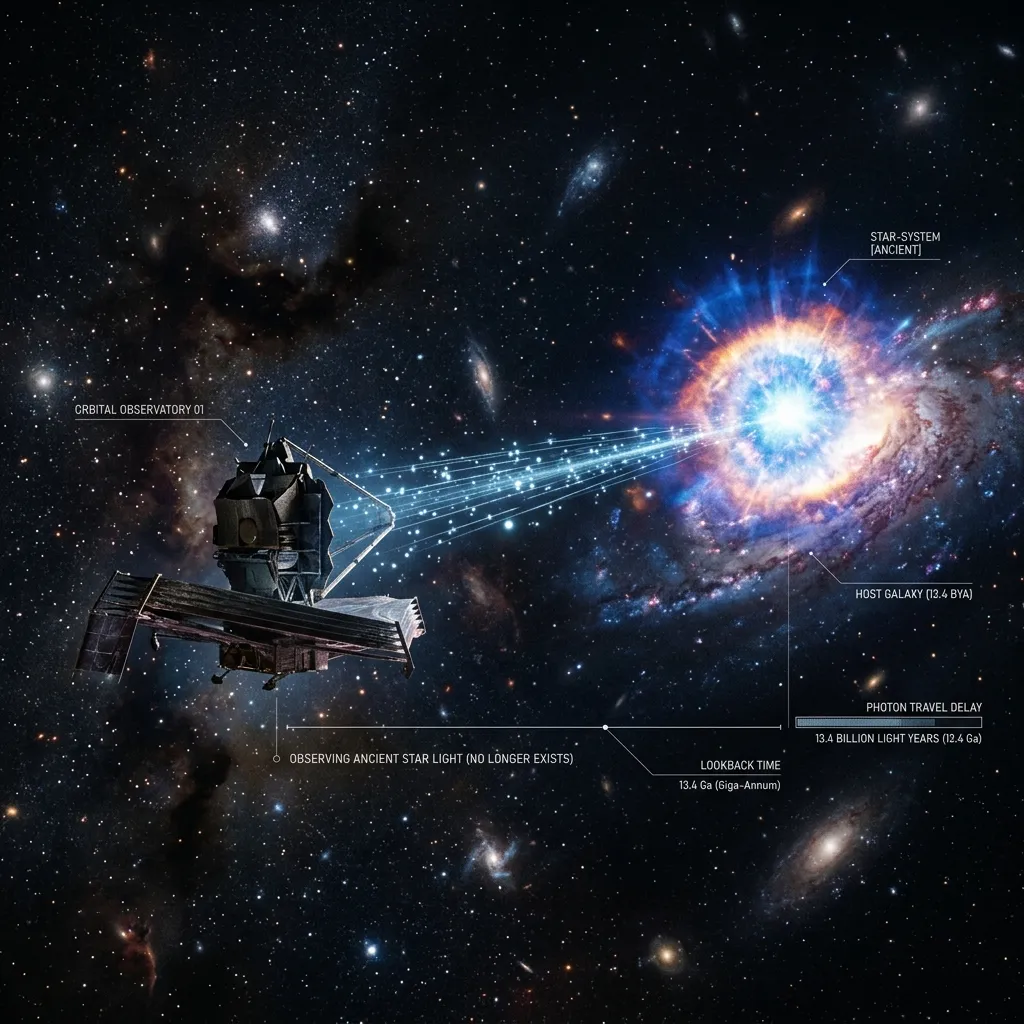
Light is fast, but space is gigantic. It takes time for light to travel.
- The Moon: 1.3 seconds away.
- The Sun: 8 minutes and 20 seconds away.
- The Nearest Star (Proxima Centauri): 4.2 years away.
- Andromeda Galaxy: 2.5 Million years away. When you look at the stars, you are not seeing the present. You are seeing the past. You are a Time Traveler. If the Sun exploded right now, we wouldn't know about it for 8 minutes and 20 seconds. We would still see the ghost of the sun shining in the sky while gravity held us in orbit around a phantom. Telescopes like the James Webb are technically "Time Machines." They look at galaxies so far away that we are seeing them as they looked 13 billion years ago, just after the Big Bang.
The Twin Paradox
Relativity gets weirder. Speed slows down Time. Imagine two identical twins, Scott and Mark.
- Scott stays on Earth.
- Mark flies a spaceship at 99.9% light speed for a round trip of 1 year. When Mark returns, he has aged 1 year. He is still young. But Scott is an old man. 50 years have passed on Earth. Time is not a constant clock ticking in the background. It is stretchy. The faster you move through Space, the slower you move through Time. Space and Time are the same thing (Spacetime).
- Real Proof: GPS satellites move at 17,000 mph. Time runs slightly slower for them than for us. Engineers have to program the clocks to "tick" faster to match Earth time. If they didn't, Google Maps would be wrong by 6 miles every day.
Cheating Physics: Warp Drive
In Star Trek, they use "Warp Drive" to go faster than light. Is this possible? Maybe. You can't move through space faster than light. But you might be able to move space itself. The Alcubierre Drive is a theoretical engine concept. It doesn't move the ship. Instead, it shrinks the space in front of the ship and expands the space behind it. The ship sits still in a "bubble" of normal space, while the bubble surfs a wave of distorted spacetime. It is like standing on a moving airport walkway. You aren't walking, but the floor is moving you faster than Usain Bolt. NASA is actually studying this (though it requires "Negative Energy," which we haven't found yet).
The Ghost Particle: Neutrinos
If light is the fastest thing, what is the most elusive? The Neutrino. It travels at almost the speed of light. But it interacts with nothing. Trillions of neutrinos are passing through your body right now. They were created in the center of the sun during nuclear fusion. They fly through the Earth as if it wasn't there. To a neutrino, the entire planet is as empty as a ghost. Scientists have to build detectors deep underground in gold mines, filled with pure water, just to catch one of them per year.
Fast Facts
- Round the World: Light is fast enough to circle the Earth 7.5 times in one second.
- Tachyons: These are hypothetical particles that always move faster than light. If they existed, they would travel backward in time. We have never found one (and probably never will).
- The Dark Ages: For the first 300,000 years after the Big Bang, the universe was opaque (foggy). Photons couldn't travel. Light was trapped. Then the universe cooled, the fog lifted, and light broke free. We can still see this "First Light" today as the Cosmic Microwave Background radiation on your TV static.
Diagram Prompts
- The Light Cone: A 3D Cone diagram. Bottom point is "The Big Bang". Middle Slice is "The Present". Top slice is "The Future". Light rays form the edges of the cone. Label: "The Event Horizon of Time."
- Twin Paradox: Split screen. Left Side: Old Man Scott on Earth with a long beard. Right Side: Young Man Mark in a rocket ship with a clock moving slowly. Label: "Time Dilation."
- Solar Time Lag: A diagram of the Solar System. A beam of light leaves the Sun. Labels show: "Earth (8 mins)", "Jupiter (43 mins)", "Pluto (5.5 hours)".