
Phases of the Moon: The Mirror in the Sky
The Dead Mirror
The Moon does not make its own light. It is a cold, dead rock. It acts as a giant mirror reflecting the Sun. Here is the secret: Half the Moon is ALWAYS lit up. Just like Earth has Day and Night, the Moon has a Day side and a Night side. The shape doesn't change. The lighting doesn't change. The only thing that changes is our perspective. We are watching a ball spin around us, and depending on the angle, we see different amounts of the "Day Side."
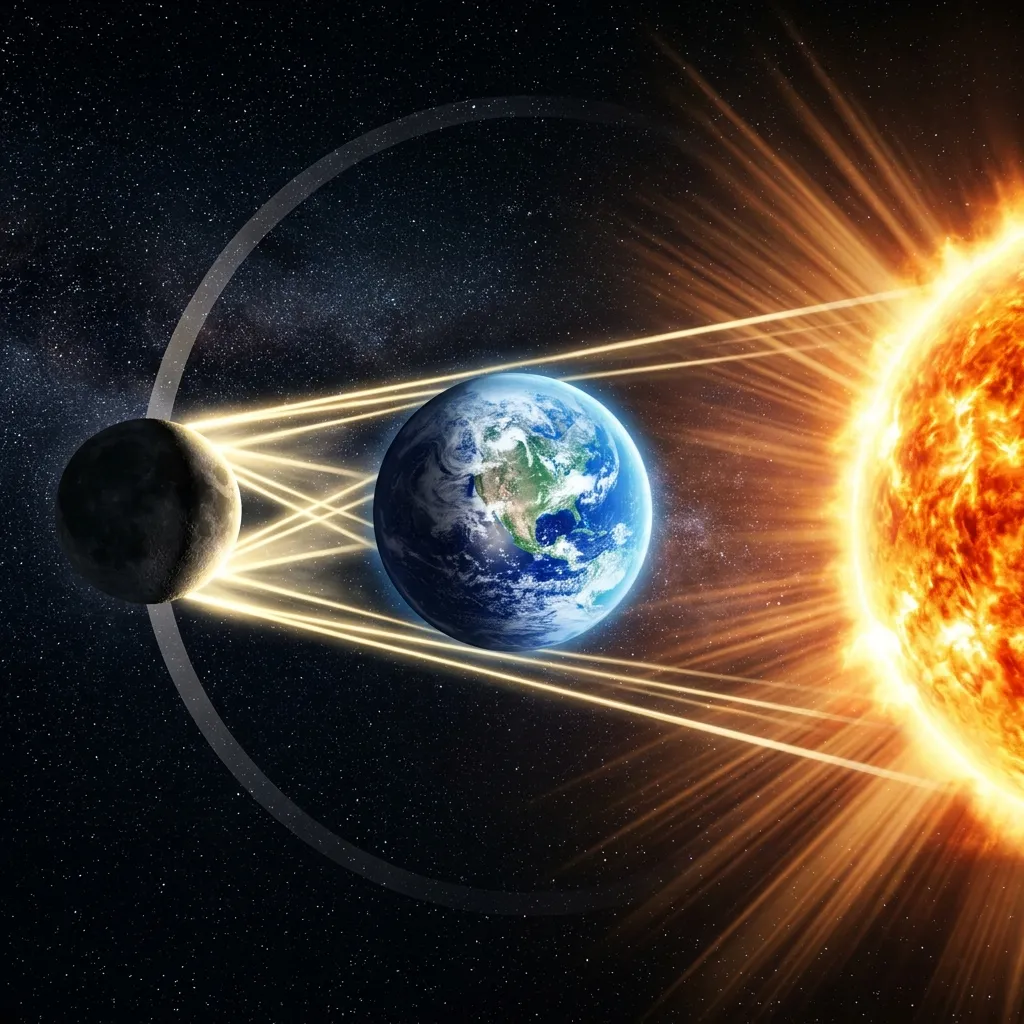
The 29.5 Day Cycle
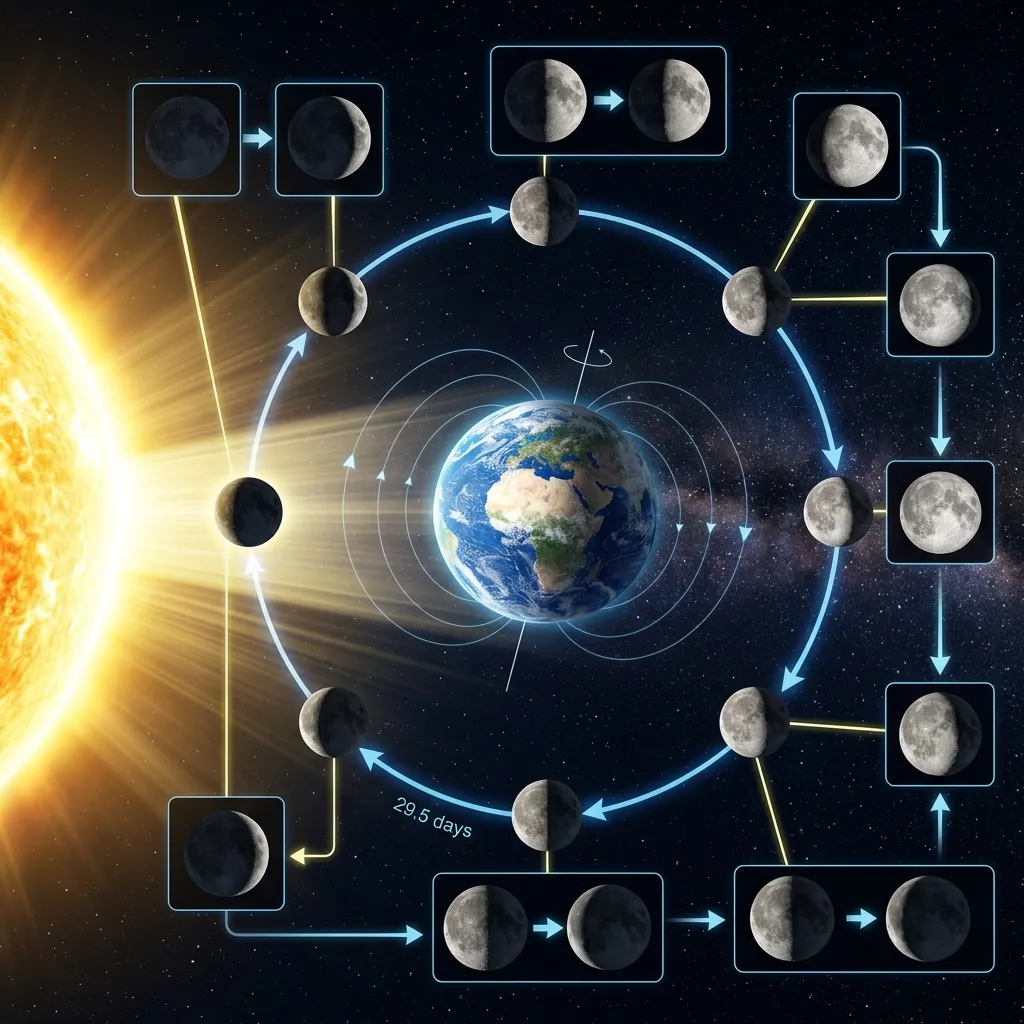
It takes the Moon 29.5 days (a "Month") to complete one lap around Earth. As it runs this lap, the angle of sunlight changes.
- New Moon: The Moon is standing between Earth and Sun. The bright side is facing the Sun (away from us). We are staring at the dark shadow. It looks invisible.
- Full Moon: The Earth is standing between the Moon and Sun. The sunlight flies past us and hits the Moon head-on. The bright side faces us fully.
- The Quarters: When the Moon is to our side (90 degree angle), we see half light and half shadow.
Wax On, Wane Off
How do you know if the Moon is growing or shrinking? There is a trick.
- Waxing (Growing): Think of "dipping a candle in wax." It gets bigger. In the Northern Hemisphere, the light grows from the Right.
- Waning (Shrinking): The shadow eats the light from the Right.
- Gibbous: A bulging moon (pregnant shape).
- Crescent: A fingernail moon. Mnemonic: "DOC."
- D shape = Waxing (Growing).
- O shape = Full.
- C shape = Waning (Shrinking). (Note: If you live in Australia or South America, this is reversed!)
Tidal Locking: The Dark Side
We only ever see one face of the Moon. The "Man in the Moon" never turns his head. Why? Does the moon not spin? Actually, it does. It spins at the exact same speed that it orbits (once every 27 days). This is called Tidal Locking. Millions of years ago, Earth's gravity grabbed onto a heavy bulge in the moon's rock (like a handle) and slowed its spin down until it matched the orbit perfectly. It is locked in a gravitational dance, staring at us forever. There is no "Dark Side of the Moon" (all sides get sun). There is only the "Far Side"—the side we never see. We didn't know what the back of the moon looked like until 1959, when a Russian probe flew behind it and took a grainy photo. (Spoiler: It's very bumpy and has no "Man" face).
Earthshine
Sometimes, when the moon is a thin crescent, you can faintly see the rest of the dark moon glowing a ghostly grey. This is Earthshine. Or "The Old Moon in the New Moon's Arms." It is light reflected from the Earth. Sunlight hits the Earth, bounces off our bright white clouds and blue oceans, flies to the Moon, illuminates the dark side, and bounces back to our eyes. You are seemingly seeing the Moon lit by the glow of your own planet. Leonardo da Vinci was the first person to explain this in 1500.
Science vs. Fiction: The Moon Illusion
Why does the Moon look GIGANTIC when it is near the horizon, but tiny when it is high up? People think the atmosphere acts like a lens and magnifies it. That is false. If you take a photo and measure the pixels, the Moon is the exact same size at the horizon as it is at the zenith. It is a Brain Glitch. When the moon is near the horizon, your brain sees it next to trees and houses. It thinks: "Wow, it's bigger than a house! It must be huge." When it is high in the sky, it is alone in a vast empty void. Your brain has nothing to compare it to, so it perceiving it as small. It is the oldest optical illusion in human history.
Fast Facts
- Leaving Us: The Moon is drifting away. Every year, it moves 1.5 inches further from Earth (about the speed your fingernails grow). In 600 million years, it will be too small to cover the sun, and humans (if they exist) will never see a Total Solar Eclipse again.
- Blue Moon: It isn't blue. A lunar month is 29 days. A calendar month is 30/31 days. Sometimes, you fit two full moons in one month. The second one is called a "Blue Moon." It is rare, hence the phrase "Once in a Blue Moon."
- Supermoon: The moon's orbit isn't a perfect circle; it is an oval (Ellipse). Sometimes it is closer (Perigee), sometimes further (Apogee). A "Supermoon" is just a Full Moon that happens to be at the closest point. It looks 14% bigger and 30% brighter.
Diagram Prompts
- Phases Diagram: Top-down view of the Solar System. Sun on the left. Earth in the center. Moon orbiting Earth (8 positions). Show that the Moon is ALWAYS half-lit by the sun. Show sight-lines from Earth to explain why we see Crescents vs Full. Label: "It's All About Angles."
- Tidal Locking: Two diagrams. Top: Moon spinning fast (We see diferent sides). Bottom: Moon spinning at same speed as orbit (We see same Face). A "Gravity Hand" from Earth holding the Moon's nose. Label: "Locked Eyes."
- Earthshine: Sun -> Earth -> Moon -> Eye. Arrows showing light bouncing off Earth's clouds, hitting the dark part of the Moon, and bouncing back to the Eye. Label: "Ghost Light."