
Rockets: The Chemical Explosion
The Equal Reaction
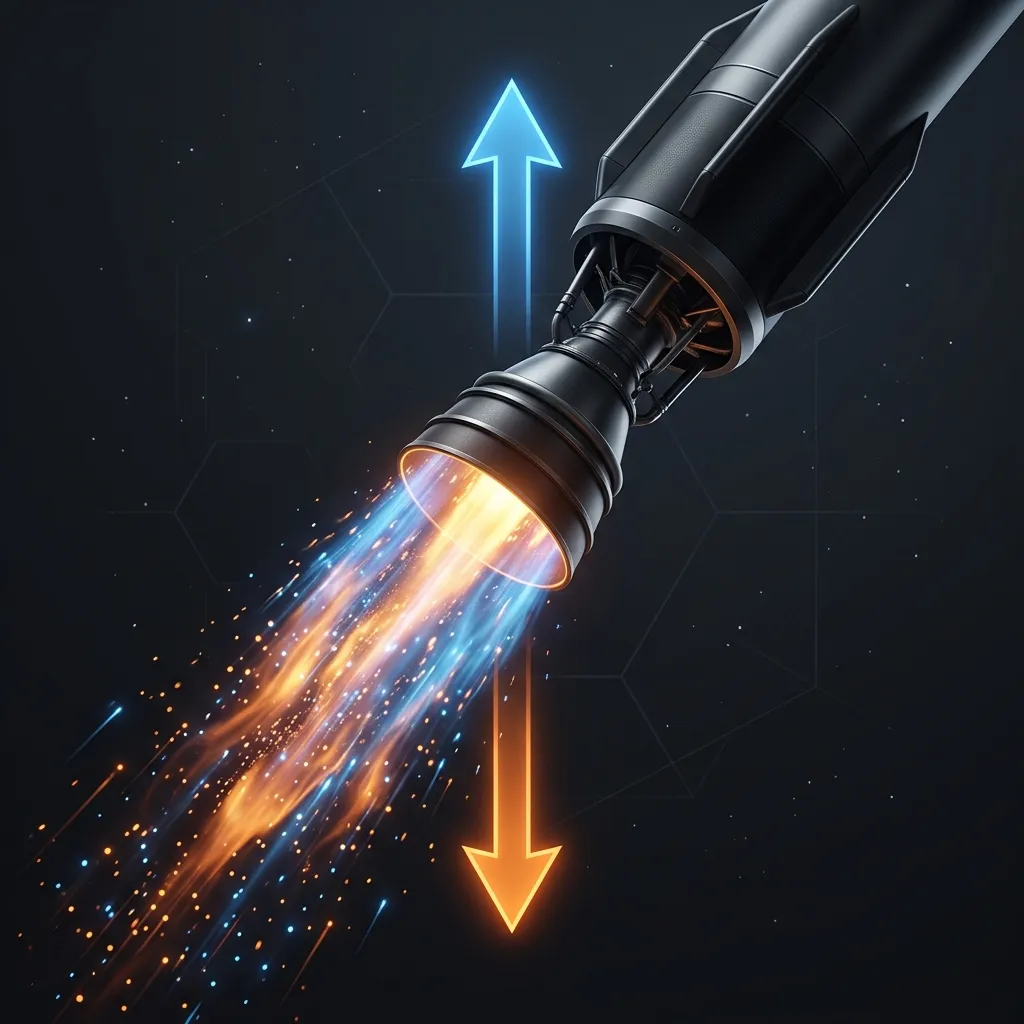
In space, there is no air to push against. So how does a rocket move? It uses Newton's 3rd Law: "For every action, there is an equal and opposite reaction." Imagine yourself standing on a skateboard holding a heavy bowling ball. If you throw the ball forward as hard as you can, you will roll backward. A rocket is the same. It creates a continuous explosion and throws the gas out the back at 6,000 mph. The gas goes down; the rocket goes up.
The Tyranny of the Rocket Equation
The problem with rockets is gravity. Fuel is heavy. To lift the fuel, you need more fuel. To lift that fuel, you need MORE fuel. This mathematical curse is called The Rocket Equation. It is why rockets are 85% tank and only 2% astronauts. The Solution: Staging. Once a gas tank is empty, it is dead weight. You must drop it off to make the rocket lighter. The giant Saturn V rocket dropped 3 separate stages just to get a tiny capsule to the Moon.

Bring Your Own Air
A jet engine is "air-breathing"—it sucks in oxygen from the sky to burn its fuel. A rocket goes where there is no air. So it has to carry its own Oxygen tank (called an Oxidizer). Mixing liquid oxygen and kerosene creates a controlled explosion powerful enough to escape Earth's gravity (17,500 mph).
The Trash Cage (Kessler Syndrome)
We have launched thousands of rockets. We left a lot of junk up there. Dead satellites, paint chips, and bolts are orbiting Earth at 17,000 mph. In 1978, scientist Donald Kessler predicted a nightmare scenario. If we launch too much stuff, the trash will start colliding. One collision creates 1,000 pieces of new trash. Those pieces hit other satellites. It becomes a chain reaction. Eventually, the Earth could be surrounded by a shell of shrapnel so dense that we can never leave. We would be trapped on our planet, unable to launch satellites or telescopes for centuries. We are dangerously close to this reality today.
Science vs. Fiction: Ion Drives
In Star Wars, ships glow with blue engines and fly forever. We actually have this! It is called an Ion Thruster. Instead of fire, it shoots out electrically charged atoms (Ions) of Xenon gas.
- The Catch: It is very weak. The push is like the weight of a piece of paper on your hand.
- The Trick: It is super efficient. It can stay on for YEARS. In space, with no friction, that tiny push adds up. It is the Tortoise vs. The Hare. Chemical rockets are fast but burn out in minutes; Ion drives are slow but win the race to Mars.
Fast Facts
- Sound Water: Launch pads dump 300,000 gallons of water in seconds during liftoff. It isn't to cool the fire; it's to dampen the Sound. Without the water, the acoustic shockwave is so loud (220 decibels) it would bounce off the concrete and rattle the rocket to pieces.
- Max Q: The moment of Maximum Dynamic Pressure. It is the time when the rocket is going super fast, but the air is still thick. It is the moment the rocket is most likely to break.
- Landing Backwards: SpaceX figured out how to fly a rocket booster backwards and land it upright. It uses grid fins to steer. It is like throwing a pencil over the Empire State Building and having it land on its eraser during a hurricane.
Diagram Prompts
- Newton's 3rd Law: A Rocket in space. Big explosion shooting DOWN (Action). Rocket shooting UP (Reaction). A boy on a skateboard throwing a bowling ball to demonstrate the same force. Label: "Throwing Fire."
- Staging: A tall Saturn V rocket. Showing it breaking into 3 pieces. The heavy bottom tanks falling away. The tiny top capsule continuing to the moon. Label: "Dropping Ded Weight."
- Ion Engine: Side-by-side. Chemical Rocket: Huge fire, runs out fast. Ion Engine: Tiny gentle blue glow, runs forever. A turtle (Ion) and Hare (Chemical) race. Label: "Slow but Steady."