
Saturn's Rings: The Jewel of the System
The Jewel of the System
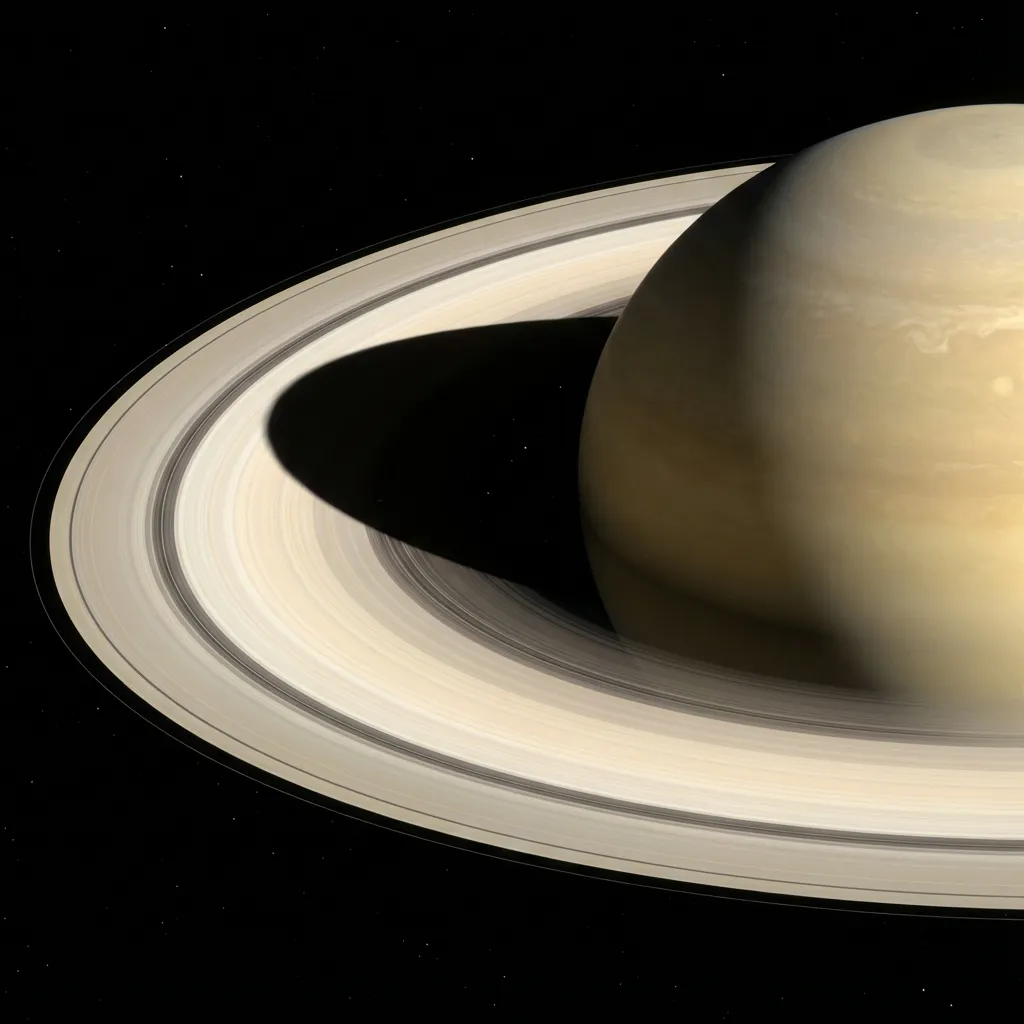
Through a telescope, Saturn looks impossible. A giant floating planet surrounded by perfect, solid frisbees of light. Galileo saw them first (1610), but his telescope was so bad he thought Saturn had "ears" or handles. We now know they are not solid. The rings are made of billions of chunks of Ice. Some are as small as dust. Some are as big as a bus. They are essentially a massive snowstorm trapped in orbit.
The Roche Limit (The Doom Line)
Where did they come from? Saturn is a bully. There is an invisible line around every planet called the Roche Limit. If a moon gets too close, the planet's gravity pulls on the front of the moon harder than the back. The moon stretches. It groans. And finally... Crack. It shatters into a billion pieces. Scientists think Saturn used to have a big icy moon that wandered too close about 100 million years ago. Saturn ripped it apart and smeared the wreckage into a ring. This means the rings are young. Dinosaurs might have looked up at a ringless Saturn. And in another 100 million years, the rings will fall into the planet and vanish. We are lucky to be alive at the exact right time to see them.
Razor Thin
The most shocking thing about the rings is how thin they are. The rings are 175,000 miles wide. (They would barely fit between Earth and the Moon). But they are only 30 feet thick. That is thinner than a 2-story house. If you built a scale model where the rings were as wide as a football field, the ring itself would be 1,000 times thinner than a sheet of paper. That is why, when Saturn tilts sideways every 15 years, the rings seem to vanish. We are looking at them edge-on, and they are invisible.
The Shepherd Moons
Why do the rings stay in neat lanes? Why don't they spread out into a mess? Because of Shepherd Moons. Tiny moons (like Pan and Daphnis) orbit inside the gaps in the rings. Their gravity acts like a sheepdog.
- If an ice chunk drifts too far inside, the moon speeds it up and pushes it back.
- If it drifts too far outside, the moon slows it down. They herd the ice particles into sharp, defined bands. Some moons even create 2-mile high "waves" of ice as they plow through the ring material.
The Hexagon
If you look at Saturn's North Pole, you see something impossible. Geometry. There is a giant storm—twice the size of Earth—that is shaped like a perfect Hexagon (6 sides). It has straight lines. Clouds shouldn't make straight lines. Scientists were baffled for decades. Computer models now show that it is a "Standing Wave" caused by different jet streams rubbing against each other at different speeds. It is a storm that has been spinning in a perfect geometric shape for at least 40 years. It proves that chaos can create order.
Fast Facts
- The Rain: The rings are "raining" onto Saturn. Gravity is slowly pulling the dusty ice down into the atmosphere. It rains about 2,000 pounds of ring-water every second.
- Other Rings: Saturn isn't special. Jupiter, Uranus, and Neptune all have rings too! But theirs are made of dark dusty rock (Charcoal), so they are almost invisible. Saturn's are made of fresh, reflective ice, which makes them shine.
- Cassini: In 2017, the Cassini spacecraft ended its mission by diving through the gap between the rings and the planet (The Death Dive). It tasted the ring rain before burning up in the atmosphere.
Diagram Prompts
- Roche Limit: A Diagram showing a moon getting too close to a planet. Step 1: Round Moon. Step 2: Oval Moon (Stretching). Step 3: Shattered debris (The Ring). Label: "The Gravity Grinder."
- Scale Model: A Football field. A single sheet of tissue paper lying on the 50-yard line. Label: "Ratio: 175,000 miles wide, 30 feet thick."
- Shepherd Moon: A tiny moon orbiting in a black gap between two white rings. The moon is creating ripples/wakes in the ice like a boat. Label: "Herding the Ice."