
Solar Eclipses: The Cosmic Coincidence
The Cosmic Coincidence
A Total Solar Eclipse is the most terrifying and beautiful sight in nature. The sky turns black in the middle of the day. The stars come out. The birds stop singing. A hole appears in the sky where the sun should be. But scientifically, it shouldn't happen. It relies on a one-in-a-billion coincidence.
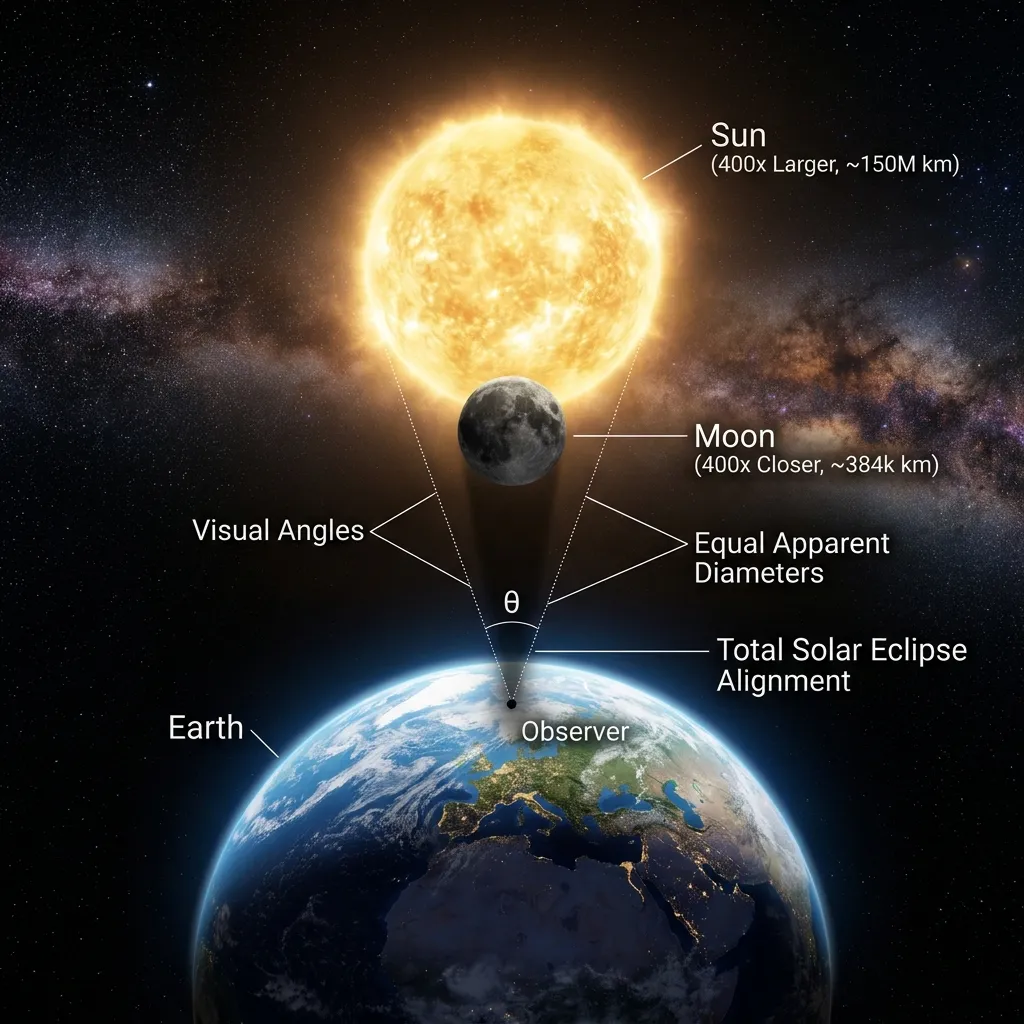
- The Sun is massive (400 times wider than the Moon).
- The Moon is tiny. But the Sun is exactly 400 times farther away. This math ($400/400 = 1$) means they look exactly the same size in the Earth's sky. If the Moon were smaller, it would just be a black dot (Transit). If it were bigger, it would block everything. Because the fit is perfect, the Moon blocks the bright disk but leaves the Sun's ghostly atmosphere visible.
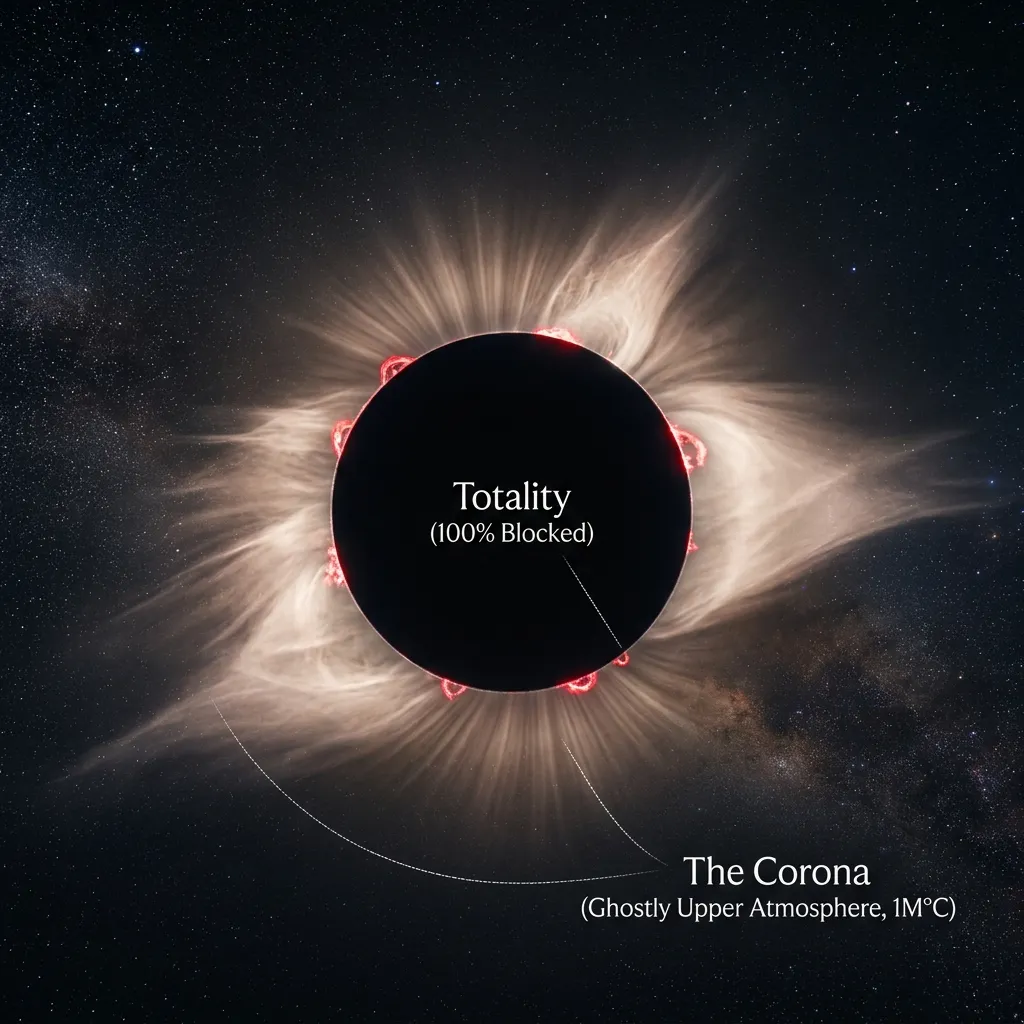
The Corona (The Crown)
When the Moon covers the Sun, a wispy white halo erupts around the black hole. This is the Corona. It is the Sun's upper atmosphere. It is always there, but usually, the Sun is too bright to see it. The Corona is a mystery. The surface of the Sun is 6,000°C. But the Corona is 1 Million Degrees. It is like walking away from a campfire and finding that the air gets hotter. Scientists think twisting magnetic fields are whipping the plasma to insane speeds. An eclipse is the only time we can study it easily from Earth.
Why Don't We Have One Every Month?
The Moon orbits the Earth every 28 days. So shouldn't the Moon pass in front of the Sun once a month? Why are eclipses rare? Because the Moon is Tilted. The Moon's orbit is tipped 5 degrees compared to the Earth-Sun orbit. Most months, the Moon passes a little too high or a little too low to block the Sun. Imagine holding a coin up to block a lightbulb. If you move it up or down by an inch, you miss. Only twice a year do the orbits cross perfectly (Eclipse Season). And because the Moon's shadow is tiny (only 100 miles wide), you have to be in the exact right spot on Earth to see it.
The Future
Enjoy eclipses while you can. The Moon is drifting away from Earth at 1.5 inches per year. In about 600 million years, it will be too far away to cover the Sun. It will look too small. There will be no more Total Eclipses. Only "Annular" (Ring of Fire) eclipses. We are living in the golden age of astronomy.
The Columbus Trick
In 1504, Christopher Columbus was stranded in Jamaica. His crew was hungry. The native Arawak people refused to give them more food. Columbus looked at his almanac (a book of star charts). He saw that a Total Lunar Eclipse was coming that night. He told the Arawak Chief: "My God is angry. He will make the moon bleed tonight." That night, the moon turned blood red (the Earth's shadow). The Arawaks were terrified. They ran to the ships with food, begging him to bring the light back. Columbus waited until the eclipse was ending, then said "My God forgives you." He used astronomy as a weapon.
Fast Facts
- Baily's Beads: Right before the eclipse becomes total, tiny beads of light sparkle around the edge of the black moon. This is sunlight shining through the valleys and mountains on the Moon's jagged surface.
- Animal Confusion: During an eclipse, nature panics. Crickets start chirping. Cows lay down to sleep. Spiders take down their webs. They all think it is sudden night.
- Einstein's Proof: The Eclipse of 1919 made Einstein famous. Astronomers used the darkness to photograph stars near the Sun. They saw the starlight bending around the Sun's gravity, proving General Relativity was correct.
Diagram Prompts
- The Syzygy: An alignment diagram. Sun -> Moon -> Earth. Show the Moon's conical shadow hitting a tiny spot on Earth. Label: "The Perfect Alignment."
- The Tilt: A side view of the orbits. Earth in the middle. The Moon's orbit shown as a tilted hula hoop. Show the Moon passing Above the Sun (No Eclipse). Label: "The 5-Degree Miss."
- Size Illusion: Visual math equation. Giant Sun (Far Away) = Tiny Moon (Close Up). A dotted line showing how they subtend the exact same angle to the eye on Earth. Label: "Ratio 400:1."