
The Trash Cage

Humanity has a bad habit. Wherever we go, we leave trash. We climbed Mt. Everest, and now it is covered in empty oxygen bottles. We dove to the bottom of the ocean, and we found plastic bags. We went to space, and now Earth is surrounded by a cloud of 100 million bullets. This is Space Junk. It includes dead satellites, spent rocket boosters, frozen pee, and even a spatula dropped by an astronaut in 2006.
The Kessler Syndrome
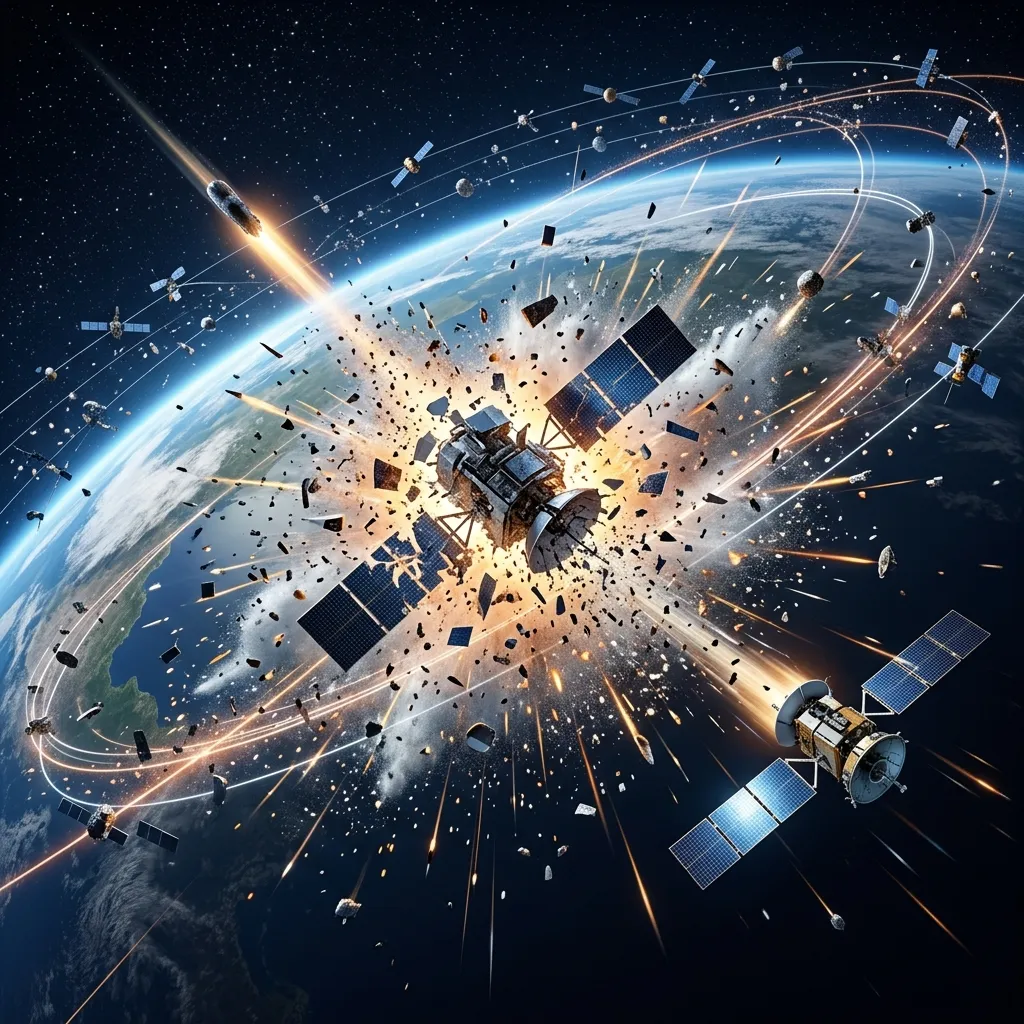
In 1978, NASA scientist Donald Kessler predicted a nightmare scenario. In space, objects travel at 17,500 mph. At that speed, a fleck of paint hits with the force of a bowling ball. A screw hits like a grenade. If two satellites collide, they don't just dent. They shatter into thousands of pieces of shrapnel. Those pieces fly off like shotgun pellets, hitting other satellites, which shatter into more pieces. This is a Chain Reaction. If it goes too far, Low Earth Orbit will become so filled with flying shrapnel that we will be trapped on Earth. No GPS. No Weather Satellites. No Mars missions. We effectively "brick" our own planet.
The Cleanup Crew
How do we fix it? We can't just send a garbage truck. The trash is moving faster than a bullet. Engineers have proposed some wild ideas:
- Laser Brooms: A ground-based laser zaps a piece of junk. It doesn't melt it; it vaporizes a tiny layer of metal. This puff of gas acts like a rocket thruster, pushing the junk slowing it down so it falls into the atmosphere and burns up.
- Space Harpoons: A satellite fires a harpoon into a dead satellite and drags it down to burn up.
- Net Capture: Literally throwing a giant fishing net around a spinning rocket booster. So far, we prove the technology works, but no one wants to pay for it.
Point Nemo
When big satellites (like the ISS) die, we crash them on purpose. We aim for the most remote place on Earth: Point Nemo in the South Pacific Ocean. It is the "Spacecraft Cemetery." It is so far from land (1,600 miles) that the nearest humans are often the astronauts on the ISS flying overhead. Hundreds of dead spaceships are sitting on the ocean floor right now, rusting in the dark.
The Day We Nuked Space
We didn't just accidentally break space. We did it on purpose once. In 1962, the US Military detonated a 1.4 Megaton Hydrogen Bomb in space (Operation Starfish Prime). They wanted to see if they could destroy Soviet missiles. It worked... too well. The explosion created an electromagnetic pulse (EMP) that wiped out 1/3 of all satellites in orbit instantly. It also created a new radiation belt that stayed there for years, frying any new satellite that tried to pass through. We accidentally built a radiation wall around our own planet. We promised never to do it again (Outer Space Treaty).
Fast Facts
- The Glove: In 1965, astronaut Ed White dropped a glove. It drifted away and orbited Earth at 17,000 mph for a month before burning up. During that time, it was the most dangerous piece of clothing in history.
- Bulletproof Windows: The windows on the ISS are made of 4 layers of heavy glass. They are constantly pitted by tiny impacts from dust and paint chips. If a bigger piece hits, they have emergency shutters to seal the module before the air rushes out.
- Orbit Decay: Space isn't a perfect vacuum. There is a tiny bit of air. Over decades, this air friction slows junk down, causing it to spiral inward and burn up. The sun helps! When the sun is active (Solar Max), the atmosphere puffs up, creating more drag and cleaning the sky faster.