
Telescopes: The Time Machine
The Time Machine
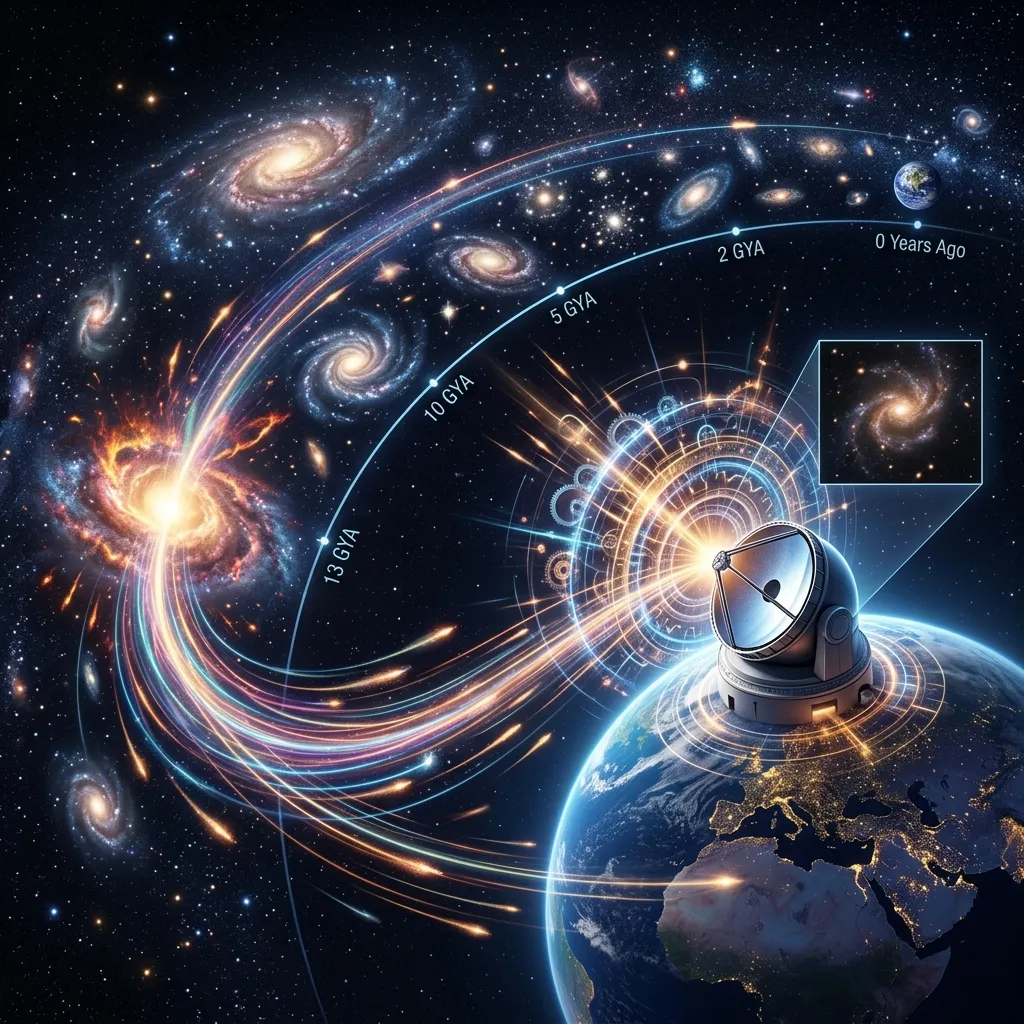
A telescope is not just a zoom lens. It is a Time Machine. When you look at the Moon, you see it as it was 1.3 seconds ago. When you look at Saturn, you see it as it was 80 minutes ago. When you look at the Andromeda Galaxy, you see it as it was 2.5 million years ago. You are looking at light that left the stars before humans even existed. The telescope allows us to see the history of the universe.
The Bucket of Light
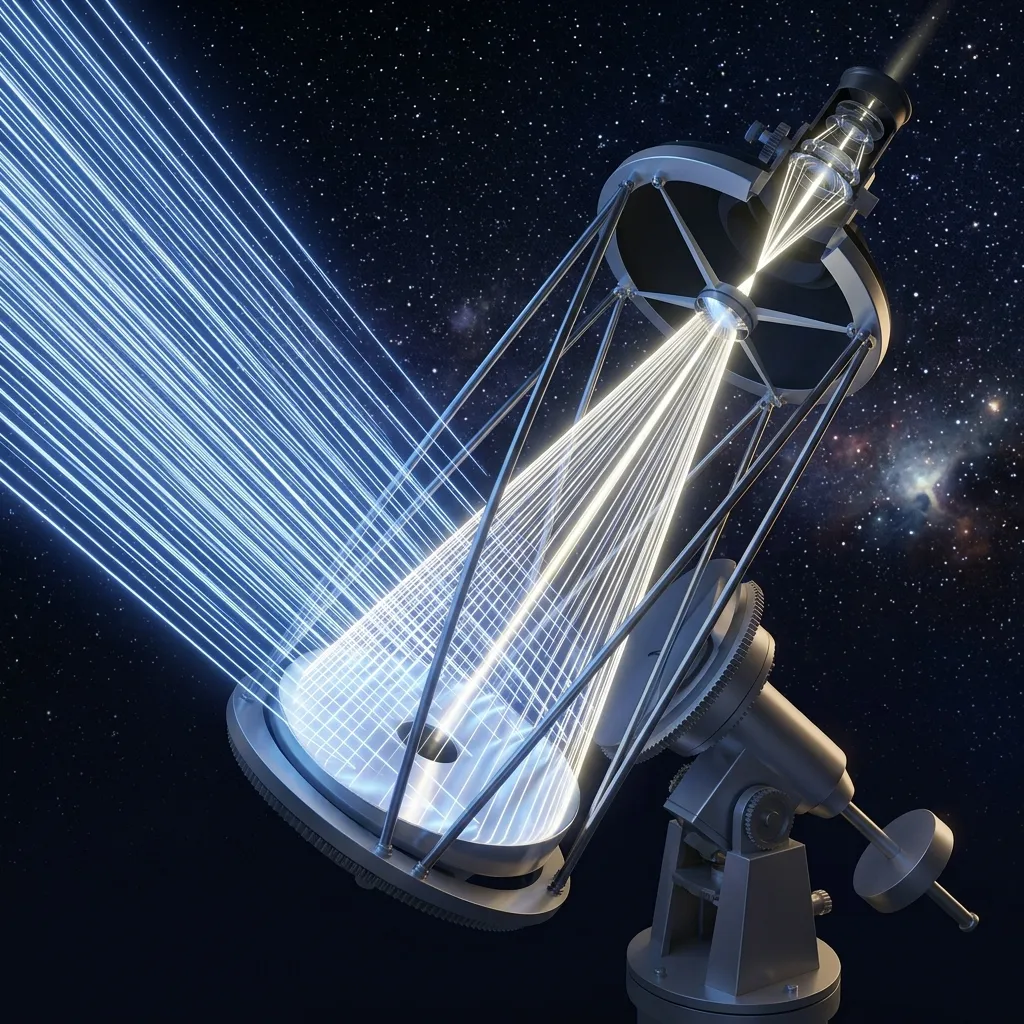
People think telescopes are about "Magnification" (Zoom). Wrong. If you zoom in on a blurry, dark image, you just get a big, blurry, dark image. The most important job of a telescope is Light Gathering. Think of your eye as a bucket. It is tiny (7mm wide). It can only catch a few drops of starlight. A telescope is a giant bucket. A 10-inch telescope can catch 1,000 times more light than your eye. It makes invisible things visible. This is why astronomers want huge telescopes. The James Webb Space Telescope has a mirror 21 feet wide made of pure gold-plated Beryllium.
Lens vs. Mirror
There are two ways to catch light:
- Refractor (Lens): Invented by Hans Lippershey (and use by Galileo). It uses a curved glass lens to bend light to a point.
- Problem: Glass is heavy. You can't make a lens bigger than 1 meter, or it sags. Also, glass acts like a prism and separates colors (Purple halos).
- Reflector (Mirror): Invented by Isaac Newton. It uses a curved mirror at the bottom of a tube.
- Advantage: Mirrors are light. You can make them huge. They reflect all colors perfectly. Almost all modern research telescopes are Reflectors.
The Atmosphere Problem
Why do we put telescopes in space? Is it to get closer to the stars? No. Being 300 miles closer to a star that is 100 trillion miles away doesn't matter. We do it to escape the Atmosphere. Air acts like a swimming pool. It wobbles. This wobbling makes stars "Twinkle." Twinkling is bad for science. It blurs the image. A space telescope (like Hubble) sees rock-steady, razor-sharp images because there is no air to distort the light.
Adaptive Optics: Laser Wars
Building space telescopes is expensive. So we invented a trick for ground telescopes called Adaptive Optics. We shoot a powerful Laser into the sky. It creates a fake "Artificial Star" in the upper atmosphere. A computer watches this laser star twinkle. It calculates exactly how the air is distorting the light 1,000 times a second. Then, it physically warps the telescope's mirror using tiny pistons to cancel out the distortion. It "un-twinkles" the stars.
The Camera the Size of Earth
In 2019, we wanted to take a picture of a Black Hole. But Black Holes are tiny and dark. We needed a telescope the size of Planet Earth to see it. We couldn't build one that big. So we used a trick (Interferometry). We linked up 8 radio telescopes all over the world (Hawaii, Chile, Antarctica, Spain). They all looked at the black hole at the exact same split-second (synchronized by atomic clocks). As the Earth rotated, they filled in the gaps. The result was the famous orange donut image of M87. We effectively turned the entire globe into one giant glass eye.
Fast Facts
- Galileo: He didn't invent the telescope (Dutch spectacle makers did). But he was the first to point it up. He saw craters on the Moon, moons orbiting Jupiter, and spots on the Sun. He proved the Earth was not the center of the universe.
- Radio Telescopes: Not all light is visible. Radio waves are light too. Radio telescopes look like giant satellite dishes (like Arecibo). They listen to the whispers of black holes.
- Looking Back: The farthest we can see is the "Cosmic Microwave Background." It is the afterglow of the Big Bang itself. It is a wall of fire that marks the edge of the visible universe, 13.8 billion years ago.
Diagram Prompts
- Refractor vs Reflector: Split screen. Left: Galileo's Telescope (Glass Lens at front). Light bending to eyepiece. Right: Newton's Telescope (Mirror at back). Light bouncing to side eyepiece. Label: "Lens vs. Mirror."
- The Light Bucket: Comparison. Human Eye: A tiny cup catching rain (Light). Telescope: A giant swimming pool catching rain. Label: "Gathering Photons."
- Adaptive Optics: A telescope shooting a Laser Beam up. The Mirror at the bottom is shown bending/wobbly (with pistons underneath). Label: "Un-Twinkling the Stars."