
Bending the Fabric of Space
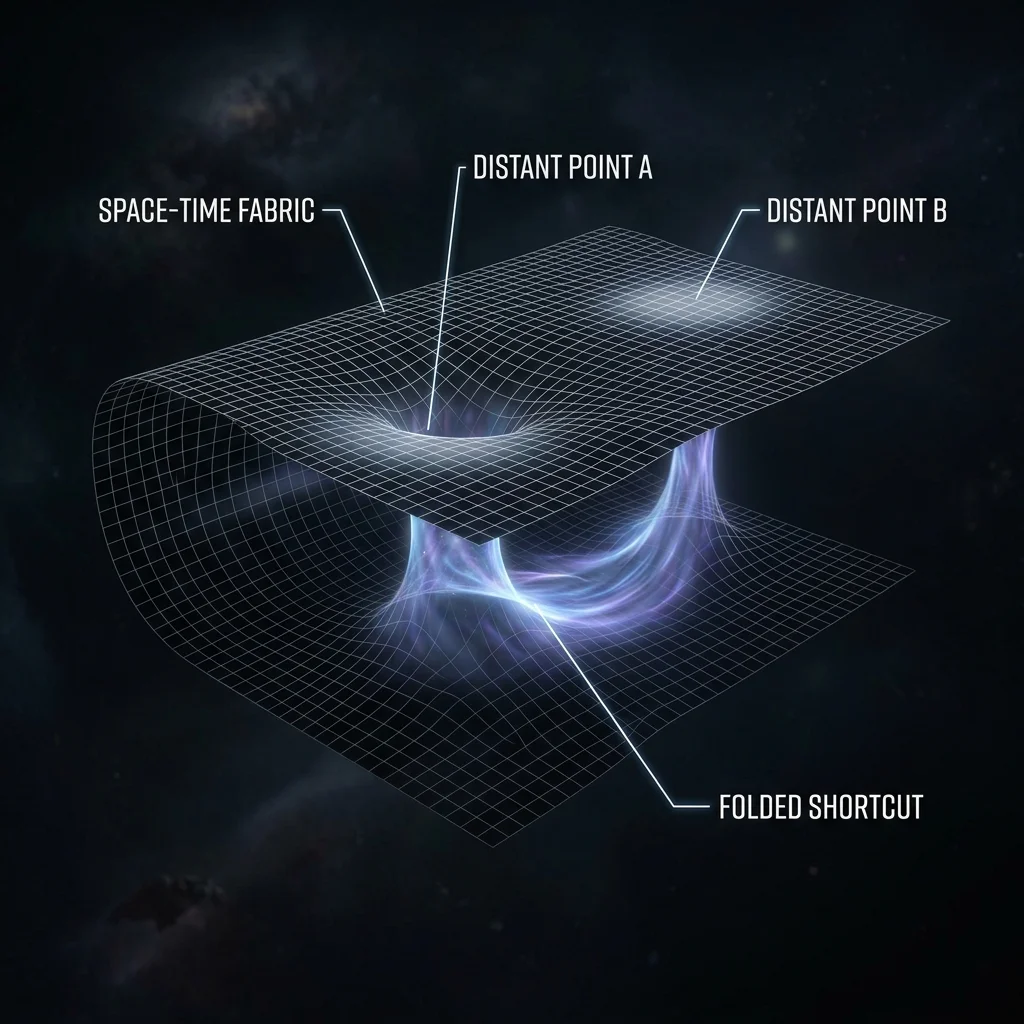
Imagine you wish to travel from one side of a vast, flat sheet of paper to the other. The quickest path is a straight line across the surface. However, if you were to fold that paper in half so the two distant points touched, you could simply step from one to the other instantly.
This is the fundamental principle behind a wormhole. In the universe, space and time are not a void, but a flexible fabric. A wormhole represents a theoretical shortcut where two distant regions of the cosmos are folded together, connected by a tunnel that bypasses the millions of light-years of empty space between them.
The Geometry of a Sphere
In popular science fiction, wormholes are often depicted as flat, swirling mirrors or glowing rings. However, if you were to encounter a real wormhole in deep space, it would look much more like a shimmering, translucent crystal ball.
Because we live in a three-dimensional world, a "hole" in space cannot be a flat circle. Just as a hole in a two-dimensional piece of paper is a one-dimensional circle, a hole in our three-dimensional universe must be a three-dimensional sphere. As you approached it, you would see a distorted, beautiful reflection of a distant part of the universe shimmering inside the sphere’s surface, visible from every possible angle.
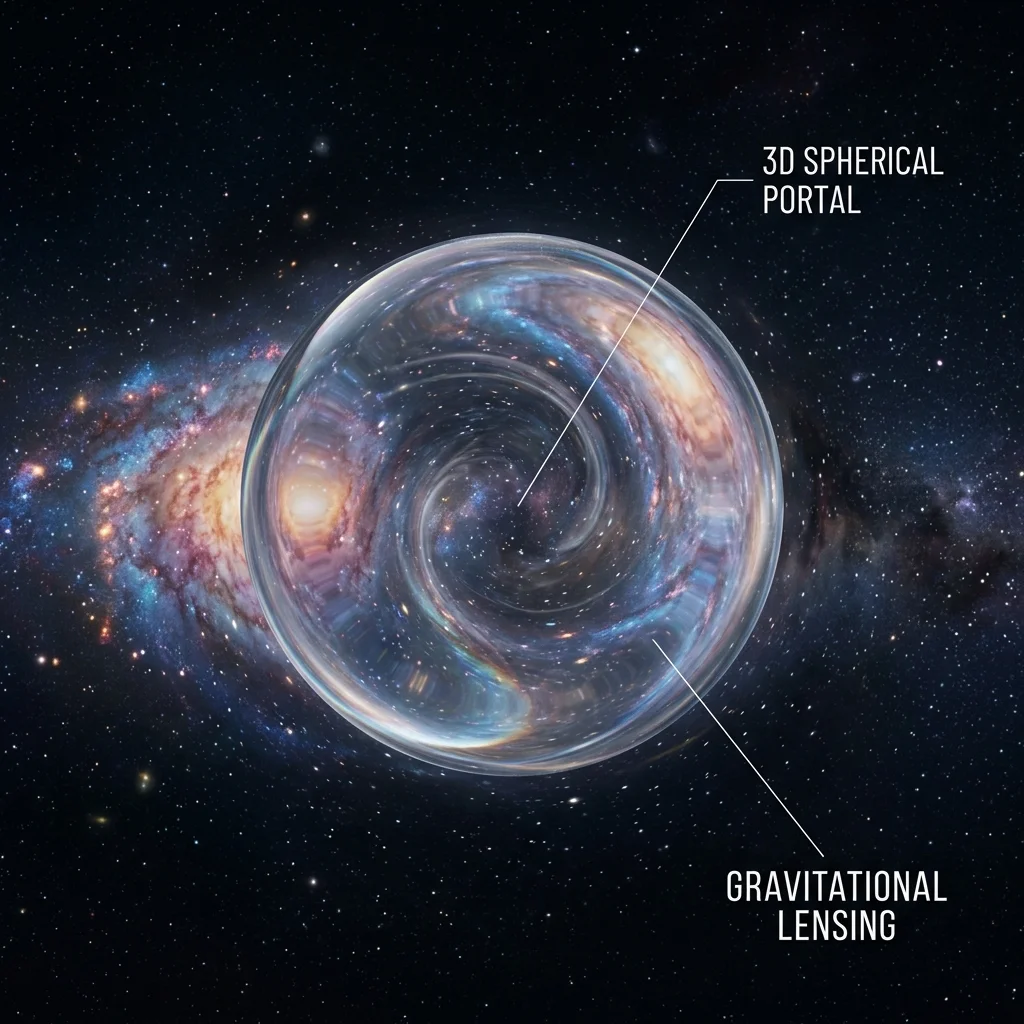 Depiction of a 3D spherical wormhole floating in space
Exotic Matter: The Cosmic Scaffolding
While the mathematics of Albert Einstein’s theories allow for the existence of these shortcuts—originally called Einstein-Rosen Bridges—they come with a significant catch. Gravity is a relentless force that naturally wants to pull things together. Without interference, a wormhole would be violently unstable, snapping shut the moment it formed.
To keep the "throat" of the tunnel open for travel, physicists believe we would need a substance called exotic matter. Unlike the matter that makes up our bodies and stars, exotic matter possesses "negative energy density." This allows it to exert a powerful repulsive force—essentially anti-gravity—that would act as a structural scaffold, pushing the walls of the wormhole outward and preventing them from collapsing.
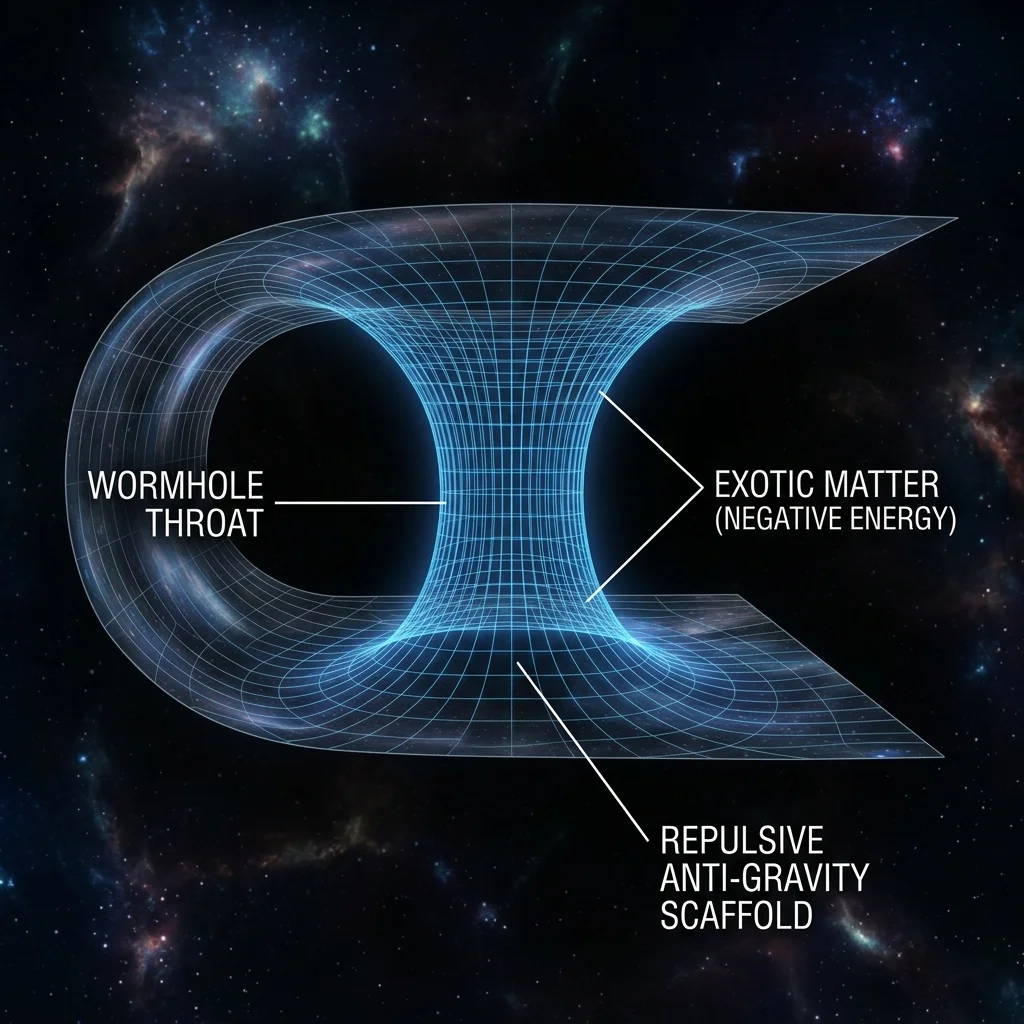 Cross-section of the stable throat of a wormhole lined with exotic matter
A Gateway Through Time
Because space and time are inextricably linked in a single fabric called space-time, a wormhole isn't just a shortcut through distance; it is a shortcut through time.
If one end of a wormhole were moved near a region of intense gravity, such as a black hole, time would pass more slowly at that entrance compared to the other. This creates a bridge between two different points in time. A traveler could theoretically step into the wormhole today and emerge at the other end decades in the future—or even in the past. While this introduces mind-bending paradoxes, it remains one of the most intriguing possibilities allowed by the laws of physics.
Fast Facts
- The Scent of Space: While space itself is a vacuum, astronauts returning from spacewalks often describe the smell of the airlock as "seared steak" or "hot metal," likely caused by high-energy particles clinging to their suits.
- Quantum Foam: Some theories suggest that microscopic wormholes are appearing and disappearing every billionth of a second all around us at a subatomic scale, a phenomenon known as "quantum foam."
- The White Hole: Some physicists hypothesize that if a black hole is a one-way entrance, a "white hole" might be the exit—a region where matter and light are expelled with incredible force, but nothing can ever enter.
- Interstellar Accuracy: The visual depiction of the wormhole in the film Interstellar was based on real mathematical equations provided by physicist Kip Thorne, making it one of the most accurate scientific visualizations ever put on screen.