
The Illusion of Zero Gravity
While colloquially known as "zero gravity" or "Zero-G," the term represents a profound misconception. Space is entirely governed by gravity. In fact, if you were aboard the International Space Station (ISS), orbiting approximately 250 miles above the terrestrial surface, you would be well within Earth's powerful gravitational grip. At that altitude, gravity remains roughly 90% as strong as it is at sea level.
If an architectural marvel could construct a tower reaching 250 miles into the sky, a person standing at its apex would weigh almost exactly the same as they do on the ground.
So, if gravity is actively pulling on them, why do astronauts appear to float? The answer is elegantly simple, yet deeply counterintuitive: they are falling.
Isaac Newton's Celestial Cannonball
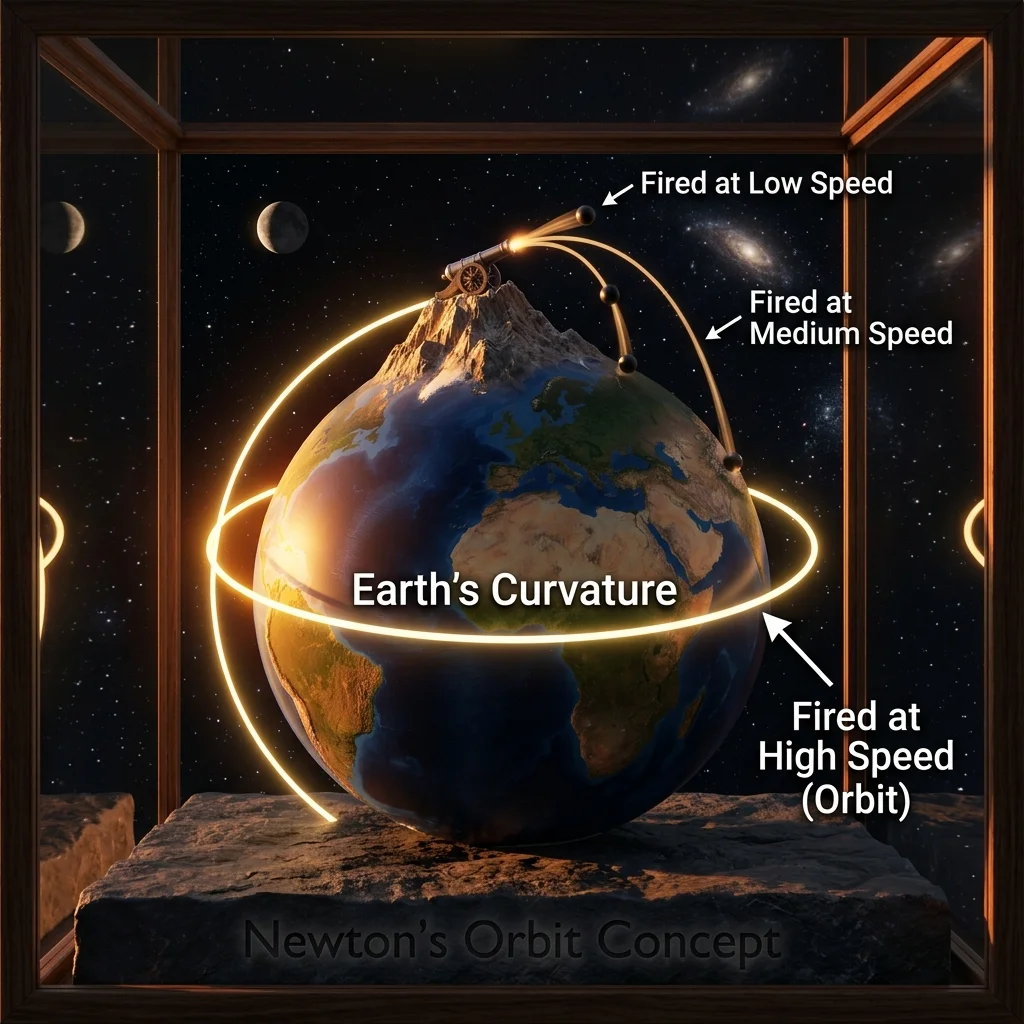
In the 17th century, Sir Isaac Newton conceptualized the mechanics of orbit through a simple thought experiment without ever leaving his garden. He imagined an immensely powerful cannon positioned atop a towering mountain.
- Shot 1: Fired with a gentle force, the cannonball is pulled down by gravity, striking the Earth relatively quickly.
- Shot 2: Fired with greater velocity, the cannonball travels much further horizontally before gravity eventually arcs it down to the surface.
- Shot 3: Fired at an astonishing orbital velocity of approximately 17,500 miles per hour, an extraordinary phenomenon occurs.
Gravity continues to pull the cannonball downward at the exact same rate. However, because of its immense horizontal speed, the cannonball travels so fast that the spherical surface of the Earth curves away beneath it. The object is perpetually falling toward the planet, but it consistently misses the ground.
This is the essence of an orbit: a permanent state of falling and missing. The astronauts, the ISS structure, and every item floating within the cabin are all hurtling through space, falling together at identical speeds.
The Parabolic Aircraft
You do not require a multi-billion-dollar launch vehicle to experience the sensation of freefall. Aerospace training facilities utilize specialized aircraft, famously nicknamed the "Vomit Comet," to simulate the experience of microgravity using terrestrial physics.
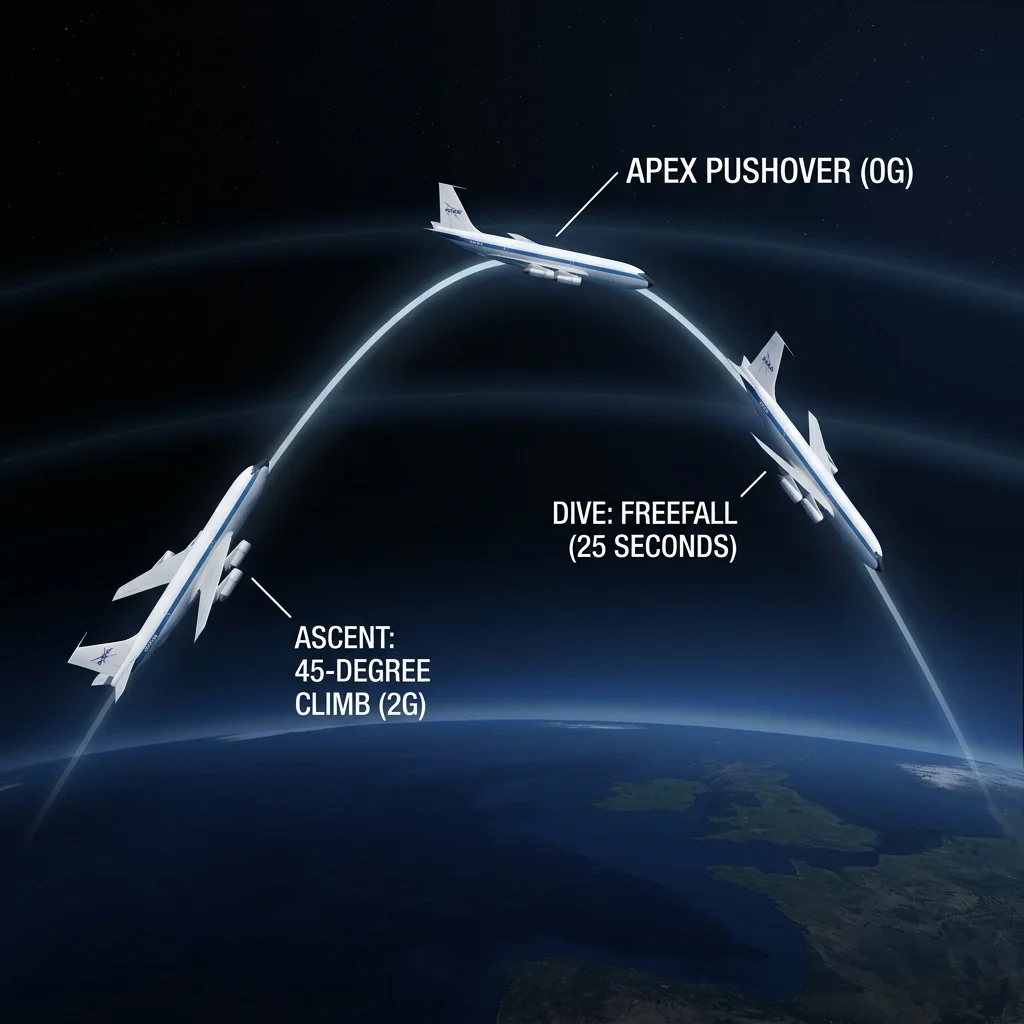
The process involves flying in a precise, roller-coaster-like trajectory known as a parabola:
- The Ascent: The aircraft ascends steeply at a 45-degree angle. During this intense climb, passengers experience a gravitational force up to twice their normal weight (2G).
- The Pushover: Reaching the apex of the curve at roughly 30,000 feet, the pilots dramatically reduce engine thrust and pitch the nose downward.
- The Dive: For the subsequent 25 seconds, the aircraft essentially falls toward the Earth.
During this controlled dive, the aircraft and its occupants fall at the exact same rate. Inside the cabin, gravity essentially "disappears." Trainees unbuckle and float effortlessly, experiencing true weightlessness. Before reaching a dangerous altitude, the pilots pull up, immediately re-introducing the crushing weight of normal gravity, and the cycle repeats.
Biological Adaptations
While spaceflight is a pinnacle of human engineering, the human body evolved under the strict physiological constraint of Earth's 1G environment. Removing that constant downward force plunges biological systems into acute distress.
Fluid Redistribution
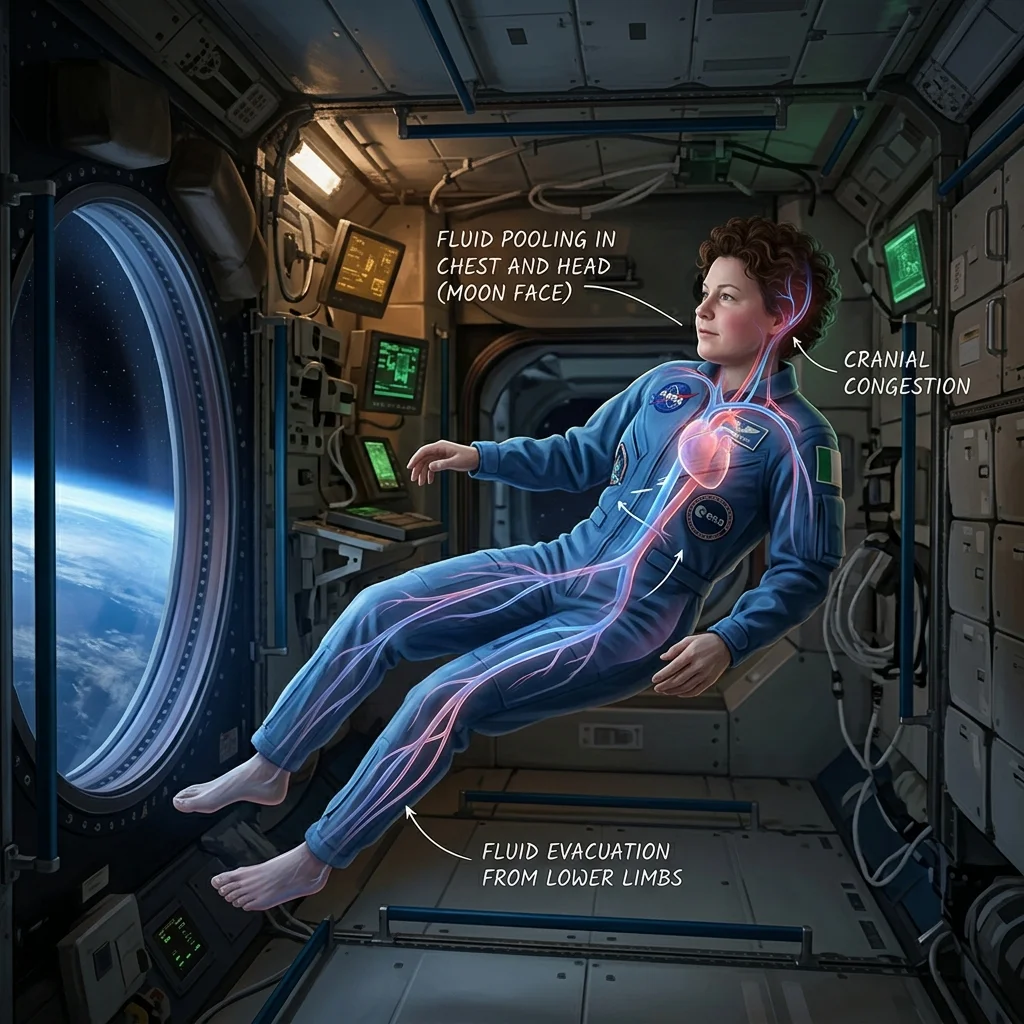
On Earth, gravity acts as a relentless anchor, pulling bodily fluids down toward the legs. The human cardiovascular system acts as a high-powered pump fighting this gravity to circulate blood back to the cerebral cortex.
In a microgravity environment, this downward resistance vanishes instantly. The heart continues pumping with immense force, driving localized fluids rapidly upward into the chest and cranial cavity.
This results in profound physical changes:
- Facial Swelling: Astronauts frequently exhibit what is known as "moon face," where the face becomes visibly swollen and flushed due to fluid pooling.
- Muscular Atrophy in Limbs: Conversely, the legs lose significant volume as fluid rapidly evacuates the region.
- Sensory Suppression: The fluid shift causes severe congestion in the sinus cavities. Astronauts suffer from a semi-permanent "space cold," drastically diminishing their sense of taste and smell. This is why orbital food is often heavily spiced with hot sauce.
The Reabsorbing Skeleton
The human skeletal system is remarkably efficient; it only maintains the density required to support its usual physical loads. Earth's gravity demands constant, low-level structural support simply to stand upright.
In freefall, the skeleton senses an immediate lack of mechanical stress. Operating on an evolutionary mandate of efficiency, the body determines the heavy calcium framework is no longer necessary and begins to dismantle it. The body literally begins to flush vital calcium from its system.
Without intervention, an astronaut loses approximately 1% of their total bone density per month. Upon arriving at a distant destination like Mars, without heavy mitigation, a crew would arrive suffering from severe, osteoporosis-like bone fragility. To counteract this, modern astronauts are strapped into specialized resistance treadmills with bungee cords, exercising vigorously for two and a half hours every single day.
Weird Physics: Fire and Water
Fundamental physical behaviors warp under the conditions of microgravity, challenging basic intuition.
Water: On Earth, spilled water collapses into a puddle under the influence of gravity. In space, the cohesive forces of molecular surface tension dominate. Water molecules grip one another, pulling the liquid into structurally perfect, wobbly spheres. You cannot physically "pour" a liquid; instead, fluids adhere stubbornly to any surface they touch. If an astronaut cries, tears do not stream down their face. They coalesce into large, stinging globes of saltwater over the eyes until physically removed with an absorbent cloth.
Fire: On Earth, the heat of a flame causes surrounding air to expand and rise (convection). This upward draft draws fresh, oxygenated air into the base of the fire, crafting the distinctive, flickering teardrop shape of a flame.
In microgravity, there is no "up" or "down" for hot air to rise toward. A candle flame forms a perfect, dim blue sphere. Without convective drafts to supply fresh air, the flame rapidly surrounds itself in a suffocating bubble of its own carbon dioxide exhaust. Without an external fan pushing oxygen into the reaction, the flame burns slowly and quietly extinguishes itself.
Fast Facts
- Spinal Expansion: Stripped of gravity's compressing weight on spinal discs, the human spine naturally relaxes and expands. Astronauts can grow up to 2 inches taller during a mission, returning to their normal height shortly after returning to Earth.
- The Scent of Space: Astronauts frequently describe space as having a distinct metallurgical scent. Once they remove their helmets inside the pressurized airlock, they perceive the odor of seared steak, hot metal, and welding fumes, caused by trace amounts of high-energy atomic oxygen reacting with the exterior of their spacesuits.
- Sleeping Quarters: Sleep requires deliberate restraint. To avoid floating aimlessly into heavy instrumentation or drifting into dead-air pockets, astronauts fasten themselves into sleeping bags affixed securely to the cabin walls. Furthermore, they must sleep near ventilation fans to ensure their expelled carbon dioxide is dispersed, preventing a localized, suffocating bubble of exhaled gas from coalescing around their faces.