
Locks and Keys: The Puzzle in Your Door
The Cheating Stick
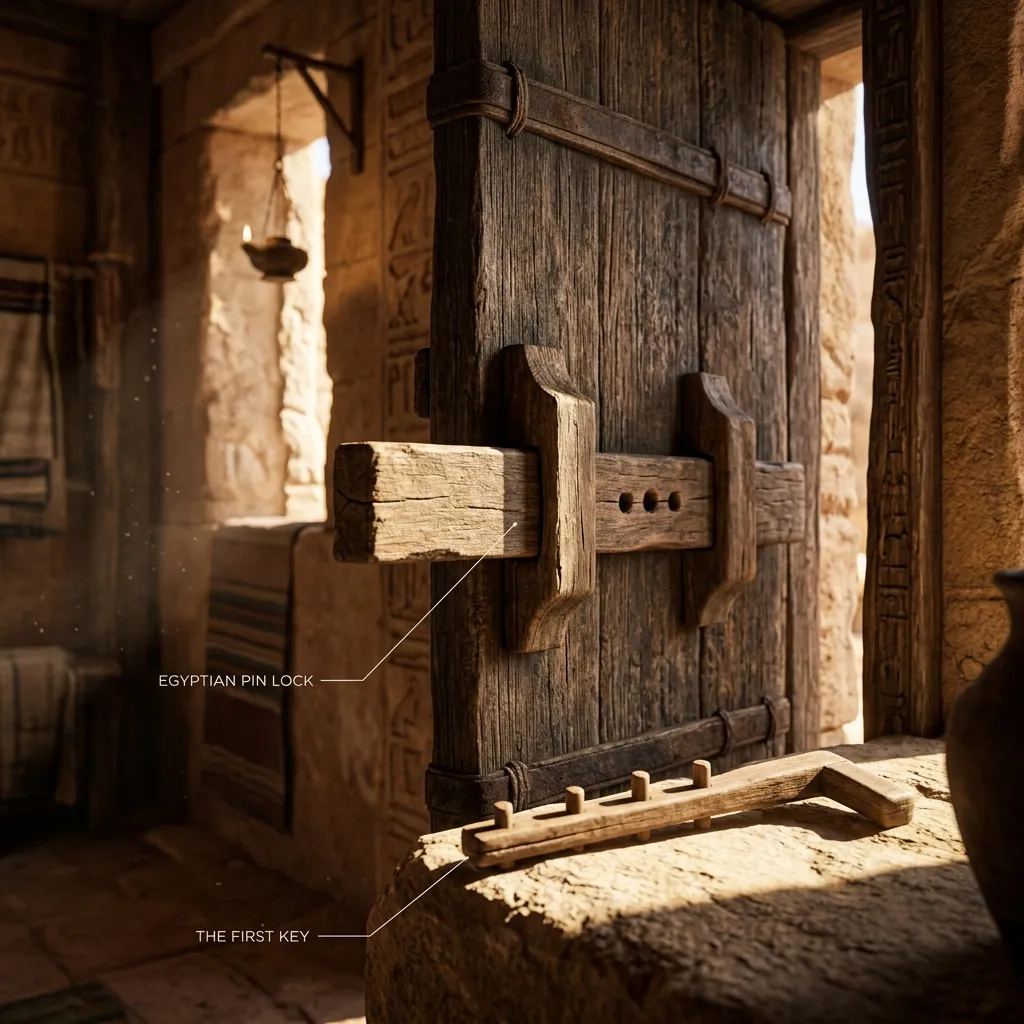
A lock is simply a mechanical puzzle. To open it, you generally solve the puzzle using a specialized tool: The Key. The most common lock in the world is the Pin Tumbler. It was invented in ancient Egypt (made of wood) but perfected by Linus Yale (yes, Yale University locks) in 1848. It relies on a single, brilliant concept: The Shear Line.
How It Works: The Pins
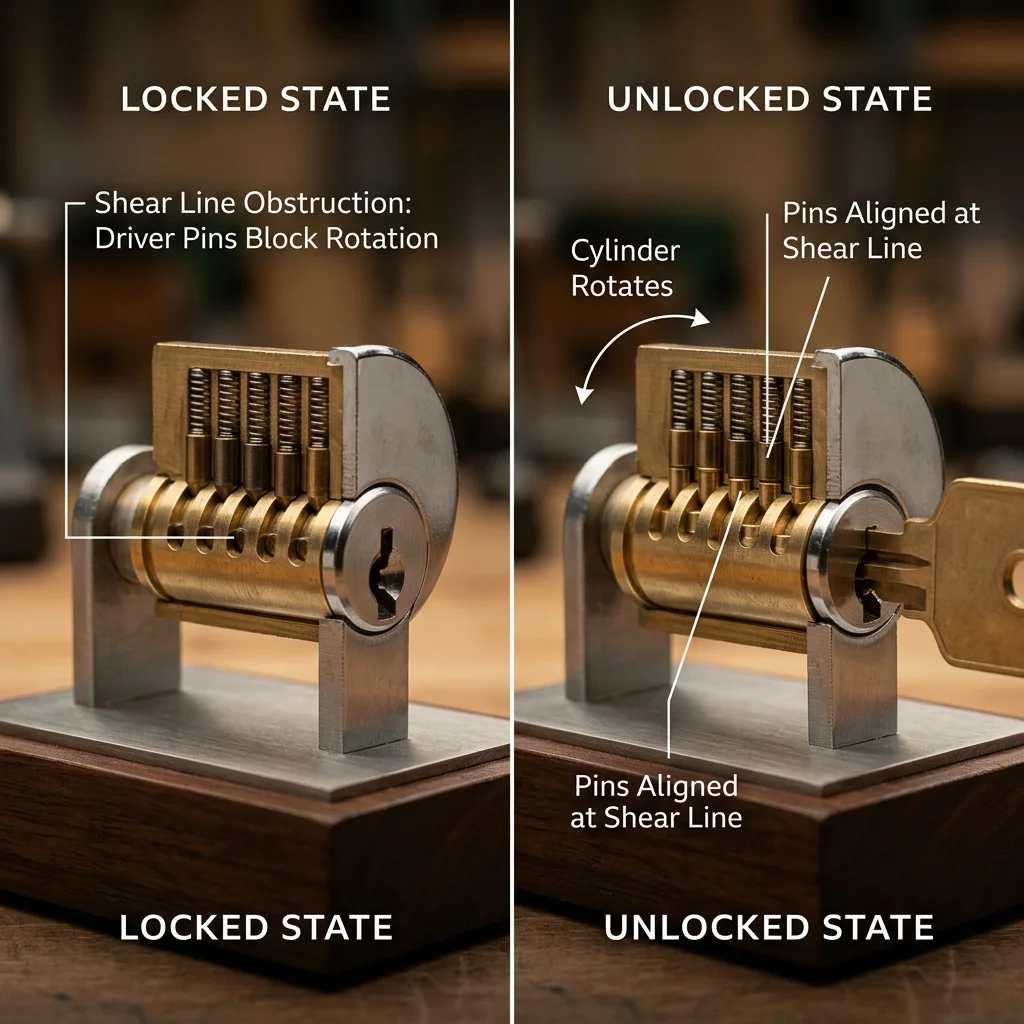
Inside the lock cylinder, there is a row of 5 vertical shafts. In each shaft, there is a stack of two metal pins sitting on a spring:
- The Driver Pin (Top): Usually blue. It pushes down.
- The Key Pin (Bottom): Usually red. It touches the key. Locked State: When there is no key, the springs push the Driver Pins halfway down into the cylinder plug. They act like a stick in a bicycle wheel. The cylinder is blocked and cannot turn. Unlocked State: When you slide the key in, the saw-tooth pattern lifts the pins. If it is the Right Key, it lifts every pin stack to the exact height where the gap between the Top and Bottom pins aligns perfectly with the edge of the cylinder. This creates a straight, unobstructed line: The Shear Line. The interruption is gone. The cylinder turns. The door opens.
Lock Picking: The Tension Wrench
How do spies pick locks in movies? Do they have a magic key? No. They exploit a manufacturing flaw. No lock is perfect. The holes are never drilled perfectly straight.
- Tension: The spy inserts a "Tension Wrench" to apply slight rotational pressure. This creates a tiny "ledge" inside the hole.
- Picking: They insert a pick and lift the pins one by one.
- The Click: When a pin reaches the shear line, the twisted cylinder catches it on the ledge. Click. The pin stays "set" up there.
- Repeat: They do this for all 5 pins.
- Open: Once all pins are set, the cylinder turns. It isn't magic; it is just patience, geometry, and a steady hand.
The Master Key Mystery
How does a High School Janitor have one key that opens every classroom, but the Teacher's key only opens one room? Do they have a skeleton key? No. The locks are special. Master-keyed locks have a Third Pin (a tiny wafer) in the stack. This creates Two Shear Lines.
- Shear Line A: Opens with the Teacher's Key (Normal height).
- Shear Line B: Opens with the Master Key (Higher height). Both keys work on the same lock.
- The Risk: Master-keyed locks are much easier to pick because there are twice as many "Winning Combinations" to find.
The Future: Invisible Keys
Hotels don't use metal keys anymore. They use plastic cards (RFID). How does it work? Inside the card is a tiny copper antenna (but no battery). When you tap it on the door, the lock shoots a burst of radio energy. This energy wakes up the chip in the card (Induction). The card uses that power to shout a password: "I am Room 204!" The lock checks its database. If it matches, a motor spins. It is a key made of invisible light. The advantage? If you lose the card, the hotel just deletes the password from the system. You can't "delete" a lost metal key.
Use Your Body as a Key
Keys get lost. Passwords get forgotten. You can't forget your face. Biometric Locks turn you into the key.
- Fingerprint: Scanners map the ridges and valleys of your skin.
- FaceID: Your phone projects 30,000 invisible infrared dots onto your face to create a 3D topographic map. It knows the exact shape of your nose.
- Retina Scan: Spies use this. It maps the unique pattern of blood vessels in the back of your eye. The Problem: You can change a password. You cannot change your fingerprint. If hackers steal your biometric data, you are compromised for life.
Fast Facts
- Bump Keys: Thieves use a "Bump Key"—a key cut with all valleys. They insert it and hit it with a hammer. The shockwave makes the pins jump up for a split second (like Newton's Cradle). In that micro-second, they turn the lock. Modern locks have "Anti-Bump" mushroom pins to stop this hack.
- Skeleton Keys: In the old days, locks were simple boxes with obstacles (Wards). A Skeleton Key was a key filed down to the bare bones so it could bypass the obstacles. They do not work on modern pin locks.
- Safe Cracking: In movies, safecrackers listen with a stethoscope. This is real! They are listening for the click of the tumblers contacting the drive wheel. However, modern high-security safes use silent nylon wheels to defeat this.
Diagram Prompts
- Pin Tumbler Mechanics: A cross-section of a lock cylinder. Locked: Blue pins (Drivers) are crossing the shear line, blocking rotation. Unlocked: A key lifts the Red pins (Key Pins) so the gap aligns with the shear line. Cylinder can turn.
- Master Key Wafer: A clear zoom of a pin stack. Show Bottom Pin, Master Wafer (Green), and Top Pin. Show two different shear lines (Gap 1 and Gap 2) indicating two different keys can open it.
- RFID Lock: A hotel door lock emitting radio waves (Circles). A plastic card receiving the waves and sending back a digital code (10101). Label: "Wireless Power."