
The World Model
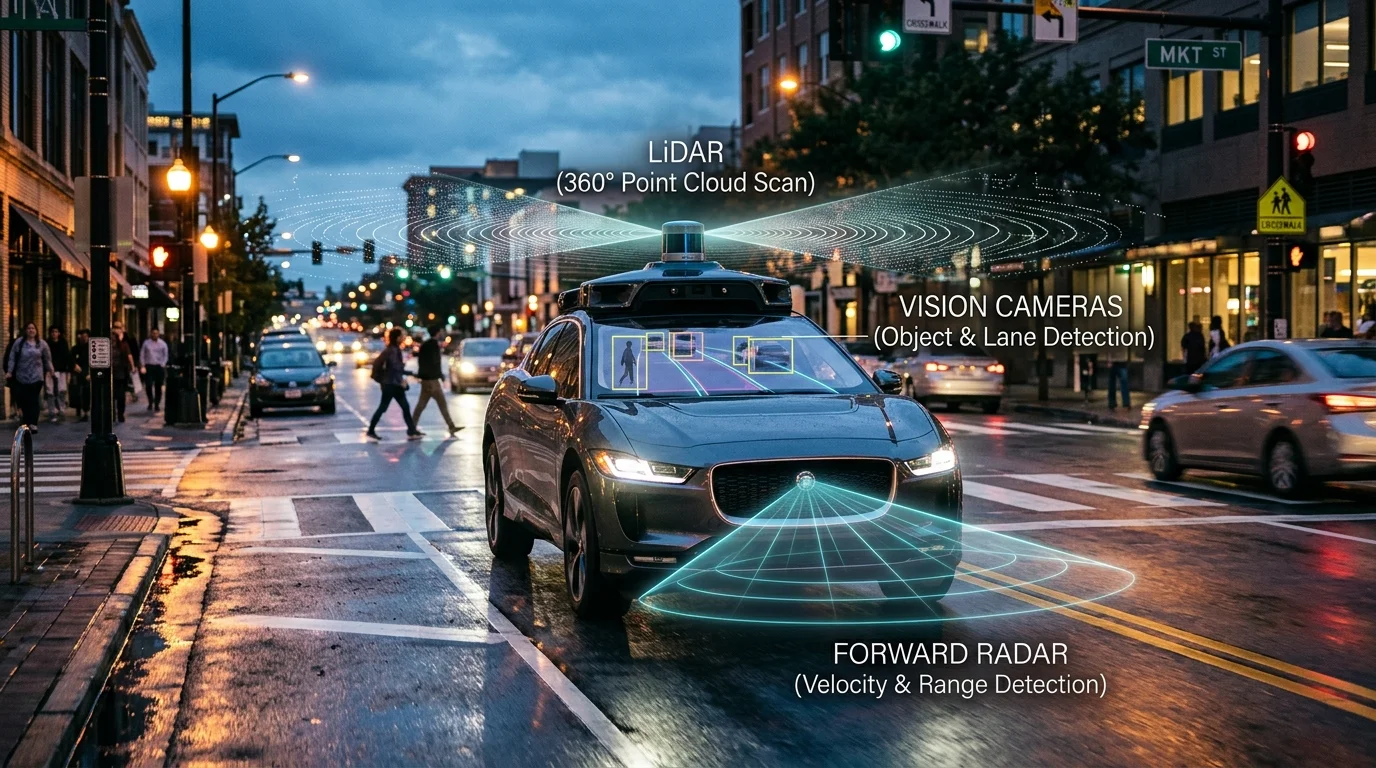
Driving is the hardest thing humans do daily. To drive, you have to predict the future. "That kid looks like he might chase his ball." "That truck is weaving; he might be on his phone." A self-driving car (AV) has to do this too. It builds a World Model. It uses cameras, radar, and Lidar (lasers) to track every object 360 degrees around it. It updates this map 20 times a second. It knows exactly how fast every car is moving and where it will be in 3 seconds.
The Brain: Neural Networks
You can't program a car with simple rules like "Stop if Red." What if the sun is glaring on the light? What if the light is broken? Instead, we use Machine Learning. We show the car's computer billion of hours of human driving video. The computer learns by watching. It learns that "Red Octagon" means Stop. It learns that "Person waving hand" might mean "Go ahead." But it makes mistakes. It might see a picture of a Stop sign on the back of a bus and slam on the brakes. These are called "Edge Cases," and they are why full autonomy is taking so long.
The Race at the End of the World (DARPA)
How did this start? With a race in the desert. In 2004, the US Military (DARPA) offered $1 Million to anyone who could build a car that could drive itself 150 miles across the Mojave Desert. Result: It was a disaster. The best car went 7 miles and caught on fire. Most cars drove into rocks or just spun in circles. But they tried again in 2005. This time, 5 cars finished. A team from Stanford (led by Sebastian Thrun) won. Google hired Sebastian Thrun the next day. He started "Project Chauffeur," which became Waymo. The entire industry was born from a single contest in the dirt.
The Great Debate: Eyes vs Lasers
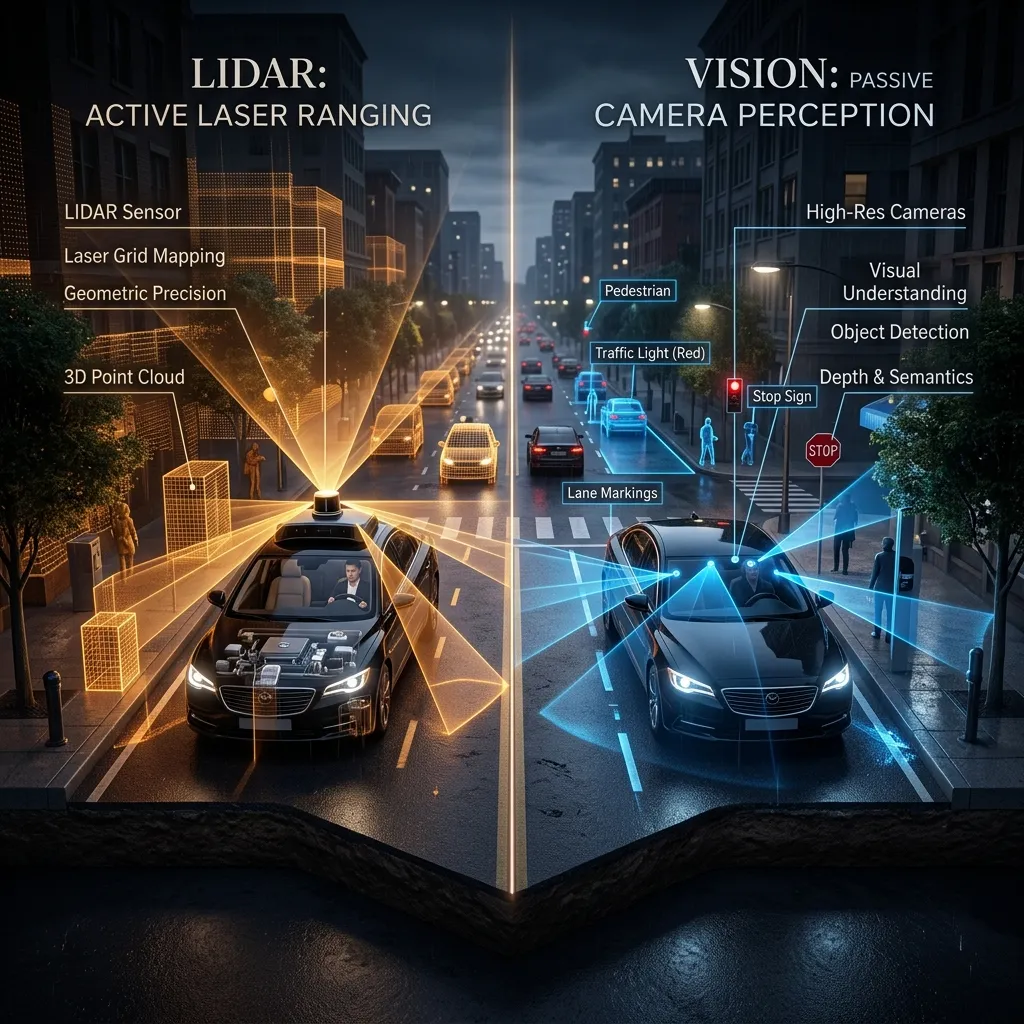
There are two religions in the self-driving world.
- Lidar (Waymo/Cruise): Use lasers to measure distance perfectly.
- Pro: Extremely accurate. Safe in the dark.
- Con: Expensive ($10,000 per car). Ugly roof bumps. Hates rain.
- Vision (Tesla): Use cameras only. Humans drive with eyes; cars should too.
- Pro: Cheap. Cars look normal.
- Con: Computer vision is hard. Cameras can be blinded by the sun or confused by shadows. Tesla bets that AI will get smart enough to drive like a human. Waymo bets that sensors are safer than humans.
The Trolley Problem (Ethics)
This is the dark side of AI. Imagine a car is driving 60 mph. Suddenly, a child runs into the road. The car can't stop in time.
- Option A: Swerve Left. Hit a tree. Kill the Passenger (You).
- Option B: Go Straight. Hit the child. Kill the Child. A human driver would panic and react instinctively. But a robot makes a decision. Who do we program the car to save? Does it prioritize the owner who bought it? Does it prioritize the child (more years of life)? Does it calculate "Total Lives Saved"? This is an unsolved ethical nightmare. Mercedes-Benz once hinted they would program their cars to prioritize the passenger (Save the Customer), causing a scandal.
Fast Facts
- The Handover: The most dangerous moment is when the car gives control back to the human. If the autopilot fails, it beeps at you. But if you were sleeping or texting, it takes you 5-10 seconds to figure out what is happening. That 10 seconds is fatal.
- Phantom Jams: Sometimes self-driving cars cause traffic jams. If one car brakes too hard for a plastic bag (Ghost), the car behind it brakes, and the chain reaction causes a jam that lasts for hours.
- Levels: Meaning of Levels:
- Level 2: Hands on wheel (Tesla Autopilot).
- Level 3: Eyes off road, but ready to take over (Mercedes Drive Pilot).
- Level 4: No steering wheel needed in specific cities (Waymo Taxi).
- Level 5: Drive anywhere, anytime (Does not exist yet).