How Do Birds Flock?
The Big Idea
Step into the mesmerizing mathematical dance of bird murmurations. Discover how thousands of individual birds follow three simple rules to create a giant, intelligent super-organism that can confuse predators and turn instantly without a single leader.
Key Vocabulary & Concepts
Hands-On Observation Checklist
Teacher & Parent Discussion Starters
- Why is understanding how do birds flock? important in everyday real life?
- What variable or factor had the biggest impact when testing the simulation?
- How does this concept connect to another science topic you have learned about?
How Birds Flock: The Living Cloud
The Murmuration
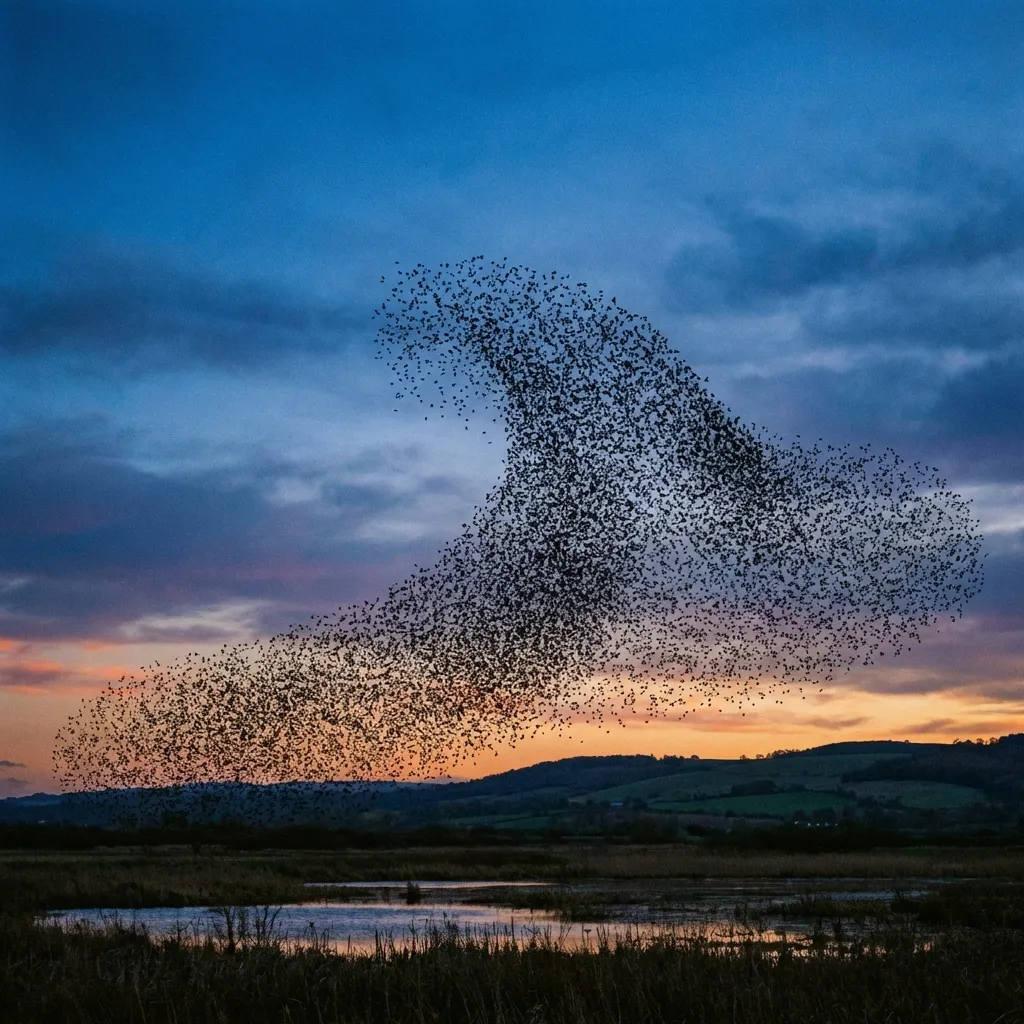
Have you ever stared up at twilight and seen a massive cloud of Starlings? Thousands of birds swoop, dive, and swirl in perfect unison, moving like a liquid black ribbon across the sky. It creates a unified "super-organism." But here is the mystery: Who is the leader? Which bird yells "Turn Left Now!"? The answer is: Nobody. There is no commander. There is no plan. The beautiful complexity of the flock is a mathematical accident.
The Code of Order: Boids
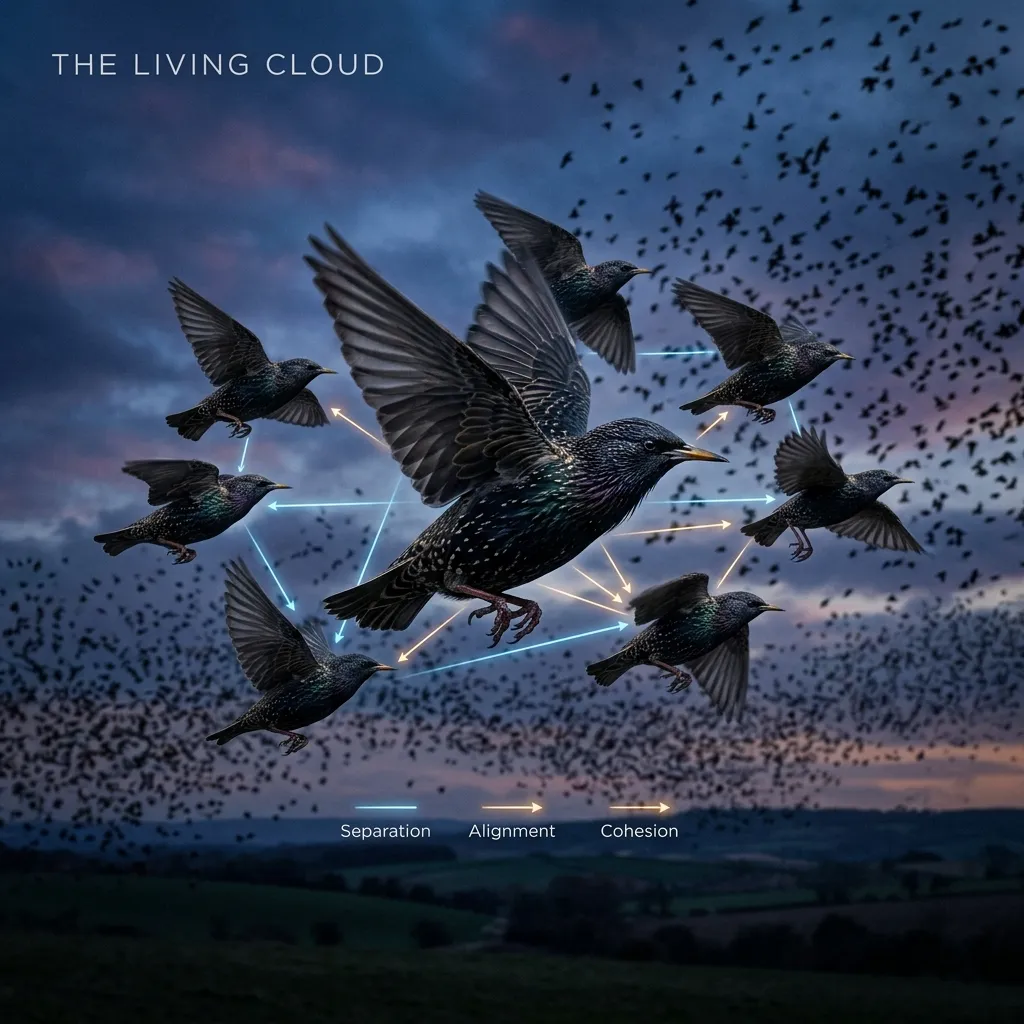
In 1986, computer scientist Craig Reynolds cracked the code. He wasn't studying birds; he was trying to program realistic flocks for computer animation (like the bats in Batman Returns). He discovered that you don't need a leader. You only need 3 simple rules for every individual bot (which he called "Boids"):
- Separation: "Don't crash into your neighbors." (Personal Space).
- Alignment: "Steer in the same average direction as your neighbors." (Peer Pressure).
- Cohesion: "Steer toward the average center of your neighbors." (Stay Together). That's it. If you program 1,000 dots with just these three instructions, complex, swirling, organic behavior emerges naturally. This is called Emergent Behavior—order rising from chaos without a central brain.
Why Do They Do It?
Flocking looks pretty, but nature doesn't do "pretty." It does survival. The main predator of the Starling is the Peregrine Falcon—the fastest animal on Earth, capable of diving at 240 mph. If a bird flies alone, the Falcon locks on and—bam—lunch. But a flock creates a defense shield:
- Probability: In a flock of 5,000, your chance of being eaten is 1/5000.
- The Confusion Effect: This is the big one. The Falcon's brain can't track a single target when thousands of targets are crisscrossing. It suffers Sensory Overload.
- The Disco Ball: As starlings turn, their wings flash from dark to light. The shimmering ripple creates a "Terror Wave" that warns birds on the other side of the flock that an attack is coming before they even see it.
The Edge of Chaos: Criticality
Physicists have analyzed high-speed video of starling flocks and found something profound. The flock exists in a state of Criticality. It is poised mathematically on the razor's edge between "Order" (a solid crystal) and "Chaos" (a gas). Because they are on this edge, the system is infinitely sensitive. If one bird on the edge spots a hawk and banks left, that "turn signal" propagates through the flock instantly with almost zero resistance. It travels like a phase change in matter. This makes the flock the most efficient communication network in the natural world.
Future Tech: Drone Swarms
The US Military is watching the birds closely. The future of war isn't one $100 Million jet; it is a swarm of 1,000 cheap $100 drones. Using the Boids Algorithm, engineers are building drone swarms that talk to each other.
- Self-Healing: If you shoot down 50 drones, the swarm doesn't break. It just closes the gap and keeps coming.
- Search and Rescue: A swarm of mini-drones could sweep a forest for a lost hiker in 10 minutes, spreading out and sharing data like a hive mind.
The Phantom Traffic Jam
Humans are bad at flocking. Have you ever been stuck in a traffic jam for an hour, only to reach the front and find... nothing? No accident. No police. Just an empty road. This is a Phantom Jam. It happens because human drivers have slow reaction times. Car A brakes slightly. Car B brakes a bit harder. Car C slams on the brakes. A "Stop Wave" travels backward through the line. Birds don't have phantom jams because they pay attention to the front, sides, and back simultaneously. If self-driving cars were programmed with "Flocking Logic," traffic jams would vanish. All cars would accelerate and brake in perfect unison, moving like a train of water.
The Wisdom of the Crowd
A single starling is not very smart. A flock is a genius. Experiments show that a group can sense the direction of food or a predator much faster than the smartest individual. This is Collective Intelligence. When you average out the guesses of thousands of brains, the individual errors cancel each other out, and the truth remains. It is the same reason "Ask the Audience" is the most powerful lifeline on Who Wants to Be a Millionaire. Nature figured out that 1,000 dumb brains are better than one smart one.
Fast Facts
- V-Formation: Geese don't flock in clouds; they fly in a rigid "V". This is purely for aerodynamics. The leader cuts the wind, creating an updraft (wake) behind him. The followers surf on this free lift. Taking turns at the front allows the whole group to fly 70% further than a solo bird could.
- Rome's Poop Problem: Millions of starlings winter in Rome. Their evening aerial dance over the Vatican is world-famous. However, millions of birds mean tons of poop. The city has to close roads because the "guano rain" makes the cobblestones as slippery as ice. They employ falcons and loudspeakers to scream at the birds to leave.
- Schooling Fish: Fish schools use the exact same Boids rules. It is the universal mathematics of survival in a 3D space.
Diagram Prompts
- The 3 Boids Rules: A diagram with three panels using arrow-shaped birds. Panel 1: "Separation" (Center bird pushing away from crowded neighbors). Panel 2: "Alignment" (Center bird turning to match the direction of neighbors). Panel 3: "Cohesion" (Center bird steering toward the dense center of forces).
- Confusion Effect: A Falcon's POV. A target reticle trying to lock onto one bird, but dozens of "ghost" trails and crossing lines confuse the focus. Label: "Sensory Overload."
- V-Formation Aerodynamics: A side/top view of geese. Show the "Air Vortex" coming off the leader's wingtips. Show the follower bird positioning its wing right in the rising part of the vortex ("Free Lift").