
How CRISPR Gene Editing Works
The Big Idea
Discover how scientists adapted nature's microscopic bacterial immune system—CRISPR-Cas9—into programmable molecular scissors that can search through 3 billion letters of human DNA, snip out genetic defects, and cure inherited diseases with nucleotide precision.
Key Vocabulary & Concepts
Hands-On Observation Checklist
Teacher & Parent Discussion Starters
- Why is understanding how crispr gene editing works important in everyday real life?
- What variable or factor had the biggest impact when testing the simulation?
- How does this concept connect to another science topic you have learned about?
How CRISPR Gene Editing Works
Discover how scientists adapted nature's microscopic bacterial immune system—CRISPR-Cas9—into programmable molecular scissors that can search through 3 billion letters of human DNA, snip out genetic defects, and cure inherited diseases with nucleotide precision.
How CRISPR Gene Editing Works: Rewriting the Code of Life
Inside almost every cell in your body sits an astonishing library: your genome. Written in a chemical alphabet of just four letters—A (Adenine), T (Thymine), C (Cytosine), and G (Guanine)—your DNA spans over 3.2 billion base pairs. If printed in standard paperback books, your genetic instructions would fill over one thousand telephone directories stacked to the ceiling.
For decades, if a single letter in this vast library was misspelled—such as a single A mistakenly flipped to an A-to-T transversion causing sickle cell anemia—physicians had no way to correct the typo. They could treat the symptoms, but they could not edit the code.
Enter CRISPR-Cas9: a revolutionary molecular editing system that functions like the "Find and Replace" command in a word processor. Armed with atomic-scale guidance, it can navigate trillions of microscopic letters, locate a single faulty sentence, snip the defect cleanly in half, and paste in a healthy sequence.
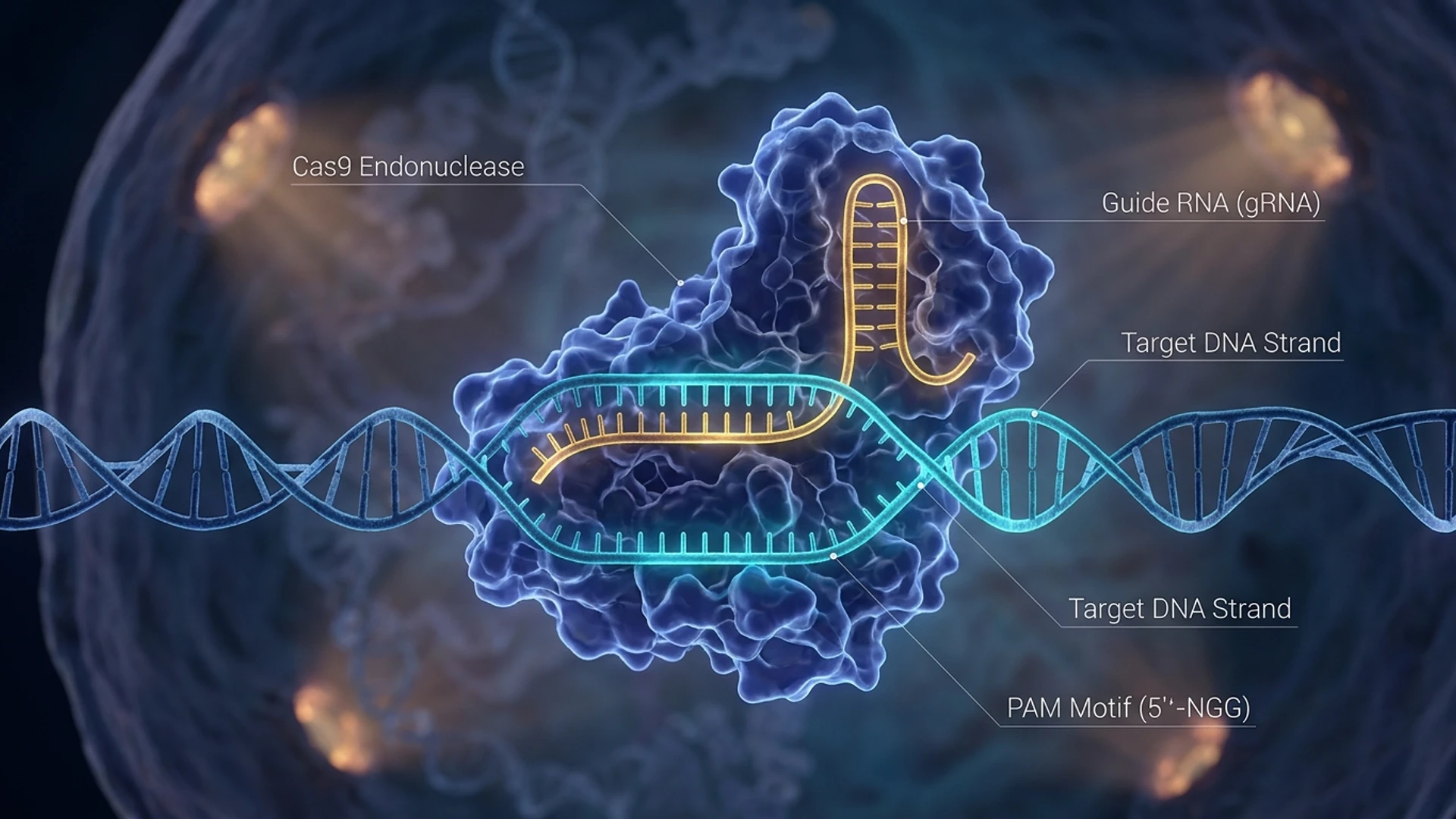
CRISPR-Cas9 Endonuclease Complex and Guide RNA Docked to DNA Double Helix
1. The Microscopic Origin: Bacterial Immune Warfare
Humans did not invent CRISPR from scratch. Nature engineered it over billions of years of ruthless microscopic warfare.
Bacteria are relentlessly hunted by tiny viruses called bacteriophages. A bacteriophage lands on the surface of a bacterium like a lunar lander and injects its viral DNA, hijacking the bacterium's cellular machinery to replicate until the bacterium bursts.
To survive, bacteria evolved an ingenious adaptive memory system called CRISPR (Clustered Regularly Interspaced Short Palindromic Repeats):
- Capture: When a bacterium survives a viral invasion, specialized Cas enzymes carve off a tiny fragment of the virus's DNA.
- Archival: The bacterium inserts this viral snippet into its own genome between repeating palindromic sequences. It creates a molecular "mugshot" gallery of every enemy it has ever encountered.
- Defense: The bacterium transcribes these viral mugshots into short Guide RNA molecules. When a recognized virus invades again, the Guide RNA teams up with an endonuclease enzyme called Cas9.
- Destruction: Cas9 rapidly matches the Guide RNA to the invader's genome and chops the viral DNA into harmless pieces!
In 2012, biochemists Jennifer Doudna and Emmanuelle Charpentier made a world-changing leap: they realized that by swapping out the bacterial Guide RNA with an engineered custom sequence, Cas9 could be directed to cut any DNA sequence in any living organism on Earth.
2. The Anatomy of Molecular Scissors: Cas9 and Guide RNA
The CRISPR-Cas9 tool consists of two fundamental components that operate in tight biochemical synchrony:
1. The Cas9 Endonuclease (The Scissors)
Cas9 is a multi-lobed protein enzyme with two distinct catalytic cutting domains:
- RuvC Domain: Cleaves the non-target DNA strand.
- HNH Domain: Cleaves the target DNA strand that base-pairs with the guide RNA.
Together, these twin blades act as molecular shears, creating a clean double-strand break (DSB) across the phosphodiester backbone of the DNA.
2. The Single Guide RNA (gRNA / The Navigator)
The guide RNA is an engineered single-strand molecule typically 100 nucleotides long:
- The Targeting Region (Spacer): The first 20 nucleotides at the 5' end. Scientists synthesize these 20 letters to be the exact Watson-Crick complement ($A \leftrightarrow U, C \leftrightarrow G$) of the gene they wish to target.
- Scaffold Region: The remaining hairpin loop structure that physically anchors and docks the RNA molecule into the cradle of the Cas9 protein.
3. The Secret Password: The PAM Motif
If human DNA is 3.2 billion letters long, how does Cas9 find its 20-letter target without spending weeks unwinding every twist of the double helix?
It relies on a 3-letter biological shortcut known as the Protospacer Adjacent Motif (PAM).
For the most widely used Cas9 (derived from the bacterium Streptococcus pyogenes, or SpCas9), the PAM sequence is:
$$5'\text{-NGG-}3'$$
Where N can be any nucleotide ($A, T, C, \text{or } G$), followed strictly by two Guanine (G) bases.
Cas9 bounces along the DNA strand at high speed, inspecting only regions that feature the PAM motif. When it bumps into an NGG sequence:
- It physically anchors to the PAM site.
- It locally melts and unzips the adjacent DNA double helix.
- It tests whether the unzipped DNA bases match its 20-letter Guide RNA.
- If there is a mismatch, Cas9 detaches and glides to the next PAM.
- If all 20 letters match perfectly, Cas9 snaps shut, activating its RuvC and HNH blades exactly 3 base pairs upstream of the PAM site to cleave the DNA!
4. How the Cell Heals: NHEJ vs. HDR
Making the cut is only half the battle. Once Cas9 snips the double helix, the living cell senses the broken strand as a life-threatening catastrophe and initiates repair immediately through one of two pathways:
Pathway A: Non-Homologous End Joining (NHEJ) — The Knockout
- How it works: The cell's emergency repair enzymes quickly stick the broken ends back together without a reference guide.
- The result: This quick fix is error-prone. It frequently inserts or deletes a few random letters (called an indel).
- The application: An indel shifts the genetic reading frame, permanently deactivating or "knocking out" a harmful or defective gene (such as a viral receptor or cancer-driving oncogene).
Pathway B: Homology-Directed Repair (HDR) — Precision Editing
- How it works: Scientists supply a custom donor DNA template along with the Cas9-gRNA complex.
- The result: The cell's repair enzymes read the donor template and copy its sequence into the break site to patch the gap flawlessly.
- The application: This allows researchers to rewrite mutated letters back to their healthy, wild-type sequence, or insert brand new therapeutic genes directly into chromosomes!
5. Real-World Cures: The Era of Genomic Medicine
CRISPR has already transitioned from laboratory curiosity to clinical cure:
- Sickle Cell Disease (Casgevy): Patients suffering from sickle cell anemia produce misshapen hemoglobin that clogs blood vessels, causing agonizing pain and early death. In late 2023, regulatory agencies worldwide approved Casgevy, the first clinical CRISPR medicine. Physicians extract patient blood stem cells, use CRISPR to turn off the BCL11A genetic switch, and infuse the edited cells back. The cells immediately start producing healthy fetal hemoglobin, permanently freeing patients from sickle crises!
- Targeted Cancer Immunotherapies: Doctors use CRISPR to edit a patient's T-cells (CAR-T therapy), removing checkpoint receptors that tumors use to hide from the immune system, transforming the immune cells into supercharged cancer hunters.
- Climate-Resilient Crops: Plant scientists are editing staple crops like rice, wheat, and tomatoes to thrive in severe drought, resist fungal blights, and yield more nutrients without synthetic fertilizers.
6. Fun Fact: Did You Know?
[!TIP] Beyond Scissors: Base & Prime Editing! Modern bioengineers have created upgraded versions of CRISPR that do not even cut the DNA backbone! By fusing a deactivated Cas9 (dCas9) with special deaminase enzymes, Base Editors can chemically convert a single $C$ into a $T$, or an $A$ into a $G$, with zero double-strand breaks. And Prime Editors act like genetic search-and-replace word processors, copying new genetic sentences directly into the genome with microscopic precision!
Inspire Lifelong Curiosity
Join 15,000+ teachers, homeschool parents, and curious minds. Get free weekly hands-on STEM experiments, printable classroom lab worksheets, and new wonder releases delivered straight to your inbox.
Related Wonders
 Space
How Do Birds Flock?
Step into the mesmerizing mathematical dance of bird murmurations. Discover how thousands of individual birds follow three simple rules to create a giant, intelligent super-organism that can confuse predators and turn instantly without a single leader.
 Nature
How Do Bats See In The Dark?
Journey into the night to discover the incredible biological sonar of bats. Learn how these masters of the dark use high-frequency sound waves to 'see' their surroundings, navigate pitch-black forests, and hunt tiny mosquitoes at 40 miles per hour.
 Physics
How Do Batteries Store Energy?
Peek inside the metallic shell of a battery to discover the silent chemical war that powers our modern world. Learn how trapped ions and escaping electrons create the invisible force that fuels everything from your smartphone to electric cars.