
How Do Bats See In The Dark?
The Big Idea
Journey into the night to discover the incredible biological sonar of bats. Learn how these masters of the dark use high-frequency sound waves to 'see' their surroundings, navigate pitch-black forests, and hunt tiny mosquitoes at 40 miles per hour.
Key Vocabulary & Concepts
Hands-On Observation Checklist
Teacher & Parent Discussion Starters
- Why is understanding how do bats see in the dark? important in everyday real life?
- What variable or factor had the biggest impact when testing the simulation?
- How does this concept connect to another science topic you have learned about?
How Do Bats See In The Dark?
The Scream in the Night
Close your eyes. Imagine running through a dense, overgrown forest at night. It is pitch black. There are thick trees in every direction, and sharp branches are whipping at your face. Without a flashlight, you would likely smash into a massive tree trunk within three steps.
Now imagine doing exactly that, but flying at 40 miles per hour. And you aren't just flying in a straight line; you are chasing a tiny, erratic mosquito that is darting wildly in three-dimensional space.
This is the everyday life of a bat. To us, they seem to possess a magical, supernatural sixth sense. They dive and swoop through total, absolute darkness with the extreme precision of a military fighter jet. They never graze a single leaf, and they can snatch tiny moths directly out of thin air.
For centuries, scientists assumed bats simply had incredible, owl-like night vision. One Italian scientist in the 1700s, Lazzaro Spallanzani, even blindfolded bats and found they could still fly perfectly around the room. But when he plugged their ears, they crashed violently into the walls.
It turns out, bats don't see with their eyes. They see with a scream.
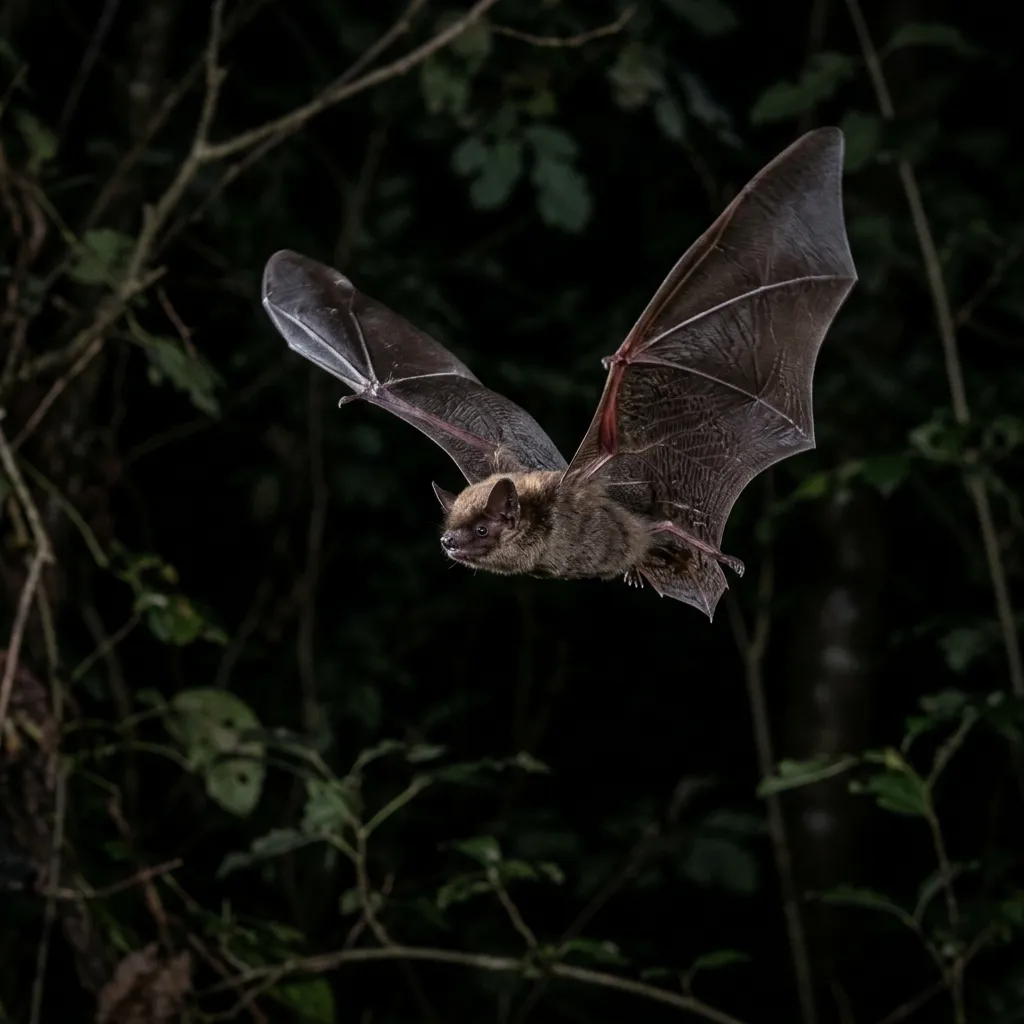
A breathtaking macro photograph of a bat flying through a pitch-black forest at night
Shaping the World with Sound
The incredible superpower that bats use is called Echolocation (biological sonar).
As a bat flies through the darkness, it shouts. It shouts incredibly loud—up to 140 decibels, which is louder than a rock concert or a roaring jet engine. But you will never hear it. The shout is Ultrasonic, meaning it is pitched at a frequency far higher than the human ear can physically detect. While human ears max out at hearing sounds up to 20,000 Hertz, hunting bats can scream at a piercing 100,000 Hertz.
Here is exactly how the system works:
- The Pulse: The bat emits a rapid-fire burst of sound clicks from its specialized nose or mouth.
- The Reflection: These sound waves travel out into the dark, hit a tree, a moth, or a cave wall, and bounce back.
- The Map: The bat's massive ears pick up the tiny returning echoes.
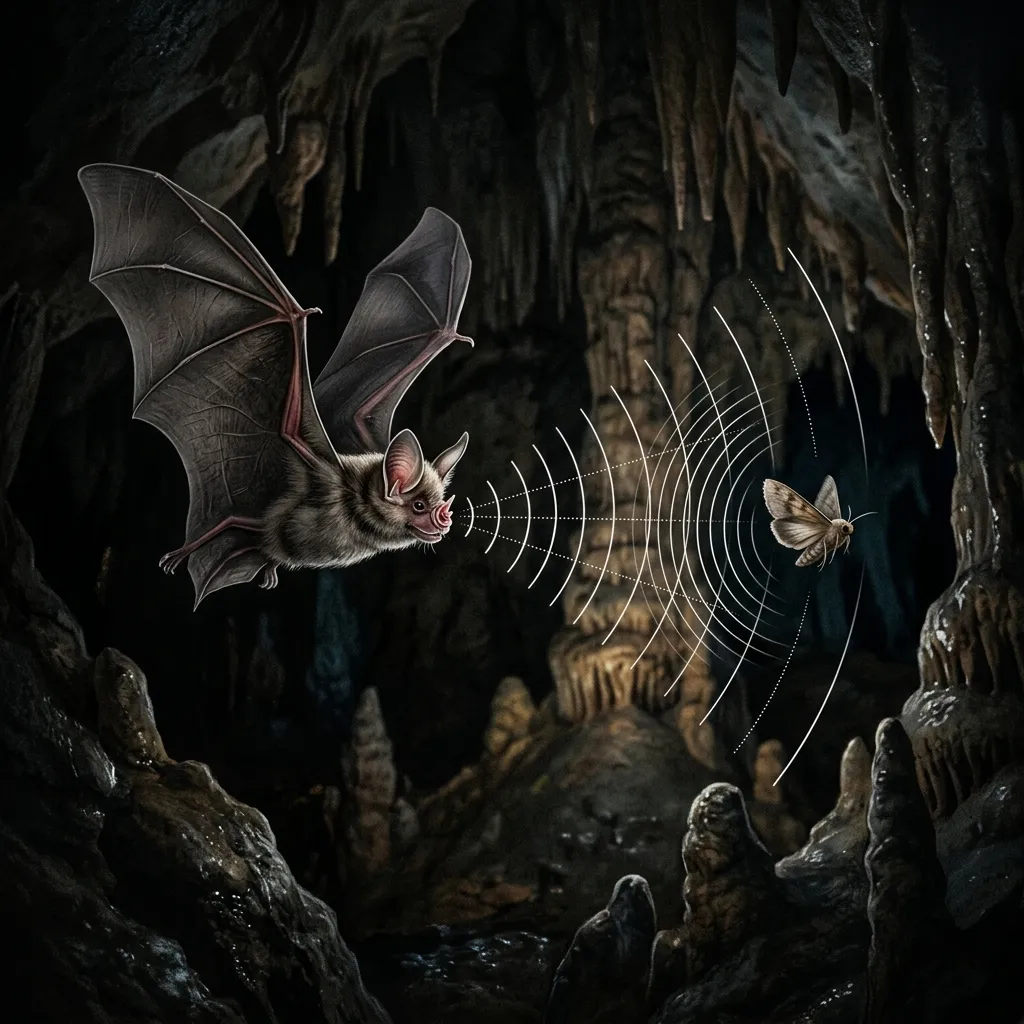 A cinematic illustration of a bat using ultrasonic sound waves to echo off a flying moth
By analyzing the microscopic difference between the sound it sent and the sound that came back, the bat's brain instantly calculates a perfect, high-resolution 3D model of the world.
- Distance: How long did the echo take to return? (A longer time means the object is further away).
- Texture: Did the echo come back sharp or fuzzy? (A sharp echo means a hard rock; a fuzzy echo means a soft, delicious moth).
- Velocity: Is the pitch of the echo higher or lower than the original scream? (This is known as the Doppler Effect—if the pitch comes back slightly higher, it means the bug is flying rapidly towards the bat!).
This incredible mathematical processing happens in milliseconds. It is so utterly precise that a bat can detect a wire the exact width of a single human hair in total darkness.
The Arms Race in the Sky
This sonar is a perfect, deadly weapon. But nature rarely allows a weapon to go unanswered. The prey fights back.
Over millions of years of evolution, moths (the bat's favorite late-night snack) have evolved to survive this sonic warfare. Some moths have developed highly specialized "ears" on their wings that are specifically tuned to hear the frequency of a bat’s scream. When they hear the sonar lock onto them, they don't just keep flying. They perform intense evasive maneuvers. They fold their wings and drop out of the sky like a stone, spiraling wildly toward the ground to confuse the bat's tracking.
Other moths have gone even further into military tactics. The Tiger Moth has evolved the ability to literally jam the bat’s radar. When it hears a bat approaching, the Tiger Moth emits its own rapid series of ultrasonic clicks. These clicks confuse the bat's range-finding, creating "phantom echoes" and completely overwhelming the bat's sensory input. It is the exact same jamming technology that modern stealth jets use to confuse enemy radar, but evolved in a bug the size of your thumb.
Not Blind at All
The old phrase "blind as a bat" is actually a total myth. Bats are not blind in the slightest. They have perfectly functioning eyes and can see quite well during the daylight hours.
But at night, vision is a slow, unreliable liability. Shadows can trick the eyes. Sound, however, is absolute truth. Next time you see a bat swooping erratically in the twilight, don't think of it as a chaotic flier. Think of it as a master mathematician. It is screaming into the void thousands of times a minute, painting the world with invisible sound, calculating complex trajectories, and hunting in a landscape that, to its ears, is as bright and deeply detailed as a sunny day.