
How Do Batteries Store Energy?
The Big Idea
Peek inside the metallic shell of a battery to discover the silent chemical war that powers our modern world. Learn how trapped ions and escaping electrons create the invisible force that fuels everything from your smartphone to electric cars.
Key Vocabulary & Concepts

Hands-On Observation Checklist
Teacher & Parent Discussion Starters
- Why is understanding how do batteries store energy? important in everyday real life?
- What variable or factor had the biggest impact when testing the simulation?
- How does this concept connect to another science topic you have learned about?
How Do Batteries Store Energy?
Peek inside the metallic shell of a battery to discover the silent chemical war that powers our modern world. Learn how trapped ions and escaping electrons create the invisible force that fuels everything from your smartphone to electric cars.
How Do Batteries Store Energy?
The Silent Powerhouse
In our modern world, we are surrounded by batteries. They are in our pockets, our laptops, our toys, and even our cars. We treat them like magic black boxes—you plug them in, they fill up, and then they provide invisible power for hours.
But if you cut a battery open, you wouldn't find a tiny lake of liquid lightning or a miniature nuclear reactor. In fact, you wouldn't find any electricity at all! A battery doesn't actually "store" electricity. It stores Chemical Potential Energy.
It is essentially a tiny, highly-controlled chemical factory that is designed to start a silent war the second you turn on your device.
A breathtaking cinematic photograph of modern alkaline and lithium batteries
The Three-Part War
Every battery on Earth, from the giant one in a Tesla to the tiny one in a watch, has three main parts:
- The Anode: The negative (-) end, usually made of a material that has "extra" electrons it wants to get rid of (like Zinc).
- The Cathode: The positive (+) end, usually made of a material that is "hungry" for electrons (like Manganese).
- The Electrolyte: A liquid or paste that sits between them.
The Anode and the Cathode are in a constant state of chemical tension. The Anode desperately wants to send its extra electrons over to the Cathode, but the Electrolyte sitting in the middle acts like a brick wall—it allows chemicals to move, but it blocks the electrons from crossing over directly.
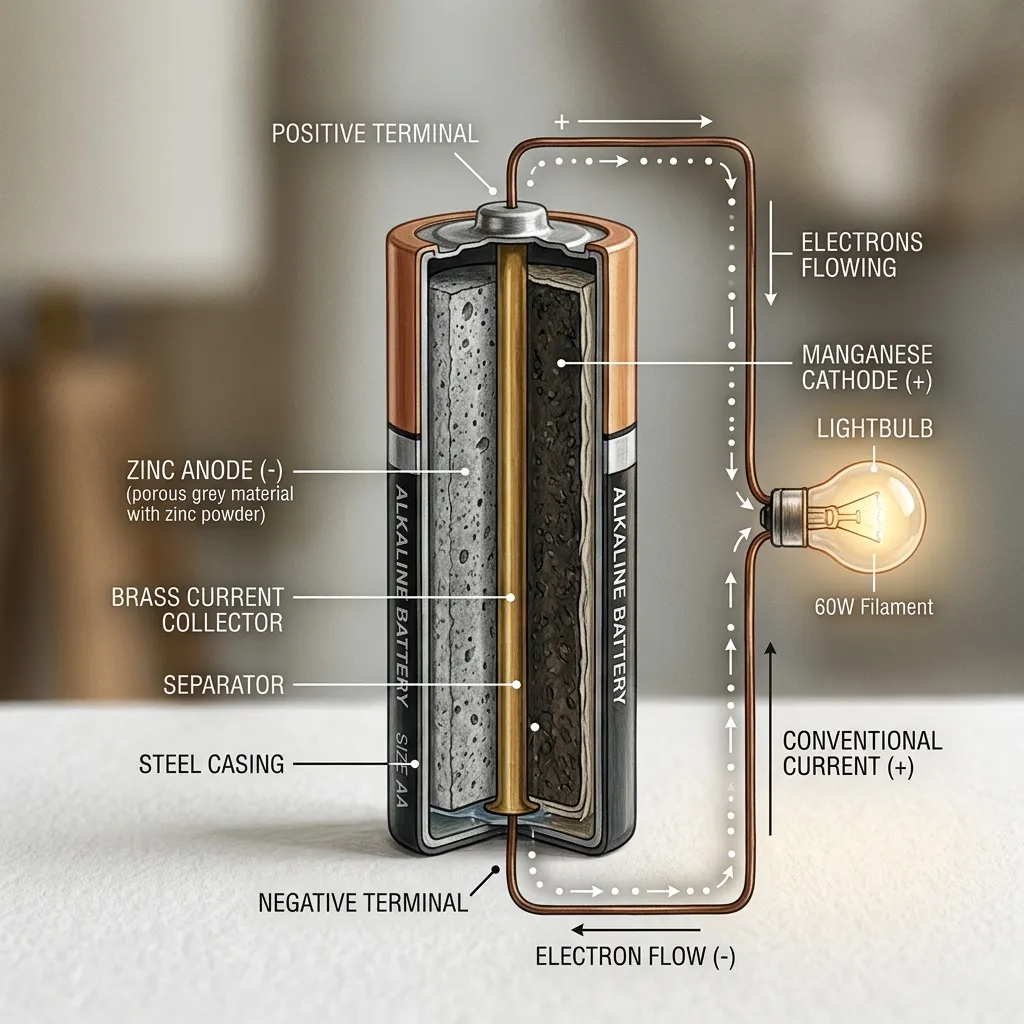 A beautiful cinematic cross-section illustration of an alkaline battery showing the anode, cathode, and electron flow
The Bridge
The only way the Anode can get its electrons to the Cathode is if you build them a bridge. That bridge is the Wire in your device.
When you flip the switch on your flashlight, you close the circuit. Suddenly, the electrons have a path! They race out of the Anode, through the wire (powering the lightbulb along the way), and finally crash into the waiting Cathode.
This flow of tiny, negatively charged particles is exactly what we call Electricity.
Why They Die
Eventually, the chemical war comes to an end. Every time an electron leaves the Anode and reaches the Cathode, the materials inside the battery physically change. The Zinc turns into Zinc Oxide, and the Manganese changes its structure.
Once every single atom has reacted and found its new partner, the "pressure" between the two ends disappears. There are no more electrons left that want to move. The battery is now "dead."
In a Rechargeable battery, the process is even cooler. By plugging it into the wall, you are using the power from the city to physically force the chemical reaction to run in reverse! You are manually pushing the electrons back onto the Anode side, resetting the chemical factory so it can start the war all over again.
It is a silent, microscopic masterpiece of chemistry that makes our entire mobile lives possible! Just remember: when they finally do run out of "war," always recycle them properly, as those chemicals are powerful and shouldn't be left in the ground.