
How Do Fish Breathe Underwater?
The Big Idea
Dive beneath the surface to explore the engineering genius of gills. Discover the elegant biological system that allows fish to pull invisible, life-saving oxygen directly out of the water, enabling them to thrive in an environment where we could never survive.
Key Vocabulary & Concepts
Hands-On Observation Checklist
Teacher & Parent Discussion Starters
- Why is understanding how do fish breathe underwater? important in everyday real life?
- What variable or factor had the biggest impact when testing the simulation?
- How does this concept connect to another science topic you have learned about?
How Do Fish Breathe Underwater?
Dive beneath the surface to explore the engineering genius of gills. Discover the elegant biological system that allows fish to pull invisible, life-saving oxygen directly out of the water, enabling them to thrive in an environment where we could never survive.
How Do Fish Breathe Underwater?
The Panic of the Deep
We have all felt it. You excitedly dive into the deep end of a swimming pool. You confidently hold your breath. For thirty seconds, you are perfectly fine, peacefully floating in the blue. Then, a creeping, primal panic sets in. Your chest violently burns. Your lungs aggressively scream for air. You frantically kick for the surface, aggressively gasping for that sweet, invisible gas we confidently call oxygen.
To us, being trapped underwater is a suffocating, terrifying nightmare. To a fish, it is a perfectly peaceful home.
Fish gracefully glide through the crushing depths of the ocean without a single care in the world. They don't desperately surface for massive gulps of air. They don't heavily strap on metal scuba tanks. They have flawlessly unlocked a massive biological secret that actively allows them to violently pull life-saving oxygen directly out of the liquid surrounding them.
But here is the massive physical problem: Water is actually terrible at holding oxygen. Air is incredibly rich; it is a massive 21% oxygen. The heavy ocean water, on the other hand, holds an incredibly tiny fraction of that—usually far less than 1%. Trying to casually breathe underwater is physically exactly like trying to aggressively drink a massive, incredibly thick milkshake through a tiny, crushed coffee stirrer. It is brutally hard work.
So how do fish survive in such a brutally air-poor environment? They didn't just casually adapt; they biologically engineered one of the absolute most efficient, high-tech filtration systems on Earth.
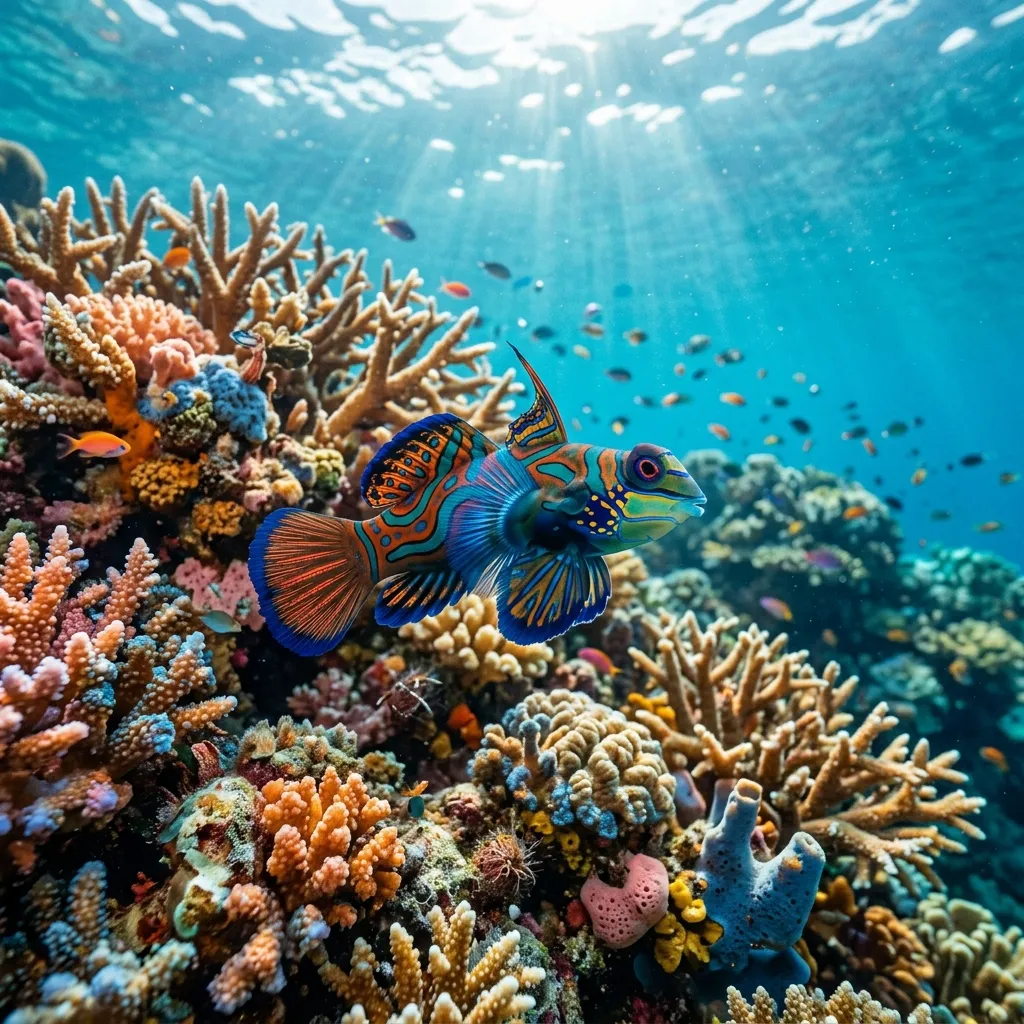
A breathtaking cinematic photograph of a colorful tropical fish swimming through a pristine coral reef
The Feathery Engine
Humans have massive lungs—two giant, stretchy bags securely locked inside our chests that we violently inflate and deflate like balloons. Fish, however, have highly specialized organs called Gills.
If you look incredibly closely at the side of a fish's head, you will clearly see heavily protected slits. Safely tucked inside those armored slits are the delicate gills. They physically look like massive stacks of deep red, incredibly feathery combs.
The "red" and "feathery" aspects are the absolute key to their survival:
- Red: The intense color comes from thousands of incredibly tiny, heavily packed blood vessels sitting directly at the extreme surface of the organ.
- Feathery: The wildly chaotic shape is entirely about maximizing Surface Area. If you surgically took a tiny fish's gills and physically unfolded all the microscopic layers, they would astonishingly cover a massive physical area. This brilliantly maximizes the exact amount of water that physically touches the fish's blood.
The process is simple but wildly elegant. The fish simply opens its mouth and gulps water. It forcefully pushes that water back over the gills. As the liquid violently flows over the feathery filaments, invisible oxygen molecules effortlessly dissolve right out of the water, seamlessly pass through the incredibly thin walls of the gills, and directly enter the fish's rushing bloodstream.
The Engineering Genius
If this were the entire biological story, fish would heavily struggle to survive. They desperately needed an extra trick to aggressively squeeze every last, microscopic drop of oxygen from the suffocating water.
It is a brilliant biological hack known as Counter-Current Exchange.
Imagine two massive conveyor belts running directly side by side.
- Water flows quickly from Left to Right.
- Blood flows quickly from Right to Left.
They physically move in completely opposite directions! This is breathtaking engineering.
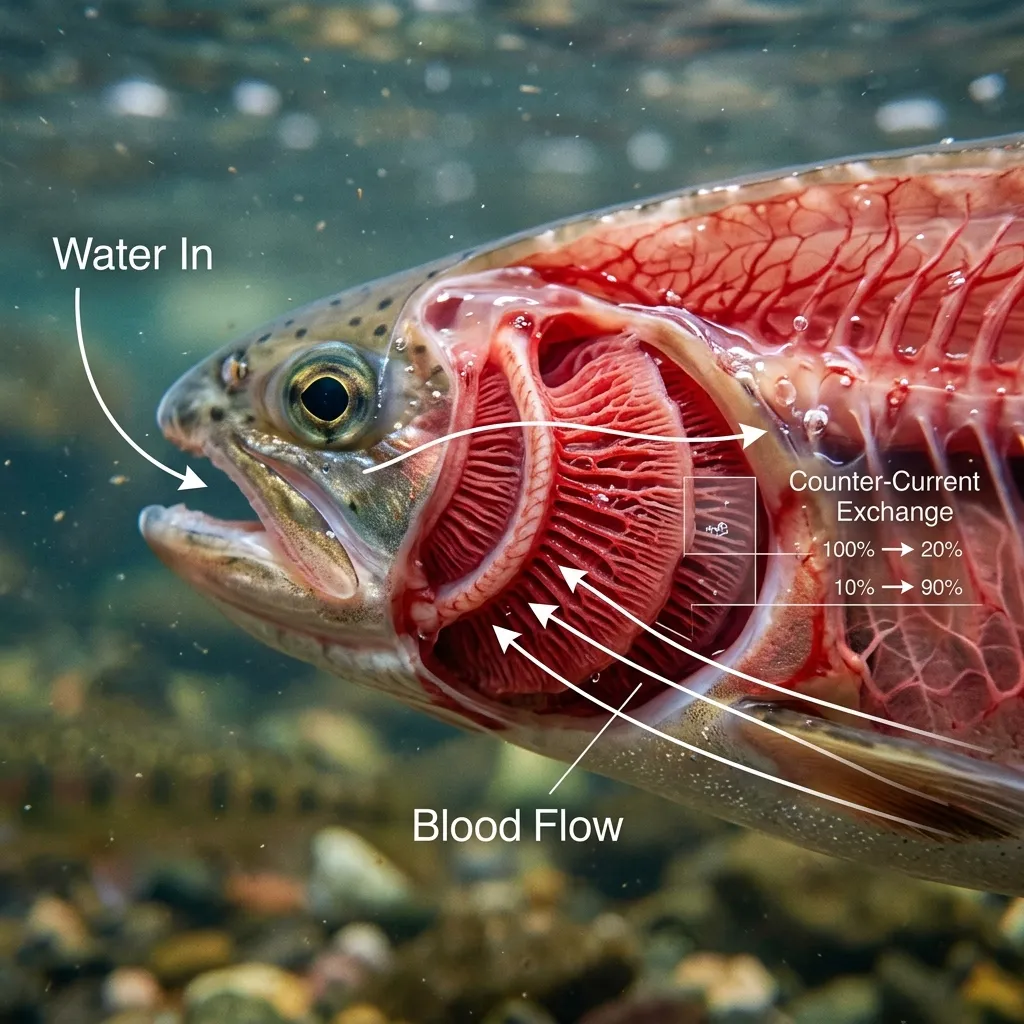 A cinematic medical illustration of a fish's internal gills showing water and blood flowing in opposite directions
As the toxic, oxygen-depleted blood enters the gills, it first meets water that has already given up most of its oxygen. But since the dark blood currently has zero oxygen, it eagerly absorbs whatever tiny bits are left. As the blood moves further and further along the gill, it aggressively meets fresher and fresher incoming water with even higher oxygen levels.
Because they brutally flow against each other, there is always slightly more oxygen in the water than in the blood at every single microscopic point of contact. This genius trick allows the fish to aggressively absorb up to 80% of the oxygen trapped in the water. If the blood and water flowed the lazy way (in the exact same direction), they would reach a boring balance quickly, and the fish would only get 50%. They are living, hyper-efficient filters, actively breathing easily where we would perish in moments!