
How Do Rockets Work in Space?
The Big Idea
If space is a total vacuum with no air to push against, how does a massive rocket ship actually move forward? Unlock the secrets of Newton's Third Law and the physics of fire that allow us to reach the stars.
Key Vocabulary & Concepts
Hands-On Observation Checklist
Teacher & Parent Discussion Starters
- Why is understanding how do rockets work in space? important in everyday real life?
- What variable or factor had the biggest impact when testing the simulation?
- How does this concept connect to another science topic you have learned about?
How Do Rockets Work in Space?
The Vacuum Problem
Here is a serious physics question that completely stumped the brilliant editors of the New York Times in 1920. How do you actually move forward if there is absolutely nothing to push against?
Think deeply about how we move around on Earth.
- Walking: You push your heavy boot backward against the solid ground. The ground pushes you forward.
- Swimming: You cup your hands and push the heavy water backward. The water pushes you forward.
- Airplanes: The massive spinning propeller grabs the air and throws it backward. The air pushes the plane forward.
Every single method of transportation relies on grabbing onto something in the environment and shoving off of it. But deep Space is a perfect Vacuum. There is no ground to walk on. There is no water to paddle. There is absolutely no air for a propeller to grab. It is entirely empty.
So if a rocket ship is floating in deep space, and it fires its massive engines, what exactly is the fire pushing against? For a long time, people (including the New York Times) thought space travel was utterly impossible because there was no "air" to push off of. They thought a rocket in a vacuum would just spin its wheels and go nowhere. They were completely wrong.
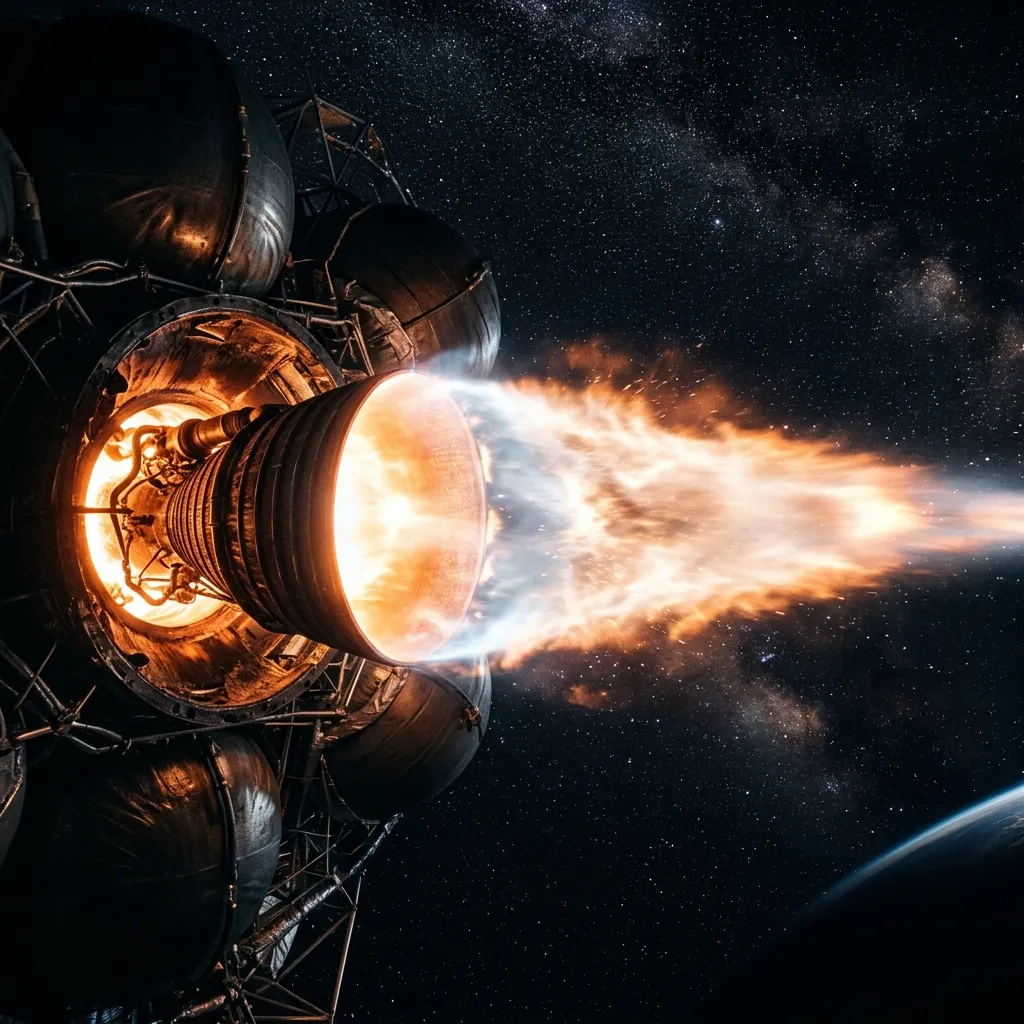
A cinematic photograph of a massive rocket engine firing a cone of superheated gas in deep space
The Skateboard Trick
Rockets do not push against the air. In fact, air just gets in their way and slows them down with friction (drag). A rocket works flawlessly in a vacuum because it pushes against itself.
This brilliant concept is dictated by Sir Isaac Newton's Third Law of Motion:
"For every action, there is an equal and opposite reaction."
Imagine you are standing on a skateboard in an empty parking lot. You are holding an incredibly heavy bowling ball. If you wind up and throw that bowling ball forward as hard as you physically can, what happens?
The heavy ball flies forward. But you and the skateboard instantly roll backward. You didn't push against the air to move. You pushed the heavy mass of the ball. Because you violently threw a heavy object one way (Action), the physical universe created an equal force that pushed your body the other way (Reaction).
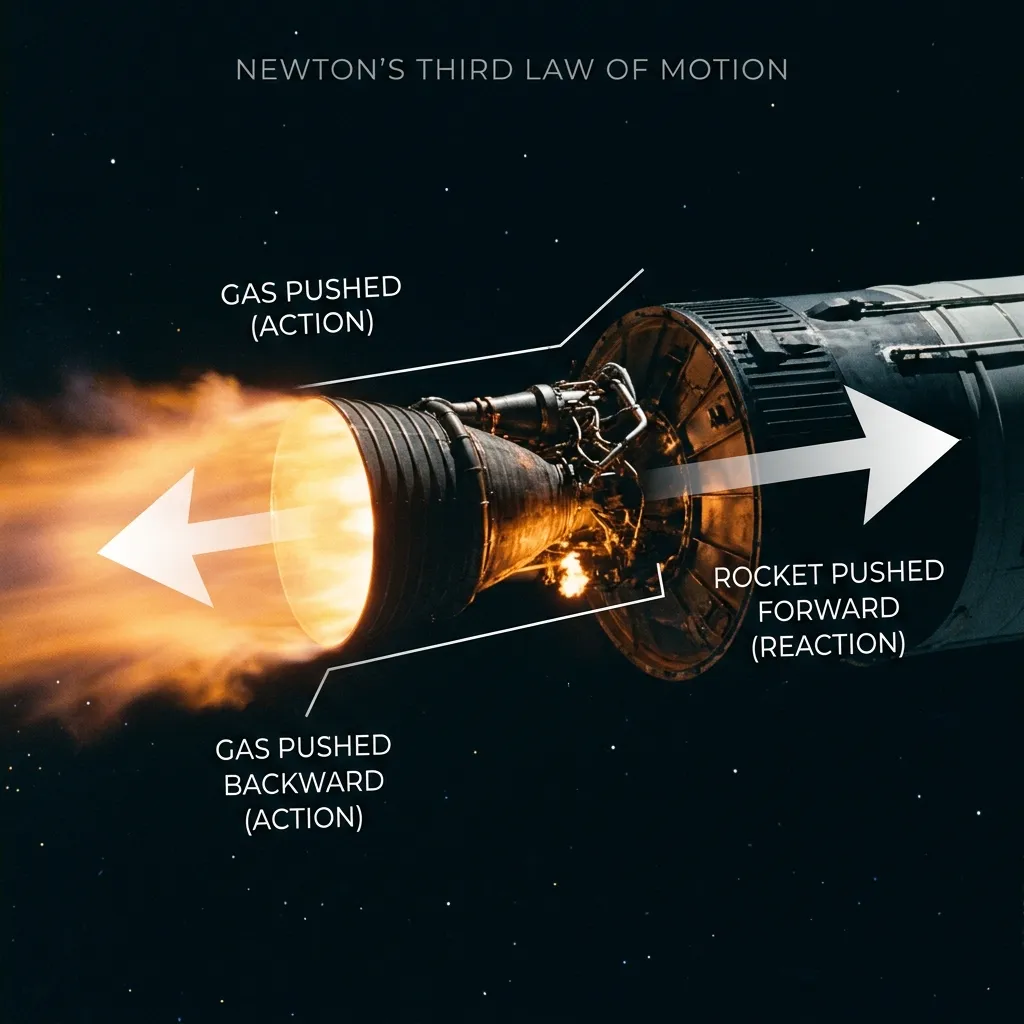 A cinematic illustration of a rocket engine firing in a dark void, showing the action and reaction arrows
Controlled Explosions
A rocket ship is fundamentally just a giant skateboard armed with a machine gun that shoots millions of tiny bowling balls. Except instead of heavy bowling balls, the rocket is shooting Superheated Gas.
Inside the belly of the rocket engine, highly volatile fuel is mixed with oxygen and violently ignited. This creates a massive, continuous, controlled explosion. The burning fuel rapidly turns into a high-pressure, insanely hot cloud of expanding gas.
The rocket is engineered so this expanding gas is trapped and only has one possible way to escape: out the bell-shaped nozzle at the very back. The engine throws this massive weight of gas backward at staggering speeds (thousands of miles per hour). Because the rocket is violently throwing thousands of pounds of gas backward (Action), the gas pushes the massive metal rocket forward (Reaction) with equal violence.
It does not matter if the rocket is fighting through the thick atmosphere of Earth or floating silently in the empty vacuum of deep space. The relationship is purely between the rocket and the mass of its own fuel.
The Tyranny of the Equation
This incredible method of movement brings us to the single biggest headache in space travel: The Rocket Equation.
To go incredibly fast, you need to throw a massive amount of stuff out the back. This means you need to carry a lot of fuel. But fuel is incredibly heavy. To carry more heavy fuel, you need to build a bigger, stronger rocket. But a bigger rocket is heavier, which means it requires even more fuel just to lift its newly added weight off the launchpad.
It is a vicious, inescapable mathematical cycle. That is exactly why rockets meant for deep space are so impossibly huge. Look at the famous Saturn V rocket that took astronauts to the Moon. It was the physical size of a towering 36-story skyscraper. The tiny metal capsule at the very top where the three astronauts sat was barely the size of a minivan.
The entire rest of the massive skyscraper—over 90% of the entire vehicle—was just heavy "bowling balls" (fuel) waiting to be violently thrown out the back to push the tiny minivan all the way to the moon.