
How Do Seeds Know Which Way Is Up?
The Big Idea
Uncover the hidden biological balance sensors that allow a tiny, buried seed to feel the Earth's gravity. Discover how heavy starch marbles inside plant cells ensure that roots always grow down and stems always reach for the sun.
Key Vocabulary & Concepts
Hands-On Observation Checklist
Teacher & Parent Discussion Starters
- Why is understanding how do seeds know which way is up? important in everyday real life?
- What variable or factor had the biggest impact when testing the simulation?
- How does this concept connect to another science topic you have learned about?
How Do Seeds Know Which Way Is Up?
The Blind Burial
Imagine I blindfolded you, spun you around ten times, and buried you head-first in a deep pit of dirt. You wouldn't know which way was up. You might try to dig your way out, but you could accidentally dig deeper into the earth.
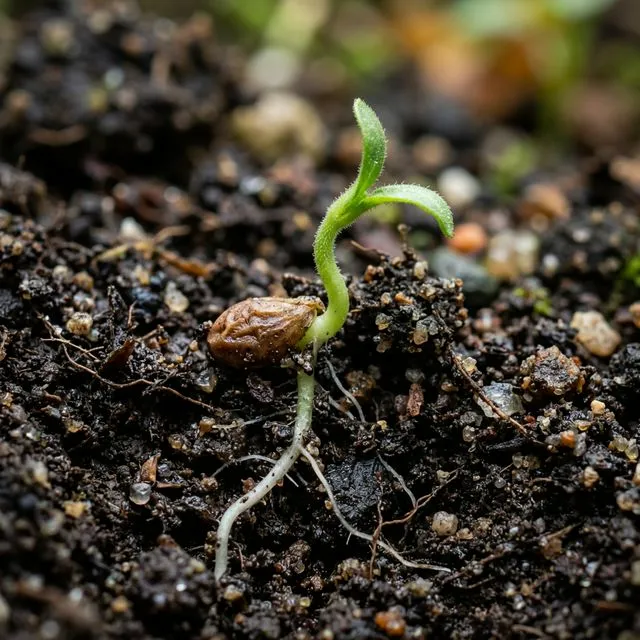
This is the challenge every single seed faces. When a gardener throws a seed into the soil, it tumbles. It lands sideways, upside down, or diagonally. It is buried in total darkness. Yet, somehow, the seed never makes a mistake. The Roots always go down (to find water). The Shoots always go up (to find sun).
Even if you tape a seed upside down to the wall of a jar, it will curl its root around in a U-turn to point down. How?
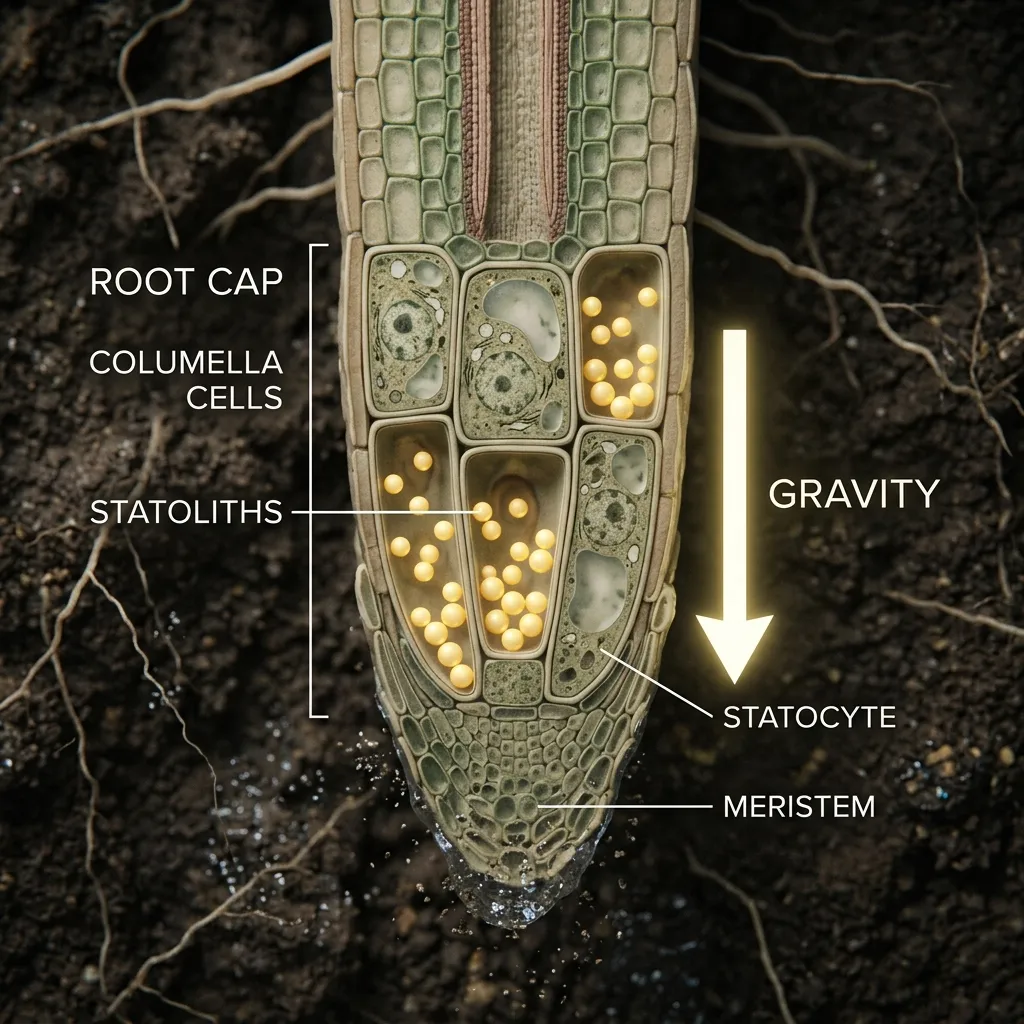 Biological Balance: How sinking starch marbles (statoliths) tell a plant which way is down
Hearing the Gravity
Plants don't have eyes or ears, but they have a sense of balance that is even better than yours. They can "feel" gravity. This superpower is called Gravitropism (Gravity Movement).
Deep inside the cells of the root cap (the very tip of the root), there are special heavy sacks called Statoliths. Think of them like tiny marbles in a water balloon. These marbles are made of dense starch. Because they are heavy, gravity always pulls them to the bottom of the cell.
- If the plant is standing up straight, the marbles sit at the bottom.
- If you tip the plant on its side, the marbles roll and settle on the new bottom side of the cell.
This rolling movement triggers a signal (like a mechanical switch). It tells the plant: "Hey! The gravity is coming from that direction now!"
The Growth Hormone Trick
Once the plant knows where "Down" is, it has to move. But plants don't have muscles. They can't just flex a bicep to turn. Instead, they grow their way into a turn. They use a growth hormone called Auxin.
When the statoliths sink to the bottom, the plant sends Auxin to the cells on the opposite side of the root (the top side). Auxin makes cells grow longer and faster. So, the cells on the Top of the root grow super long, while the cells on the Bottom stay short. This uneven growth forces the root to curve downward.
It is like driving a tank or a tractor: if you spin the right wheels faster than the left wheels, the tank turns left. The plant elongates one side of its body to steer itself through the soil.
Space Plants
This system is so reliant on gravity that scientists wondered: "What happens in space?" On the International Space Station, there is no "Down." The statolith marbles just float in the middle of the cell.
When NASA grows lettuce in space, the plants do get confused. Their roots grow in random directions. To fix this, astronauts have to use Light. Plants have a backup system called Phototropism (growing toward light). In space, they put lights above the plants, and the shoots ignore the lack of gravity and just grow toward the glow.
But here on Earth, gravity is king. Every tree, every blade of grass, and every flower is silently feeling the pull of the planet, using heavy starch marbles to make sure its feet stay in the soil and its head stays in the sun.