
How Do Snakes Slither?
The Big Idea
Explore the fascinating physics and muscle mechanics of moving without arms or legs. Discover how snakes use overlapping scales and four distinct movement patterns to glide gracefully across almost any surface on Earth.
Key Vocabulary & Concepts

Hands-On Observation Checklist
Teacher & Parent Discussion Starters
- Why is understanding how do snakes slither? important in everyday real life?
- What variable or factor had the biggest impact when testing the simulation?
- How does this concept connect to another science topic you have learned about?
How Do Snakes Slither?
Moving Without Limbs
Imagine trying to win a racing sprint with your arms tied behind your back and your feet completely bound together. For a human, this is basically impossible. But for a snake, entirely lacking arms and legs is an incredible evolutionary advantage that famously allows them to seamlessly slide quietly through dense jungle grass and squeeze into unbelievably tight spaces.
Instead of four legs, a snake gracefully relies heavily on an impossibly long, highly flexible spine. While humans only have 24 ribs, a snake is loaded with up to 400 tiny, highly movable ribs. These ribs are connected by nearly 10,000 extremely powerful, tight, heavily intertwined muscles.
The Science of Slithering
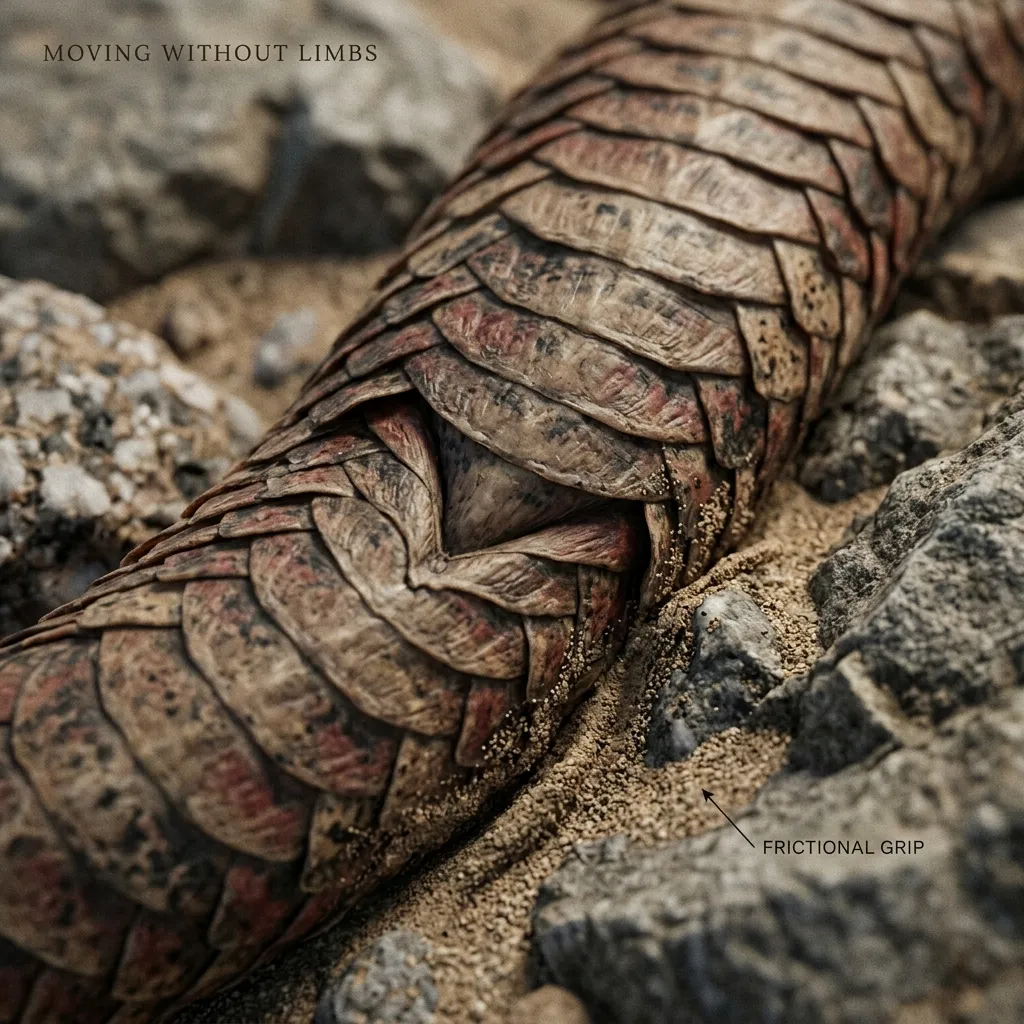
Most snakes use a classic movement called "Serpentine Locomotion" (or undulatory locomotion). This is the famous "S" shape they make as they slither. As the snake flexes its body into waves, the back curves of its body physically push against the ground—grabbing onto tiny rocks, rough dirt, and sticks. Because the bottom of a snake is covered in wide, specialized belly scales that act like the heavy tread on a mountain bike tire, they can easily grip almost any surface.
When desert snakes need to traverse burning hot, shifting sand where normal slithering would just cause them to sink, they use a unique style called "Sidewinding." They literally throw their head sideways and pull their body through the air, touching the hot sand as little as possible. The mechanics of snake movement are so incredibly efficient that scientists and engineers are actively studying them to build futuristic search-and-rescue robots!