How Do Submarines Sink?
The Big Idea
Master the physics of buoyancy and discover how massive steel ships can vanish beneath the waves. Learn how submarines use ballast tanks to control their density and navigate the crushing depths of the deep ocean.
Key Vocabulary & Concepts
Hands-On Observation Checklist
Teacher & Parent Discussion Starters
- Why is understanding how do submarines sink? important in everyday real life?
- What variable or factor had the biggest impact when testing the simulation?
- How does this concept connect to another science topic you have learned about?
How Do Submarines Sink?
Master the physics of buoyancy and discover how massive steel ships can vanish beneath the waves. Learn how submarines use ballast tanks to control their density and navigate the crushing depths of the deep ocean.
How Do Submarines Sink?
The Art of Heavy Sinking
If you drop a heavy boulder in a pool, it brutally sinks to the bottom. If you drop an empty plastic bottle, it actively pops back to the surface. But a military submarine has to flawlessly perform both tricks, hovering perfectly underwater at virtually any depth without sinking straight into the mud or rocketing back to the surface!
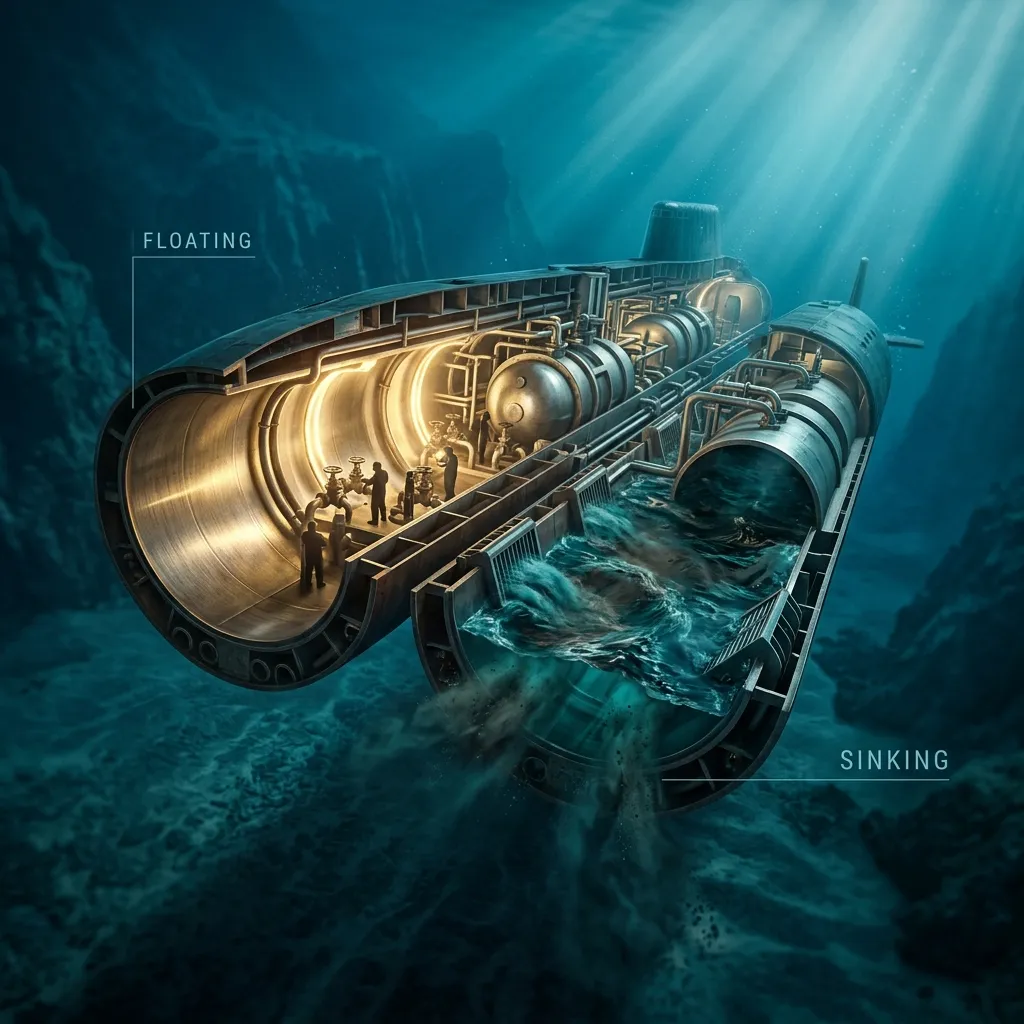
The core secret to this amazing balancing act relies on controlling something called buoyancy. A submarine is essentially wrapped inside two massive metal hulls. The space directly between the inner hull (where the crew actually lives) and the outer hull contains enormous, empty chambers known as ballast tanks.
Bubbles and Ballast
When an amazingly huge metal submarine is peacefully floating on the ocean surface, its massive ballast tanks are mostly filled with standard air. Because air is incredibly lightweight, the sub maintains positive buoyancy, effectively acting like a giant steel beach ball floating perfectly under the sun.
But when the captain orders the incredibly dangerous dive into the deep, dark ocean, giant valves forcefully open on the bottom of the submarine. Thousands of gallons of dense seawater violently flood into the empty ballast tanks, pushing the light air completely out through special escape vents on the top.
As the massive tanks securely fill with extremely heavy seawater, the specific total weight of the submarine dramatically increases. The submarine becomes negatively buoyant and flawlessly sinks into the dark depths. When it's finally time to rise again, high-pressure air is blasted straight back into the tanks, forcibly ejecting the ocean water entirely and letting the heavy sub float gracefully back up to the top!