
How Do Touchscreens Work?
The Big Idea
Uncover the invisible, microscopic electrical grid hiding inside your phone screen. Discover how a thin layer of gold and the natural electricity in your own body allow smooth glass to magically sense your every touch.
Key Vocabulary & Concepts

Hands-On Observation Checklist
Teacher & Parent Discussion Starters
- Why is understanding how do touchscreens work? important in everyday real life?
- What variable or factor had the biggest impact when testing the simulation?
- How does this concept connect to another science topic you have learned about?
How Do Touchscreens Work?
Uncover the invisible, microscopic electrical grid hiding inside your phone screen. Discover how a thin layer of gold and the natural electricity in your own body allow smooth glass to magically sense your every touch.
How Do Touchscreens Work?
The Magic Glass
Fifty short years ago, if you confidently told an engineer that you could flawlessly control a complex television simply by gently swiping your bare finger across the solid glass, they would absolutely think you were a practicing wizard.
Today, we casually touch glass all day long. We aggressively swipe, gently pinch, and rapidly tap. It feels entirely seamless and undeniably magical. But physical glass itself is incredibly boring; it is literally just melted sand. Glass doesn't have a central nervous system. It can't physically "feel" the heavy weight of your finger pressing down on it.
So how does your lifeless phone know exactly where you are touching it?
A breathtaking extreme macro photograph of a glowing smartphone screen being gently touched by a human finger
You Are Electric
The massive secret isn't just hidden inside the phone; it's hiding inside you.
The human body is a highly effective electrical conductor. Our complex brains constantly send weak electrical signals to our twitching muscles. Because our biological bodies are essentially big bags of salty water, we are absolutely fantastic at carrying specialized electricity. Without even realizing it, you are constantly holding a very small, perfectly natural electrical charge.
Modern smartphones heavily rely on this biological quirk, using a brilliant technology officially called Capacitive Touch. The word "Capacitive" comes from "Capacitor"—an electronic component that actively stores an electrical charge.
The Invisible Grid
If you took your smartphone and placed the screen under an incredibly powerful electron microscope, you wouldn't just see colored pixels. You would be shocked to see a massive, completely transparent grid of microscopic wires tightly woven directly into the glass. These invisible wires are made of a highly specialized material called ITO (Indium Tin Oxide).
This massive, invisible grid is constantly charged with a very weak, totally harmless electrical current. It projects a delicate electrostatic field completely across the entire surface of the glass.
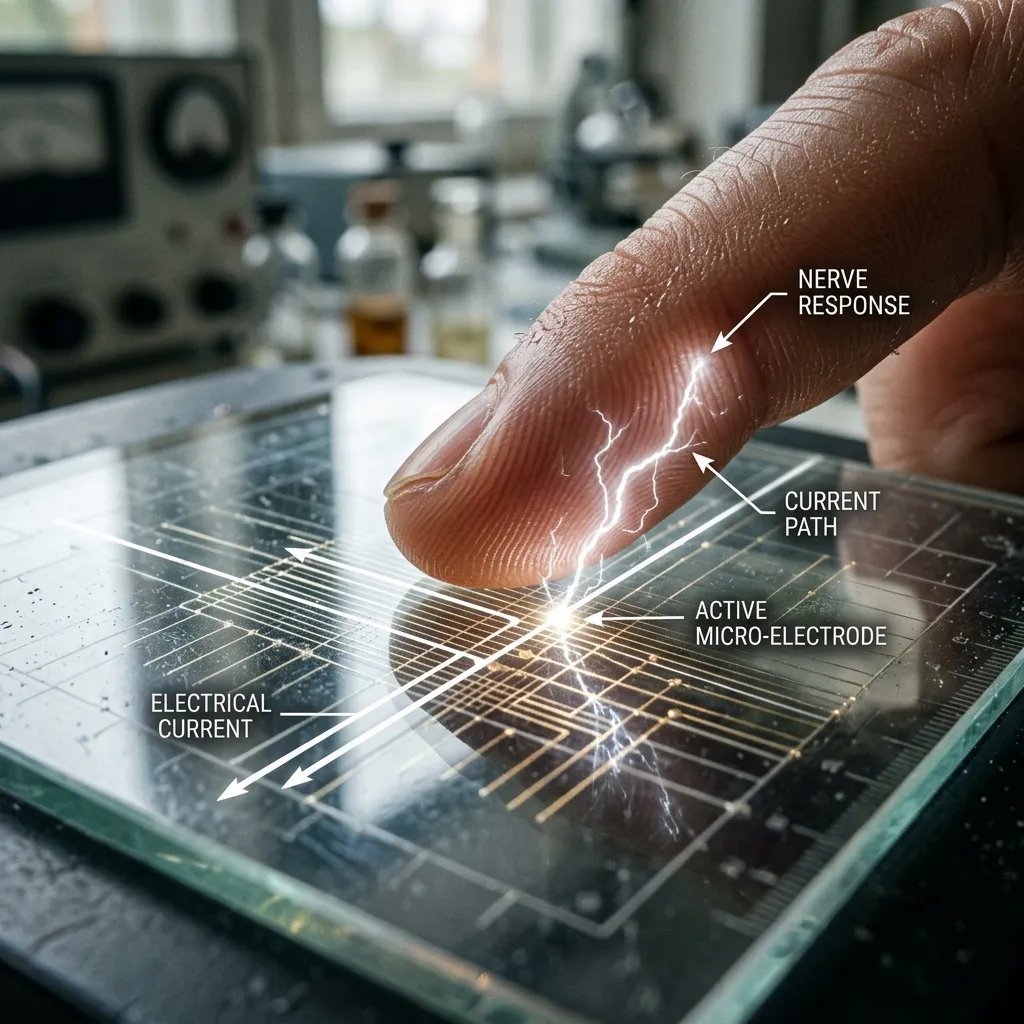 A beautiful, cinematic documentary-style illustration of a microscopic transparent wire grid under a glass screen showing electrical current leaping into a finger
When your bare finger gently touches the glass, your salty body acts exactly like an electrical sponge. Because you are highly conductive, an incredibly tiny bit of the electrical charge instantly jumps directly from the screen's invisible grid into your finger! You absolutely don't feel it (the voltage is microscopic), but the phone's computer feels it instantly.
The phone's ultra-fast processor aggressively watches the entire grid thousands of times a second. It suddenly notices: "Hey! There was a massive voltage drop at horizontal Row 45 and vertical Column 112!" It instantly calculates exactly where the electricity leaked out into your body. That exact intersection is your tap.
Why Gloves Fail
This invisible electrical magic perfectly explains why your highly advanced phone completely ignores you when you wear thick winter gloves.
Heavy wool, thick cotton, and tough leather are scientifically known as Insulators. They completely block electricity from flowing. When you touch the screen with a heavy glove, the electricity cannot jump from the screen to your finger. The electrical bridge is totally broken. Because the grid doesn't detect a voltage drop, the phone stubbornly thinks absolutely no one is there.
(This is exactly why specialized "touchscreen gloves" work! They have highly conductive silver threads secretly woven directly into the fingertips to successfully complete the electrical circuit).
Capacitive screens entirely changed the modern world because they finally allowed us to touch our computers gently. We don't have to violently mash the screen; we just have to make electrical contact. When you swipe your phone, you are quite literally, physically merging your body's electrical field with the machine's!