How Do We Remember Things?
The Big Idea
Explore the microscopic architecture of the human brain to discover how memories are made. Learn how billions of neurons create and strengthen physical connections to store everything from your first day of school to your favorite song.
Key Vocabulary & Concepts

Hands-On Observation Checklist
Teacher & Parent Discussion Starters
- Why is understanding how do we remember things? important in everyday real life?
- What variable or factor had the biggest impact when testing the simulation?
- How does this concept connect to another science topic you have learned about?
How Do We Remember Things?
Explore the microscopic architecture of the human brain to discover how memories are made. Learn how billions of neurons create and strengthen physical connections to store everything from your first day of school to your favorite song.
How Do We Remember Things?
The Library of You
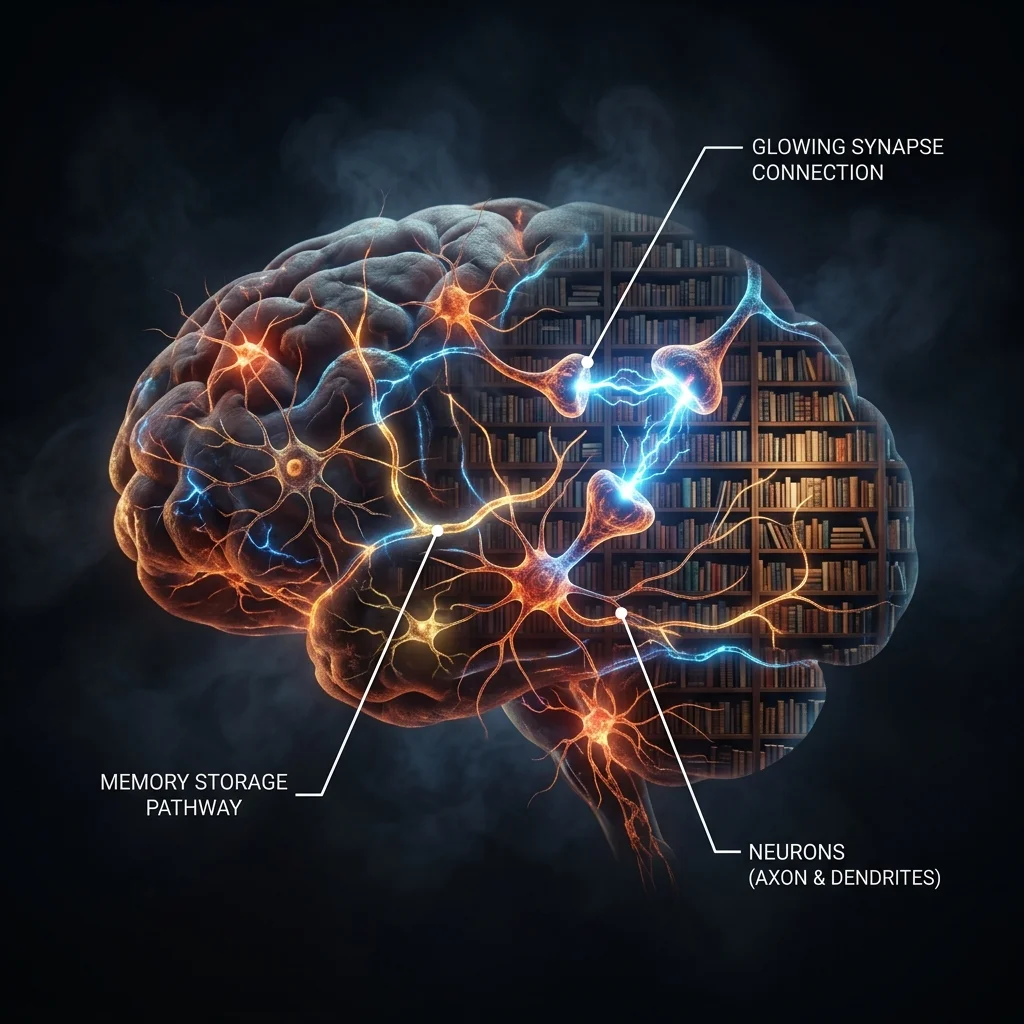
Imagine walking into a library. There are millions of books. This is your brain. It holds everything: the name of your first pet, the lyrics to "Happy Birthday," the smell of your grandma's kitchen, and the Pythagorean theorem. But unlike a library, there are no books. There is no paper. There is only Jelly and Electricity.
The Web of Wires
Your brain is made of 86 billion tiny cells called Neurons. Think of a neuron like a tree. It has a central trunk (Axon) and thousands of branches (Dendrites). When you learn something new—like "Fire is Hot"—your brain connects two neurons together. It sends an electrical spark from one branch to another. The gap between them is called a Synapse.
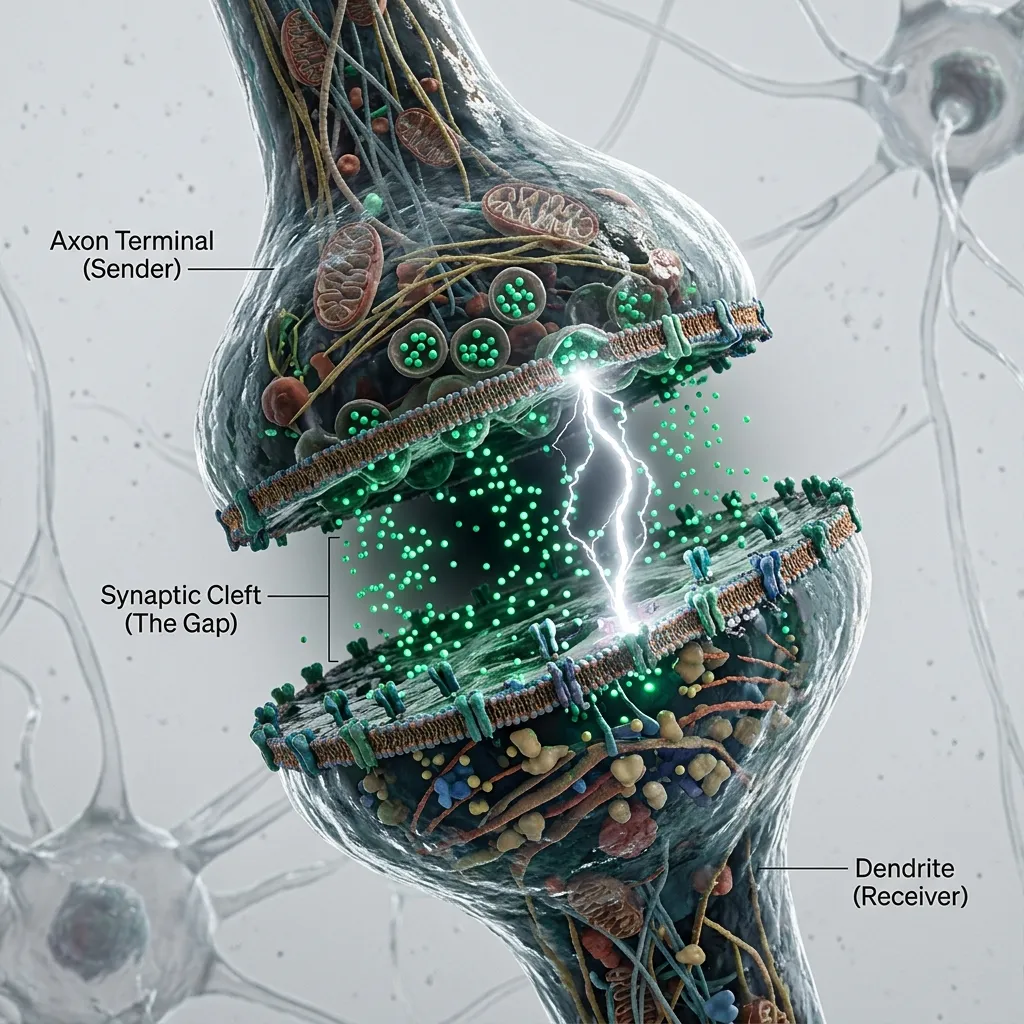 A neural synapse showing neurotransmitters and an electrical spark jumping the gap between neurons
A memory isn't a thing; it's a physical connection between neurons. When the spark jumps the gap, you 'remember.'
A neural synapse showing neurotransmitters and an electrical spark jumping the gap between neurons
A memory isn't a thing; it's a physical connection between neurons. When the spark jumps the gap, you 'remember.'
The Path through the Grass
The first time you learn something, the connection is weak. It is like walking through a field of tall grass. You leave a faint trail, but the grass springs back up. If you never walk there again, the trail disappears. Use it or lose it.
But if you practice—if you walk that path every day—the grass gets trampled down. The path becomes a dirt road. Then a paved highway. This is why studying works. Every time you repeat a fact, your brain physically strengthens the synapse. It wraps the wire in insulation (Myelin) to make the signal travel faster. By the time you are an expert, the signal can travel effectively at 200 mph.
The Save Button: The Hippocampus
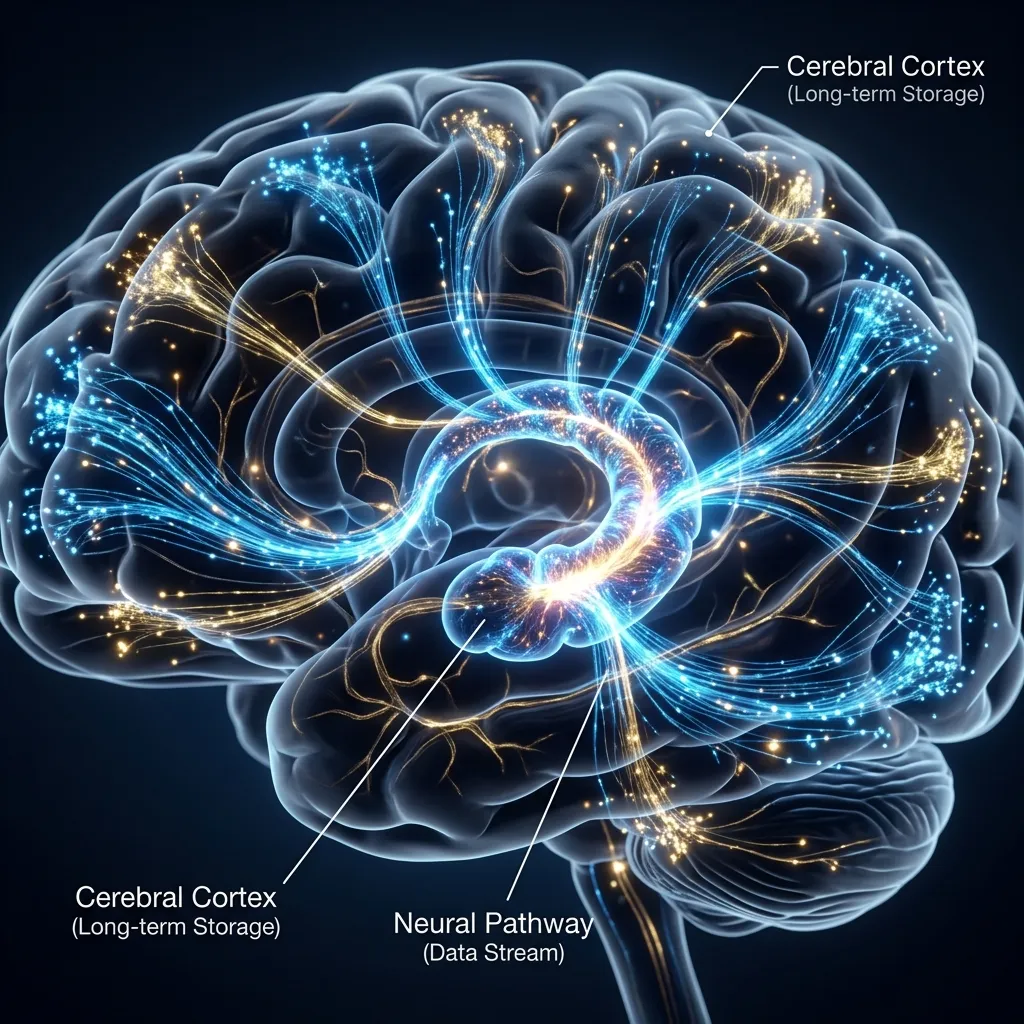
Not everything gets saved. You don't remember what you had for lunch 3 weeks ago. The decision of what to keep and what to trash is made by a seahorse-shaped part of the brain called the Hippocampus. It is the Editor.
- Boring info? Delete.
- Emotional/Scary/Important info? SAVE.
This is why you remember your first kiss or a scary car accident vividly. Emotion releases chemicals (like adrenaline) that tell the Hippocampus: "IMPORTANT! WRITE THIS DOWN IN PERMANENT MARKER!"
[Diagram: The Brain Map] Description: A side view of a human brain.
- Highlight: A small, curved Seohorse-shaped organ deep in the center labeled "Hippocampus."
- Arrows: Information goes IN to the Hippocampus, is sorted, and then sent OUT to be stored in the cortex (outer layer). Caption: The Hippocampus decides which memories are worth keeping.
The Smell of the Past
Have you ever smelled a crayon and suddenly remembered Kindergarten? That happens because of geography. The Olfactory Bulb (your smell center) is located right next to the Hippocampus (memory) and Amygdala (emotion). They are neighbors. When you smell something, the signal takes a shortcut straight to the memory center, bypassing the logical part of your brain. It is the closest thing we have to a time machine.