
How Does GPS Work?
The Big Idea
Discover the invisible network of satellites orbiting Earth that helps you find your way. Learn how high-tech atomic clocks and complex math allow your phone to pinpoint your exact location anywhere on the planet.
Key Vocabulary & Concepts
Hands-On Observation Checklist
Teacher & Parent Discussion Starters
- Why is understanding how does gps work? important in everyday real life?
- What variable or factor had the biggest impact when testing the simulation?
- How does this concept connect to another science topic you have learned about?
How Does GPS Work?
Discover the invisible network of satellites orbiting Earth that helps you find your way. Learn how high-tech atomic clocks and complex math allow your phone to pinpoint your exact location anywhere on the planet.
How Does GPS Work?
The Blue Dot Miracle
Open Google Maps. A blue dot appears. It shows you exactly where you are standing, down to the meter. You walk, and the dot moves with you. We use this every day to order pizza, find our way home, and track our runs. But have you ever stopped to think how impossible this is? Your phone doesn't have eyes. It can't see the street signs. How does a piece of plastic in your pocket know exactly where it is on a planet of 197 million square miles?
The Clocks in the Sky
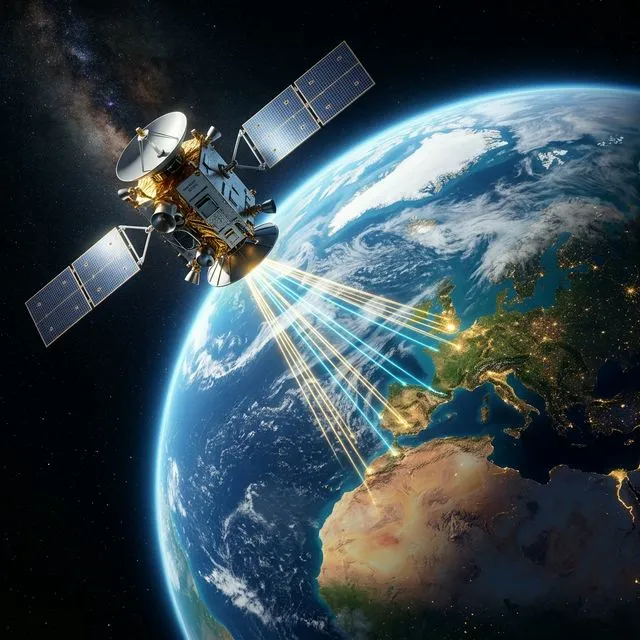
The answer lies 12,000 miles above your head. Right now, there is a constellation of about 30 satellites zooming around the Earth at 9,000 mph. This is the Global Positioning System (GPS).
These satellites are not taking pictures of you. They are basically flying clocks. Inside every satellite is an Atomic Clock—the most precise timekeeper in the universe. It is accurate to one billionth of a second.
The satellite sends out a radio signal that says two things:
- "I am Satellite #5." (Identity)
- "I sent this message at 12:00:00.000001." (Time)
The Math: Trilateration
Your phone (the Receiver) listens for these signals. It catches the signal from Satellite #5. It looks at its own internal clock and says, "Okay, I received this message at 12:00:00.050000."
It does the math.
- Signal Sent: ...01
- Signal Arrived: ...05
- Delay: 0.04 seconds.
Since radio waves travel at the Speed of Light, your phone can calculate exactly how far away the satellite is. Distance = Speed x Time.
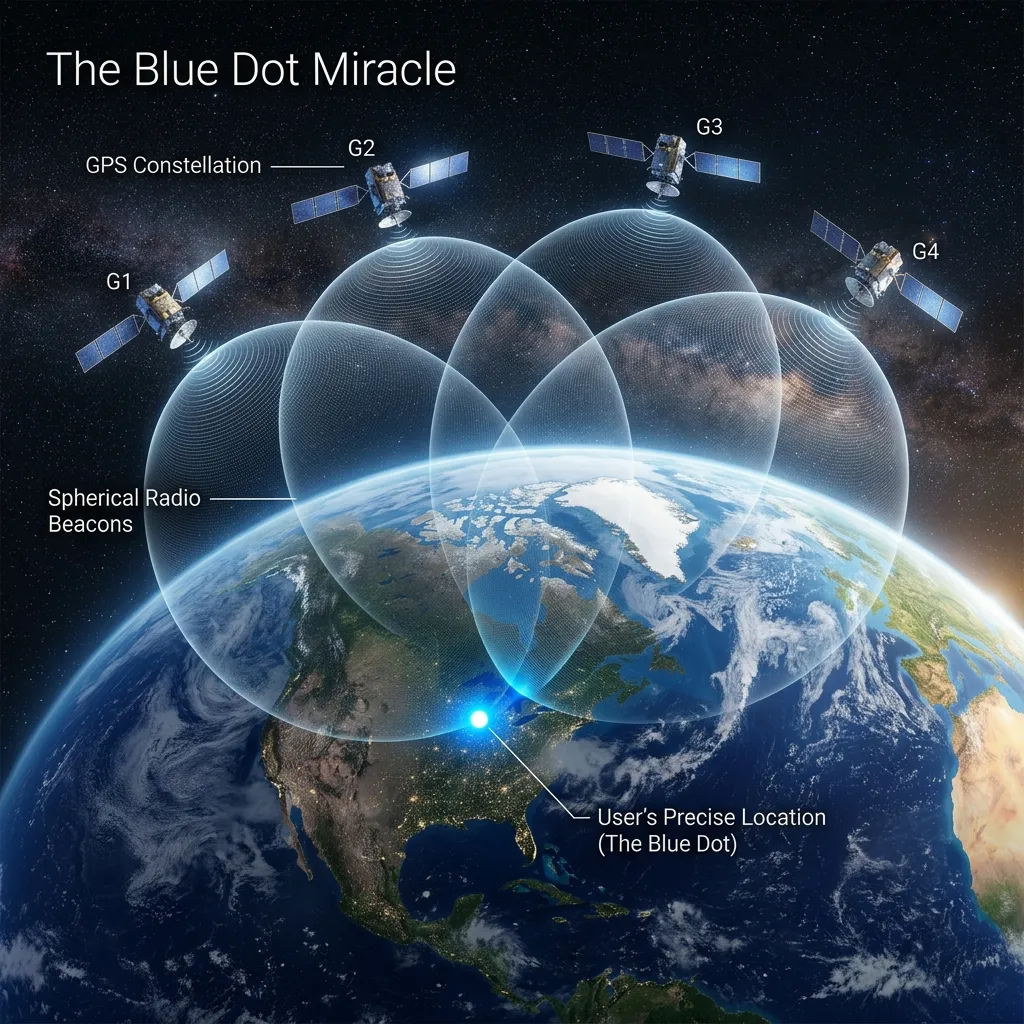
But knowing you are "10,000 miles from Satellite #5" isn't enough. That just means you are somewhere on a giant sphere around that satellite. You could be in London, or you could be in the middle of the ocean.
So, your phone listens for Satellite #6. And Satellite #7. And Satellite #8. It draws imaginary spheres around each one.
- Where 2 spheres intersect, you get a circle.
- Where 3 spheres intersect, you get two points.
- Where 4 spheres intersect, you get One Point. That point is You.
Einstein's Correction
This system requires insane precision. If the atomic clocks were off by just one millisecond (a thousandth of a second), the error would be 186 miles. Your GPS would say you were in the next state.
This is where physics gets weird. In 1915, Albert Einstein proved that Time is not constant.
- Special Relativity: Fast-moving objects experience time slower. (Satellites are fast, so their clocks slow down by 7 microseconds a day).
- General Relativity: Objects in lower gravity experience time faster. (Satellites are far from Earth, so their clocks speed up by 45 microseconds a day).
Net result: The clocks in space run 38 microseconds faster per day than clocks on Earth. If engineers didn't program the satellites to account for Einstein's theory of relativity, the entire GPS system would drift by about 6 miles (10 km) every single day. Within a week, it would be useless.
So every time you look at that blue dot to find a coffee shop, you are testing Einstein's theory of curved space-time. And it works.