
How Gravitational Waves Work
The Big Idea
Uncover how colliding black holes send ripples across the cosmic fabric of spacetime at the speed of light, and how scientists use 4-kilometer laser interferometers to listen to the whisper of the universe.
Key Vocabulary & Concepts
Hands-On Observation Checklist
Teacher & Parent Discussion Starters
- Why is understanding how gravitational waves work important in everyday real life?
- What variable or factor had the biggest impact when testing the simulation?
- How does this concept connect to another science topic you have learned about?
How Gravitational Waves Work
Uncover how colliding black holes send ripples across the cosmic fabric of spacetime at the speed of light, and how scientists use 4-kilometer laser interferometers to listen to the whisper of the universe.
How Gravitational Waves Work: The Cosmic Symphony of Spacetime
Imagine sitting beside a perfectly still mountain lake on a moonlit night. If two massive stones drop into the center and begin swirling around each other in a frantic whirlpool, circular ripples spread outward across the water, carrying energy to distant shores.
Now replace the water with the fabric of space and time itself, and replace the stones with two gargantuan black holes, each containing thirty times the mass of our Sun, spiraling into each other at half the speed of light.
This is not science fiction. It is the reality of our universe: gravitational waves.
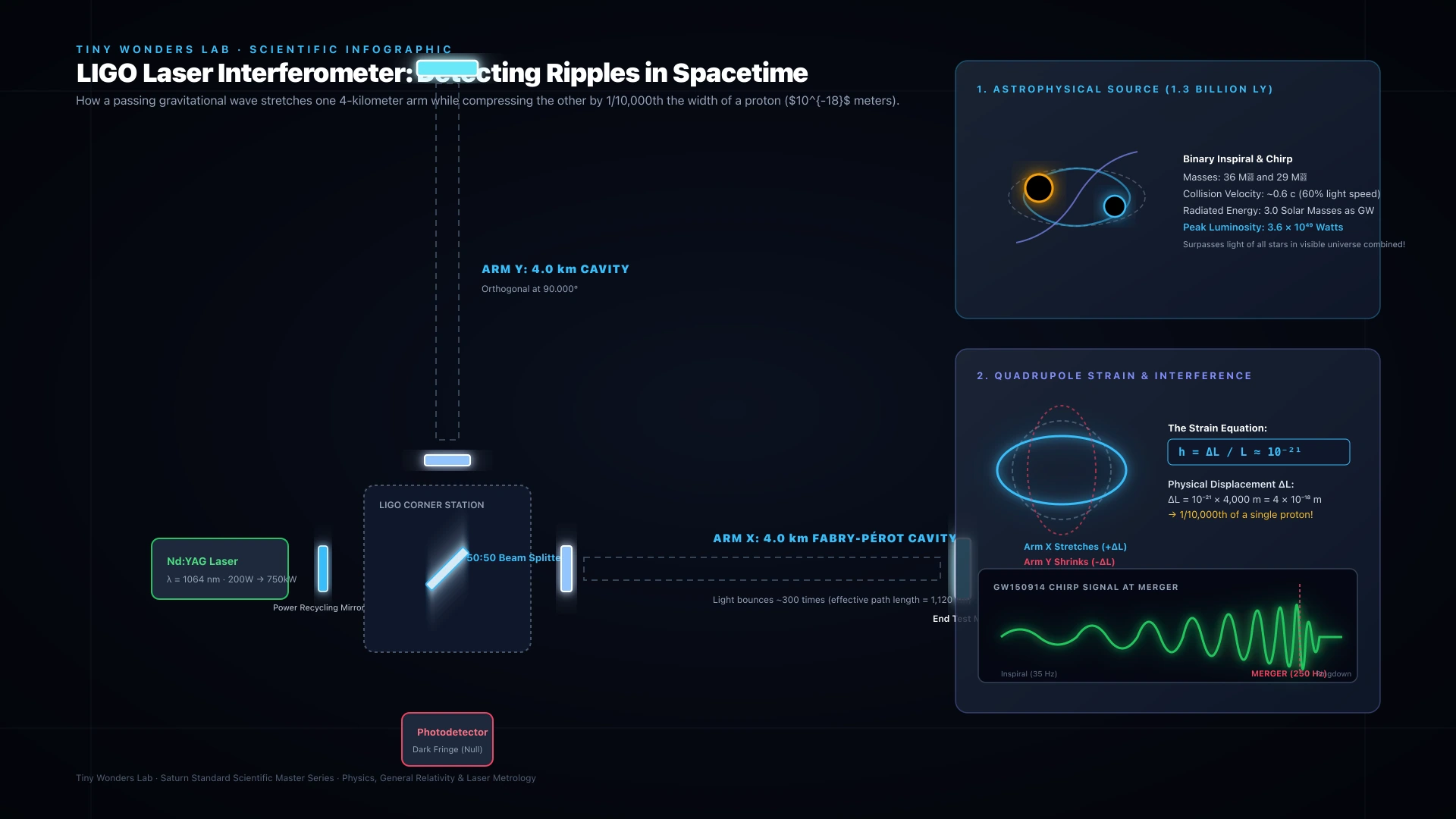
LIGO Laser Interferometer and Gravitational Wave Detection
Einstein’s Spacetime Trampoline
For centuries, Sir Isaac Newton’s law of universal gravitation ruled physics. Newton viewed space as a rigid, unmoving stage upon which planets and stars orbited according to invisible, instantaneous forces.
In 1915, Albert Einstein shattered this picture with his General Theory of Relativity. Einstein proposed that space and time are not a rigid backdrop. Instead, they are woven into a four-dimensional, flexible fabric called spacetime.
Think of spacetime like a vast, stretched trampoline:
- Place a light marble on the trampoline, and the fabric dips slightly.
- Place a heavy bowling ball on it, and it curves deeply downward.
- If you roll a marble past the bowling ball, it follows the curved contour created by the heavy ball—which we perceive as gravity.
In 1916, Einstein calculated a startling consequence of his equations: if two massive objects accelerate around each other, they cannot simply slide across the trampoline without disturbing it. They must shake the fabric, sending out ripples in spacetime traveling at the speed of light.
Einstein dubbed these ripples gravitational waves. Yet, because gravity is the weakest of the four fundamental forces, Einstein believed these tremors would be so minuscule that humanity would never possess the technology to detect them.
The Dance of Giants: Inspiral, Coalescence, and the "Chirp"
Where do detectable gravitational waves come from? Ordinary movements—like a car accelerating down a highway or an airplane banking in the clouds—create gravitational waves, but their energy is astronomically microscopic.
To shake the cosmos noticeably, you need cataclysmic cosmic engines:
- Binary Black Holes: Two stellar-mass or supermassive black holes trapped in each other’s gravitational grip.
- Binary Neutron Stars: The ultra-dense remnants of exploded giant stars, packing the mass of our Sun into a sphere the size of a city.
- Supernovae: Asymmetric core-collapse stellar explosions.
As two black holes orbit each other, their quadrupole motion continuously radiates gravitational wave energy outward into space. Because energy is drained from the orbit, the black holes inexorably draw closer together.
As their orbital radius $R$ shrinks, Keplerian orbital mechanics force them to orbit faster and faster. Over millions of years, the orbit decays slowly. But in the final fractions of a second, the dance turns into a terrifying relativistic frenzy:
- The black holes whirl around each other hundreds of times per second, reaching over 60% of the speed of light.
- The gravitational wave frequency rises exponentially—from a deep 35 Hz rumble to a piercing 250 Hz peak.
- In the final millisecond, they collide and coalesce into a single, rotating Kerr black hole.
This rapid upward sweep in frequency and amplitude is known to astrophysicists as the "Chirp". During the peak merger of the historic GW150914 event, the power radiated as gravitational waves exceeded $3.6 \times 10^{49}$ Watts—more power than the light emitted by all the stars in the observable universe combined!
Measuring the Impossible: LIGO and the 4-Kilometer Laser Ruler
How can we detect a wave that does not shine, cannot be reflected, and passes right through solid planets as if they were made of mist?
The answer lies in LIGO—the Laser Interferometer Gravitational-Wave Observatory—with twin facilities located in Hanford, Washington, and Livingston, Louisiana.
LIGO is an engineering marvel designed around a giant Michelson laser interferometer:
- The L-Shaped Arms: Two perpendicular vacuum tubes stretch exactly 4.0 kilometers (2.5 miles) across the landscape. They represent the purest vacuum on Earth ($10^{-9}$ torr).
- The Beam Splitter: An ultra-pure quartz optic splits a stabilized 1064-nanometer laser beam into two identical beams, sending one down Arm X and the other down Arm Y.
- Fabry-Pérot Cavities: At the ends of the arms, 40-kilogram test mass mirrors, suspended by spider-web-thin fibers of fused silica, bounce the laser light back and forth roughly 300 times before it recombines at the beam splitter.
- Destructive Interference (The Dark Fringe): In the absence of a gravitational wave, the lengths of the two arms are tuned so that the light waves returning from Arm X and Arm Y meet perfectly out-of-phase (crest meets trough), canceling each other out completely. The photodetector sees absolute darkness.
The Quadrupole Squeeze
When a gravitational wave sweeps through Earth, its quadrupole strain alternately stretches space in one direction while compressing it in the perpendicular direction.
As Arm X stretches by a tiny distance $+\Delta L$, Arm Y simultaneously shrinks by $-\Delta L$. Half a cycle later, the distortion reverses!
Because the arm lengths are no longer identical, the laser beams no longer cancel out perfectly. A flicker of laser light escapes through the beam splitter and strikes the photodetector. By monitoring the brightness of that flicker, LIGO reconstructs the exact waveform of the passing spacetime wave.
How small is this movement? The strain amplitude measured by LIGO is:
$$h = \frac{\Delta L}{L} \approx 10^{-21}$$
Over LIGO’s 4,000-meter arm, the mirror shifts by only:
$$\Delta L \approx 4 \times 10^{-18} \text{ meters}$$
That is less than 1/10,000th the diameter of a single subatomic proton! It is equivalent to measuring the distance from Earth to the nearest star (Proxima Centauri, 4.2 light-years away) with an accuracy finer than the width of a human hair.
Multi-Messenger Astronomy: A Brand New Sense
On September 14, 2015, at 5:51 AM EDT, the twin LIGO detectors simultaneously recorded a 0.2-second chirp signal that had traveled through space for 1.3 billion years: the collision of two black holes of 36 and 29 solar masses.
For this monumental triumph, the 2017 Nobel Prize in Physics was awarded to Rainer Weiss, Barry C. Barish, and Kip S. Thorne.
Then, on August 17, 2017, LIGO and the European Virgo detector captured the collision of two neutron stars (GW170817). Just 1.7 seconds later, space telescopes detected a burst of gamma rays from the exact same coordinates. In the hours that followed, optical, radio, and X-ray observatories around the globe witnessed the radioactive glow of a kilonova—confirming that the cosmic collision had forged vast clouds of heavy elements, including gold, platinum, and uranium.
Humans had spent thousands of years observing the universe through light. With gravitational waves, humanity has opened its ears. We are no longer deaf to the violent symphonies of dark, unseen space.
🌟 Fun Facts & Did You Know?
- Earth Stretches Too: As a gravitational wave passes through your room right now, you and your desk stretch and squeeze by an imperceptible fraction of a subatomic particle. You never feel it because every atom and measuring tape stretches by the exact same ratio!
- Space is Stiffer Than Diamond: Because it takes the collision of two black holes to warp spacetime by just $10^{-18}$ meters, physicists often describe spacetime as the stiffest, most elastic medium in the universe.
- Space-Based Interferometers: NASA and ESA are building LISA (Laser Interferometer Space Antenna), a space observatory featuring three spacecraft flying in a triangular formation 2.5 million kilometers apart, capable of detecting the massive gravitational rumble of supermassive black holes at the dawn of time.
- You Are Wearing Stardust: The heavy gold and platinum in jewelry were primarily created during binary neutron star mergers like GW170817, where extreme gravitational waves scattered newly synthesized elements across the galaxy!
Inspire Lifelong Curiosity
Join 15,000+ teachers, homeschool parents, and curious minds. Get free weekly hands-on STEM experiments, printable classroom lab worksheets, and new wonder releases delivered straight to your inbox.
Related Wonders
 Space
How Do Rockets Work in Space?
If space is a total vacuum with no air to push against, how does a massive rocket ship actually move forward? Unlock the secrets of Newton's Third Law and the physics of fire that allow us to reach the stars.
 Space
How Does GPS Work?
Discover the invisible network of satellites orbiting Earth that helps you find your way. Learn how high-tech atomic clocks and complex math allow your phone to pinpoint your exact location anywhere on the planet.
 Space
Quantum Entanglement: Spooky Action
Explore the mind-bending world of quantum physics and 'spooky action at a distance.' Discover how two tiny particles can remain perfectly connected across the universe, sharing information instantly regardless of the distance between them.