
How Nuclear Fusion Works
The Big Idea
Discover how stars crush atomic nuclei together to unleash limitless clean energy, and how scientists on Earth are using giant magnetic donuts to capture the power of the Sun.
Key Vocabulary & Concepts
Hands-On Observation Checklist
Teacher & Parent Discussion Starters
- Why is understanding how nuclear fusion works important in everyday real life?
- What variable or factor had the biggest impact when testing the simulation?
- How does this concept connect to another science topic you have learned about?
How Nuclear Fusion Works
Discover how stars crush atomic nuclei together to unleash limitless clean energy, and how scientists on Earth are using giant magnetic donuts to capture the power of the Sun.
How Nuclear Fusion Works: Creating a Star on Earth
Every second of every day, our Sun quietly converts 600 million tons of hydrogen into helium. It does not burn like wood or gasoline in a campfire—there is no oxygen in deep space. Instead, it unleashes the most powerful, primal force in the cosmos: Thermonuclear Fusion.
For nearly a century, humanity has dreamed of capturing that stellar fire inside a bottle on Earth. If we succeed, a single gallon of ocean water could provide as much clean, carbon-free energy as 300 gallons of gasoline, powering humanity for millions of years without smog, greenhouse gases, or radioactive fallout.
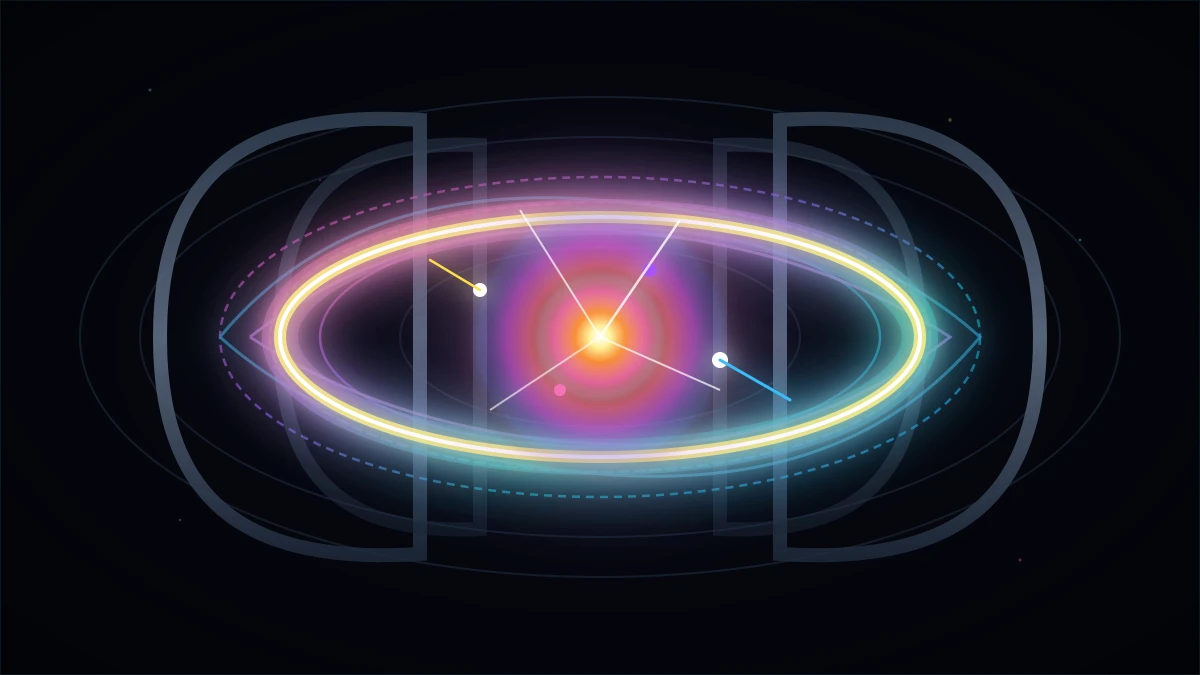 A breathtaking cinematic view of a thermonuclear fusion plasma core inside a futuristic magnetic confinement Tokamak chamber
The Electrostatic Wall: The Coulomb Barrier
To create fusion, you must force atomic nuclei to touch. But there is a massive cosmic roadblock: electric charge.
Every atomic nucleus is packed with positively charged protons. As you have probably noticed playing with bar magnets, opposite charges attract, but like charges violently repel each other. This repulsion is called the Coulomb Barrier.
Try pushing two strong North poles of refrigerator magnets together. As they get closer, the resisting force spikes exponentially. At subatomic distances, this repulsive force is immense. Left to their own devices, atomic nuclei will swerve away long before they ever get close enough to fuse.
Quantum Tunneling: The Subatomic Miracle
So how does the Sun ever manage to fuse atoms together? The secret lies in a combination of blistering heat, crushing gravity, and the bizarre rules of quantum physics:
- Extreme Thermal Kinetic Speed: Deep in the solar core, temperatures exceed 15 million degrees Celsius. Matter cannot exist as a solid, liquid, or gas—it is stripped into a swirling, electrified soup of bare nuclei and free electrons called Plasma.
- Relentless Collisions: At these astronomical temperatures, ions hurtle through space at hundreds of kilometers per second, crashing into each other with ferocious violence.
- Quantum Tunneling: Even at 15 million degrees, classical physics says the protons still lack the energy to clear the Coulomb Barrier. But quantum mechanics reveals that subatomic particles are not hard marbles—they are fuzzy waves of probability. Every so often, a proton literally "teleports" or tunnels right through the electrostatic barrier!
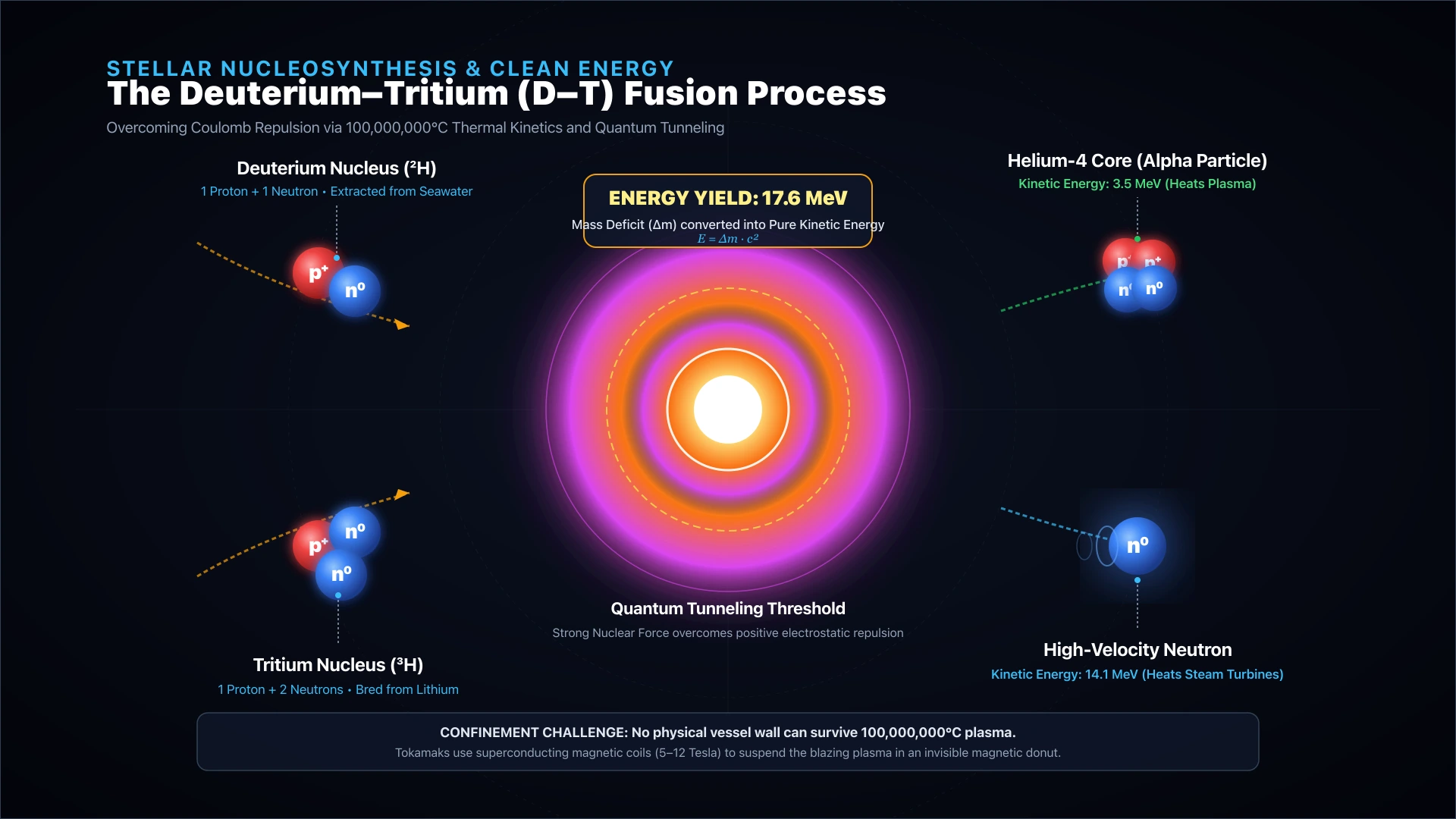
Once the protons penetrate within one femtometer ($10^{-15}$ meters) of each other, an even mightier force takes over: the Strong Nuclear Force. Like cosmic superglue, the strong force overcomes electric repulsion and snaps the nuclei together into a brand-new element.
An educational documentary diagram showing the Deuterium-Tritium fusion reaction, quantum tunneling, and the release of Helium-4 and a 14.1 MeV neutron
Deuterium, Tritium, and Einstein's Formula ($E = mc^2$)
On Earth, we cannot recreate the colossal gravitational pressure of the entire Sun. To make fusion happen in a human-built laboratory, we use two special heavy isotopes of hydrogen:
- Deuterium ($^2\text{H}$): A hydrogen atom with one proton and one neutron. It is abundant on Earth—roughly one in every 5,000 hydrogen atoms in our oceans is deuterium. There is enough deuterium in seawater to power civilization for billions of years!
- Tritium ($^3\text{H}$): A hydrogen atom with one proton and two neutrons. Tritium is rare in nature, but it can be bred inside the reactor itself using lithium.
When Deuterium and Tritium smash together, they fuse into a Helium-4 nucleus ($\alpha$-particle) and spit out a high-velocity free neutron.
Here is the wonder: if you weigh the starting ingredients (Deuterium + Tritium) on an impossibly sensitive scale, and then weigh the products (Helium + Neutron), the products are slightly lighter! A tiny sliver of mass ($\Delta m$) has mysteriously vanished.
That missing mass was not destroyed. As Albert Einstein proved with his famous equation $E = mc^2$, mass and energy are two sides of the same coin. Because the speed of light ($c$) squared is a gargantuan number ($90,000,000,000,000,000$), even an infinitesimal speck of lost matter converts into a staggering 17.6 Mega-electronvolts (MeV) of pure kinetic energy!
Taming 100 Million Degrees: The Tokamak Magnetic Cage
Because we lack the Sun's immense gravity, Earth-based fusion reactors must heat their plasma to over 100 to 150 million degrees Celsius—ten times hotter than the core of the Sun!
This presents a legendary engineering puzzle: What bowl do you put a 100-million-degree star in?
Any physical material known to science—steel, tungsten, titanium, or diamond—would instantly vaporize on contact. The solution is to hold the star with an invisible container: Magnetic Fields.
Because plasma is made of charged ions and electrons, magnetic fields exert a physical Lorentz force that bends their trajectories into tight spirals. The most successful magnetic cage ever built is called a Tokamak—a giant, hollow metallic donut surrounded by powerful superconducting electromagnets.
These superconducting magnets, cooled with liquid helium to $-269^\circ\text{C}$ (near absolute zero), generate magnetic fields up to 12 Tesla (thousands of times stronger than Earth's magnetic field). The fields twist the burning plasma into a continuous floating ribbon, keeping the scorching core suspended safely centimeters away from the cold vacuum chamber walls.
The Holy Grail of Clean Energy
Why are scientists across the globe investing billions of dollars into projects like ITER (the International Thermonuclear Experimental Reactor in France) and next-generation private fusion start-ups?
- Zero Meltdown Risk: Unlike traditional nuclear fission plants, a fusion reactor contains only a few grams of fuel at any moment. If anything goes wrong, the plasma cools in milliseconds and the reaction instantly turns off—making a runaway meltdown physically impossible.
- No Long-Lived Radioactive Waste: Fusion produces harmless helium (the same gas used in party balloons). The reactor walls become mildly activated by neutron bombardment, but this radioactivity decays safely in less than 100 years, compared to tens of thousands of years for fission waste.
- Zero Carbon Emissions: Fusion produces zero carbon dioxide or smog. It is an uninterrupted, base-load power source that does not depend on whether the sun is shining or the wind is blowing.
Controlled fusion is humanity's ultimate grand challenge: lighting our own miniature star on Earth to power a clean, sustainable future for generations to come.
Fast Facts
- The Lawson Criterion: To achieve net energy gain ($Q > 1$), a fusion reactor must satisfy the triple product: high plasma density ($n$), sufficient core temperature ($T$), and long energy confinement time ($\tau_E$).
- Hotter than the Sun: Earth's fusion reactors run at 150 million °C because the Sun's core density is 150 times greater than water, while human reactors operate in a near-vacuum!
- Ocean Power: The deuterium in a single bathtub of water contains the energy equivalent of burning 40 tons of coal.
- Helium Ash: The only direct byproduct of D-T fusion is non-toxic helium gas, which can be harvested and used for medical MRI machines and scientific cooling.
Related Wonders
 Physics
How Do Magnets Work?
Explore the invisible, quantum-level magic happening inside a piece of metal. Discover how spinning electrons create a powerful force field that allows magnets to reach out and pull objects through thin air without ever touching them.
 Physics
Quicksand: The Hollywood Lie
Separate Hollywood myth from reality in this deep dive into quicksand. Discover the non-Newtonian physics that make this mixture of sand and water so strange, and learn the simple, life-saving secret to escaping its grip.
 Physics
What Is A Mirage?
Explore the bizarre physics of atmospheric refraction that tricks your brain into seeing water in a baking hot desert. Discover how temperature layers in the air bend light to create realistic but impossible optical illusions.