
How Does Photosynthesis Work?
The Big Idea
Explore the incredible biological engine that turns sunlight into food. Discover how plants use chlorophyll to capture the sun's energy, transforming water and air into the sugar and oxygen that all life on Earth depends on.
Key Vocabulary & Concepts
Hands-On Observation Checklist
Teacher & Parent Discussion Starters
- Why is understanding how does photosynthesis work? important in everyday real life?
- What variable or factor had the biggest impact when testing the simulation?
- How does this concept connect to another science topic you have learned about?
Photosynthesis: The Sugar Factory
Eating Sunlight
Plants are the greatest alchemists in the universe. They perform a magic trick that human science still struggles to replicate efficiently. They take three ingredients that are free and abundant:
- Sunlight (Energy)
- Water (from the dirt)
- Carbon Dioxide (from the air) And they combine them to create solid food (Sugar). This process is called Photosynthesis (Greek for "Putting together with Light"). Every apple, potato, and grain of rice you have ever eaten is literally just stored sunlight held together by carbon atoms. If plants went on strike tomorrow, every animal on Earth would starve within months.
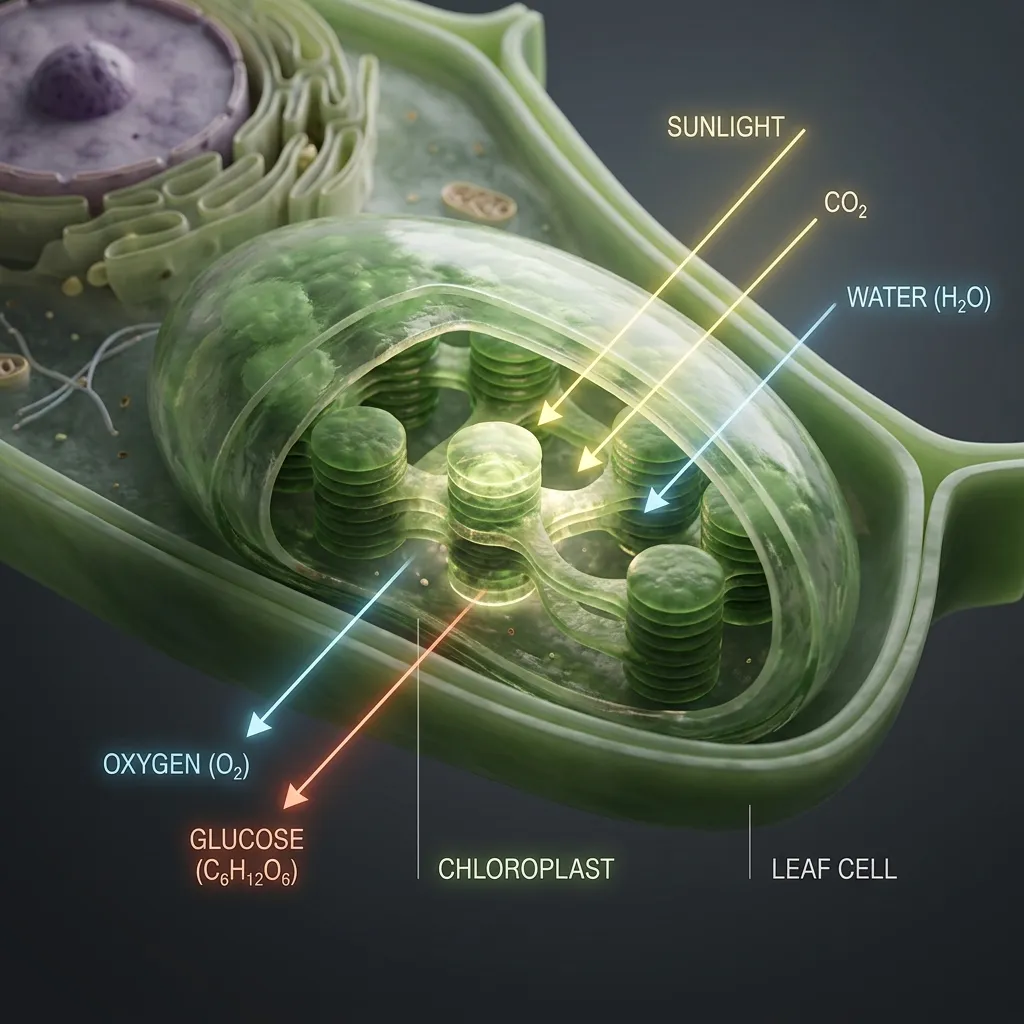 The Photosynthesis Process: A cutaway view of a chloroplast showing sunlight and molecular exchange
The Green Machine: Chloroplasts
The magic happens inside tiny, bean-shaped organs in the leaf called Chloroplasts. Inside them is a green pigment called Chlorophyll. Think of Chlorophyll as a biological solar panel or an antenna. Its job is to catch photons (particles of light). Why are plants Green? Because Chlorophyll is a picky eater. It loves absorbing Red and Blue light energy. But it hates Green light. It reflects the green wavelengths away. So when you look at a forest, you are seeing the "leftovers" of the light feast.
The Process: Smashing Molecules
Once the solar panel is charged, the factory starts humming. The process has two stages:
- The Light Reaction (The Smasher): The plant uses the captured solar energy to split Water molecules ($H_2O$) violently apart. It keeps the Hydrogen ($H$) for fuel. It throws away the Oxygen ($O$) as trash.
- Note: Yes, the oxygen we breathe is essentially plant waste—plant farts.
- The Calvin Cycle (The Builder): The plant takes that stolen Hydrogen and mixes it with Carbon Dioxide ($CO_2$) sucked in from the air. It weaves them together to build Glucose ($C_6H_{12}O_6$). This sugar is the battery of life. The plant uses it to build wood (Cellulose), grow leaves, or make sweet fruit to bribe animals into carrying its seeds.
The Event That Saved (and Killed) the World
3 Billion years ago, Earth was orange. The atmosphere was Nitrogen and Methane. There was no Oxygen. Then, a tiny blue-green bacteria called Cyanobacteria invented Photosynthesis. They started pumping out oxygen. At first, it was a catastrophe. Oxygen was poisonous to the primitive life forms that ruled the earth. This triggered the Great Oxidation Event—a mass extinction that wiped out almost everything. But... it cleared the skies. It created the Ozone layer (shielding Earth from UV rays). And eventually, it allowed high-energy animals (like dinosaurs and us) to evolve. We are the children of that bacterial pollution.
The Solar-Powered Slug
In comics, Poison Ivy blends plants and humans. In reality, the Emerald Elysia (Sea Slug) works like that. It eats algae. But instead of digesting everything, it steals the Chloroplasts. It embeds these tiny solar panels into its own skin. The slug turns bright green. Once it has enough, it can stop eating. It can survive for months just by sunbathing, letting its stolen factories make sugar directly into its bloodstream. It is the only known solar-powered animal. Scientists are studying it to see if we could ever bio-engineer "Solar Skin" for humans (though you'd have to be green).
Extreme Survival: Desert Hacks
Normal plants (C3 plants) have to open their pores (Stomata) to breathe in CO2. But if you live in the desert, opening your pores is suicide—you will lose all your water to evaporation. So, Cacti invented a hack called CAM Photosynthesis.
- The Night Shift: They hold their breath all day long. They only open their pores at Night when it is cool.
- The Battery: They suck in CO2 in the dark and store it in a chemical acid "battery."
- The Day Shift: When the sun comes up, they seal their pores tight and process the stored acid into sugar using sunlight. It is like holding your breath while running a marathon and only breathing when you sleep. It is inefficient, but it allows them to survive where nothing else can.
The Global Lungs
We often call the Amazon Rainforest the "Lungs of the Earth." While trees are vital for storing carbon (fighting climate change), the real oxygen factory is the Ocean. Tiny microscopic algae and Phytoplankton produce between 50% and 80% of the oxygen on Earth. Every second breath you take comes from the sea. We need to protect the oceans as much as the forests.
Fast Facts
- Fall Colors: Why do leaves turn orange in October? The orange/yellow pigments (Carotenoids) were there the whole time! But during summer, the green Chlorophyll is so abundant it masks them. In winter, the tree breaks down the valuable chlorophyll to store it, finally revealing the yellow colors underneath.
- Artificial Leaves: Scientists at Harvard have built a "Bionic Leaf" that uses solar electricity to split water into hydrogen fuel. It is 10x more efficient than a real leaf. This "Artificial Photosynthesis" could be the clean fuel source of the future.
- Rubisco: The key enzyme that grabs CO2 is called Rubisco. It is incredibly slow and inefficient (it creates a lot of errors). To compensate, plants make tons of it. Rubisco is arguably the most abundant protein on Earth by weight.
Diagram Prompts
- The Leaf Factory: A cutaway view of a leaf. Zoom in on a "Chloroplast" machine. Inputs arrows: Sunlight + Water + CO2. The machine gears turn. Output arrows: Oxygen bubbles + Sugar Cubes. Label: "Inputs and Outputs."
- The Light Spectrum: A graph showing Light Wavelengths. A curve shows high absorption in Blue and Red zones, and a dip (reflection) in the Green zone. An eye sees the reflected Green light. Label: "Why Plants Are Green."
- CAM Photosynthesis Cycle: A split Day/Night panel. Night Panel (Moon): Cactus pores OPEN, blue CO2 gas entering. Day Panel (Sun): Cactus pores CLOSED, internal factory churning out sugar while sun beats down. Label: "Desert Survival Hack."