
How Do Planes Fly?
The Big Idea
Unlock the secrets of flight and discover how a massive steel machine stays in the air. Learn how wings manipulate air pressure and speed to create lift, allowing us to travel across continents in just a few hours.
Key Vocabulary & Concepts
Hands-On Observation Checklist
Teacher & Parent Discussion Starters
- Why is understanding how do planes fly? important in everyday real life?
- What variable or factor had the biggest impact when testing the simulation?
- How does this concept connect to another science topic you have learned about?
How Planes Fly: The Battle for Altitude
The Elephant in the Sky
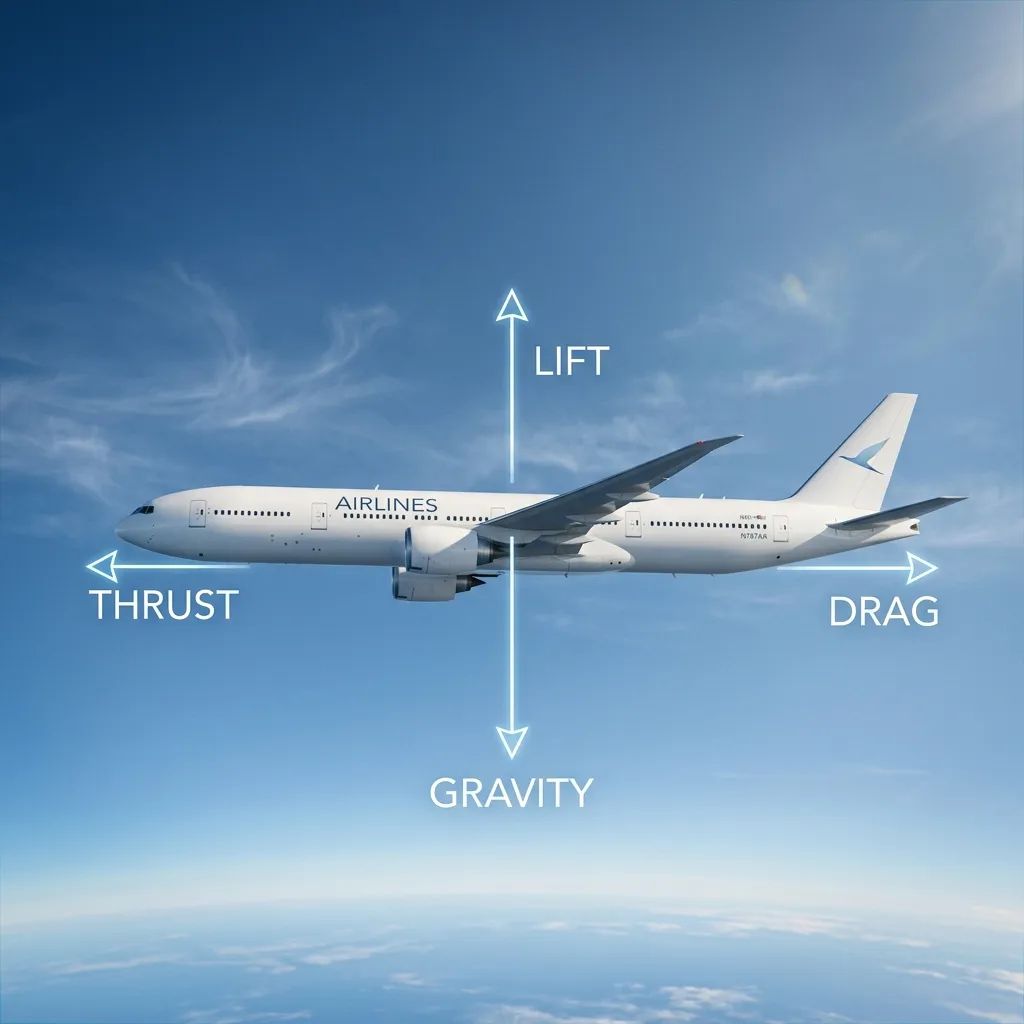
A Boeing 747 weighs 800,000 pounds. That is the equivalent of 55 full-grown African Elephants staring at you from the runway. How does something that heavy float? It doesn't. It runs. Flight is not magic; it is a wrestling match between 4 fundamental forces.
- Gravity: The Villain. It pulls everything down towards the center of the Earth.
- Lift: The Hero. It pushes the wings up, fighting Gravity.
- Drag: The Resistance. The friction of the air pushing back against the plane.
- Thrust: The Engine. The brute force pushing the plane forward to overcome Drag. To take off, Lift must defeat Gravity. To speed up, Thrust must defeat Drag. If these forces ever become unbalanced in the wrong way, the plane stops being a flying machine and becomes a very expensive falling rock.
The Eternal Battle: The four fundamental forces of flight
The Great Debate: Bernoulli vs. Newton
If you ask a physics teacher "How does a wing create lift?", they might lie to you. Or at least, tell you half the story. There are two competing camps:
- The Bernoulli Camp (The Suction): Air traveling over the curved top of the wing has to travel a longer distance than air going underneath. To keep up, it speeds up. According to Daniel Bernoulli's principle, Fast Air = Low Pressure. The slow, high-pressure air Under the wing pushes up, effectively "sucking" the plane into the sky.
- The Newton Camp (The Shove): Forget pressure. It's about reaction. The wing is tilted slightly up (Angle of Attack). As it smashes into the air, it deflects the air DOWN. According to Newton's 3rd Law ("For every action, there is an equal and opposite reaction"), the air pushes the wing UP. Textbooks used to only teach Bernoulli because it felt elegant. But real pilots know the truth: Newton does most of the heavy lifting. You fly by shoving air down.
Jet Engines: Suck, Squeeze, Bang, Blow
How do you push a skyscraper through the air at 600 mph? You use a Jet Engine (Turbofan). It is a machine designed to scream. It creates Thrust using a violent 4-step cycle:
- Suck: The giant titanium fan at the front gulps in massive amounts of air (2,000 lbs per second).
- Squeeze: Compressors squash that air until it is incredibly dense and hot.
- Bang: Jet fuel is sprayed into the compressed air and ignited. BOOM. A continuous, controlled explosion.
- Blow: The scorching hot gas shoots out the back nozzle at supersonic speed. According to the Law of Recoil (like a balloon flying around a room when you let the air out), this massive blast out the back pushes the plane forward.
Winglets: Solving the Vortex
Look at the tip of a modern airplane wing. It usually curls up vertically. This is a Winglet. Is it just for style? No. At the tip of the wing, the high-pressure air underneath desperately wants to escape to the low-pressure zone on top. It curls around the edge, creating a chaotic horizontal tornado called a Wingtip Vortex.
- The Drag: This vortex sucks energy from the plane, acting like a parachute dragging behind you.
- The Fix: The Winglet acts like a fence. It physically blocks the air from leaking around the tip. This simple piece of bent metal reduces drag so much it saves airlines billions of dollars in wasted fuel every year.
The Miracle of the Glide
What happens if all the engines fail? Do you drop like a stone? No. You become a very heavy glider. Planes are designed to slice through the air efficiently. A 747 has a Glide Ratio of 15:1. This means for every 1 mile it drops in altitude, it can travel 15 miles forward. If the engines quit at cruising altitude (35,000 feet), the pilot can glide for nearly 100 miles. That is usually enough to find an airport.
- The Gimli Glider: In 1983, a flight over Canada ran out of fuel mid-air. The pilots glided the massive 767 silently to an abandoned race track and landed safely. Passengers described it as the quietest flight of their lives.
The Sticky Spoon (Coanda Effect)
Here is a home experiment. Hold the back of a spoon gently against a stream of water from your tap. Does the water bounce off? No. The water curves around the back of the spoon and "sticks" to the surface, exiting at a different angle. This is the Coanda Effect. Fluids (like air and water) love to stick to curved surfaces. This effect helps "attach" the airflow to the curved top of a wing, forcing it to bend downwards.
- The Stall: However, if the pilot tilts the nose up too steeply, the air can't stick anymore. It peels off and becomes turbulent. The lift vanishes instantly, and the plane falls. Pilots train constantly to recover from stalls.
Breaking the Sound Barrier
What happens if you fly faster than sound (767 mph)? Sound is a pressure wave. As you speed up, these waves stack up in front of the nose like snow in front of a plow. At Mach 1, the waves fuse into a solid wall of pressure called a Shock Wave. When the plane punches through this wall, the pressure collapses instantly, creating a massive explosion: The Sonic Boom. It sounds like thunder and can shatter windows on the ground. This is why supersonic planes (like the Concorde) were banned from flying over cities.
Fast Facts
- The Black Box: The Flight Data Recorder is practically indestructible. It can survive 2,000°F fire, 3,400 Gs of impact, and 20,000 feet of ocean pressure. Ironically, it is painted Bright Orange (International Orange), not black, so divers can find it in the mud.
- Tiny Holes: Look closely at your passenger window. There is a tiny hole at the bottom. It is a "Breather Hole." It balances the pressure between the inner and outer panes so the window doesn't explode in the vacuum of the upper atmosphere.
- Turbulence: Turbulence is just "potholes in the sky"—unsteady air. It feels scary, but it cannot crash a commercial plane. Modern wings are designed to bend 25 feet up and down without snapping. You are safer in a plane during turbulence than you are walking down stairs.
Diagram Prompts
- The 4 Forces: A side profile of a jumbo jet. 4 Large Arrows originating from the center. Up Arrow (Green): "Lift". Down Arrow (Red): "Gravity". Front Arrow (Blue): "Thrust". Back Arrow (Orange): "Drag". Label: "The Eternal Battle."
- Bernoulli vs Newton: A split panel. Top Panel: "Bernoulli" showing low pressure zone above a curved wing (Suction). Bottom Panel: "Newton" showing air particles hitting the bottom of the wing and bouncing down (Action/Reaction).
- Wingtip Vortex: A diagram of a wing without a winglet showing a chaotic spiral tornado forming at the tip (Drag). Next to it, a wing WITH a winglet, showing smooth airflow with no spiral. Label: "Saving Fuel."