
How Quantum Computers Work
The Big Idea
Discover how quantum computers harness the strange laws of quantum mechanics—superposition, entanglement, and wave interference—inside a golden chandelier chilled to 15 millikelvin to solve calculations that would take conventional supercomputers thousands of years.
Key Vocabulary & Concepts
Hands-On Observation Checklist
Teacher & Parent Discussion Starters
- Why is understanding how quantum computers work important in everyday real life?
- What variable or factor had the biggest impact when testing the simulation?
- How does this concept connect to another science topic you have learned about?
How Quantum Computers Work
Discover how quantum computers harness the strange laws of quantum mechanics—superposition, entanglement, and wave interference—inside a golden chandelier chilled to 15 millikelvin to solve calculations that would take conventional supercomputers thousands of years.
How Quantum Computers Work: Unleashing the Multiverse of Calculation
Imagine you are standing at the entrance of a massive hedge maze with millions of winding pathways.
A traditional computer solves this maze like a tireless runner: it dashes down Path A, hits a dead end, retraces its steps, tries Path B, hits another wall, and repeats this process millions of times. Even if it runs at billions of steps per second, navigating a colossal labyrinth can take decades or centuries.
Now imagine a quantum computer. Instead of sending a single runner, it floods the entire maze with water all at once. The wave explores every corridor, intersection, and opening simultaneously. When the water bursts out the exit, the correct path is revealed in a split second.
This is the promise of quantum computing: not simply faster clock speeds, but a fundamentally different way of processing information rooted in the bizarre rules of quantum mechanics.
Quantum Computer Architecture, Bloch Sphere, and Wave Interference
1. Classical Bits vs. Quantum Qubits
Every smartphone, laptop, and supercomputer on Earth today speaks a language called binary. Inside microchips, microscopic silicon transistors act like binary light switches:
- OFF = 0
- ON = 1
Every photo you take, video you stream, or game you play is sliced into billions of these 0s and 1s.
A qubit (quantum bit) breaks this binary rule. Instead of a rigid switch, think of a spinning coin. While the coin is spinning on a tabletop, is it heads or tails? It is a blurring mix of both! Only when you slam your hand down to stop it does it collapse into a definite Heads (1) or Tails (0).
In quantum physics, this spinning state is known as Superposition. A qubit does not have to choose between 0 and 1; it can exist in a linear combination of both:
$$|\psi\rangle = \alpha|0\rangle + \beta|1\rangle$$
Here, $\alpha$ and $\beta$ are complex probability amplitudes. The probability of measuring $0$ is $|\alpha|^2$, and the probability of measuring $1$ is $|\beta|^2$, where $|\alpha|^2 + |\beta|^2 = 1$.
The Bloch Sphere
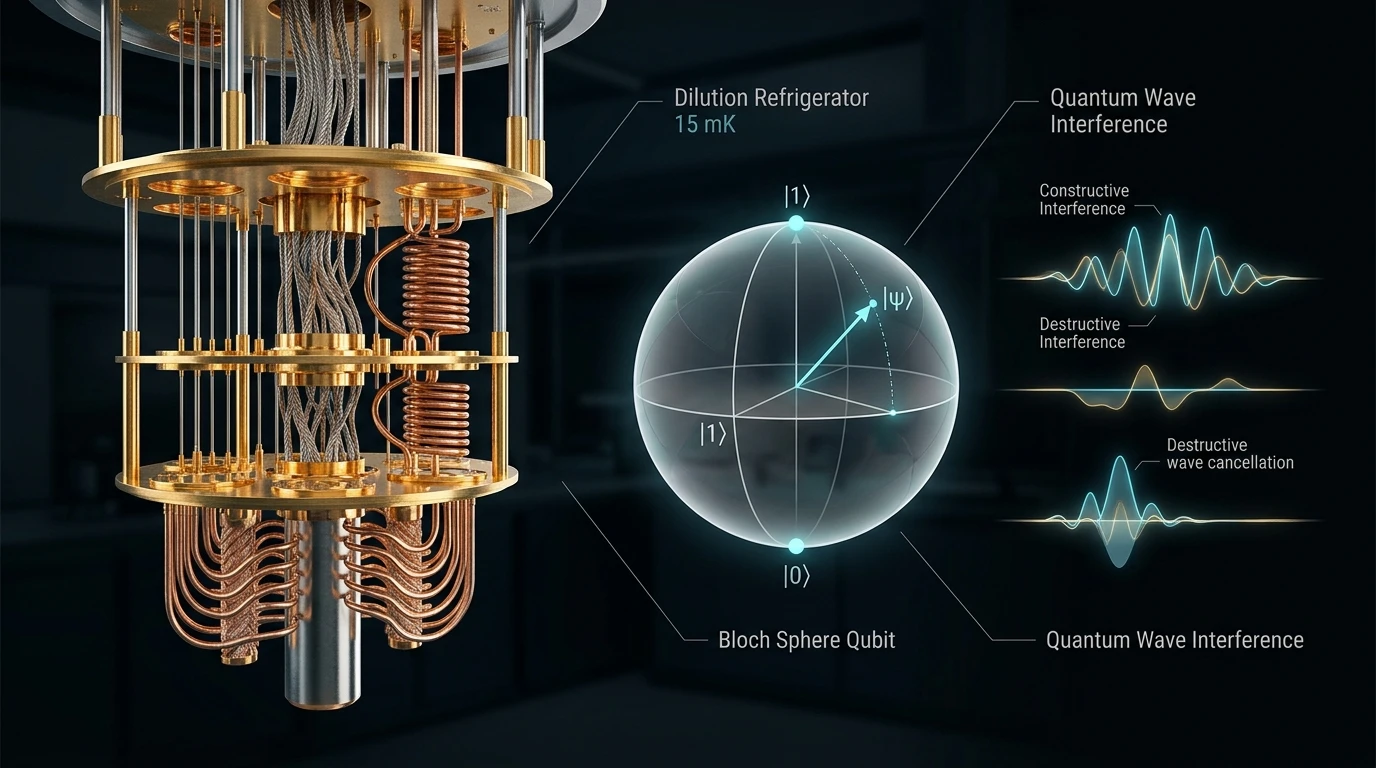
To visualize a qubit, physicists use a beautiful three-dimensional globe called the Bloch Sphere:
- The North Pole represents the pure state $|0\rangle$.
- The South Pole represents the pure state $|1\rangle$.
- Any point along the Equator represents an equal 50/50 superposition of both states.
- By firing precise microwave pulses at the qubit, quantum engineers can steer the state vector anywhere on the sphere's surface, turning information into a continuous geometric dance!
2. The Golden Chandelier: Colder Than Deep Space
When you see a photograph of a quantum computer, you are usually looking at a breathtaking, gleaming golden chandelier suspended from the ceiling.
This magnificent structure is not the processor itself—it is a dilution refrigerator, an extreme cryogenic cooling machine.
Quantum states are extraordinarily fragile. If a stray air molecule, a beam of light, or even the slight warmth of a room strikes a qubit, its delicate quantum superposition instantly shatters into ordinary classical static. Physicists call this catastrophic loss quantum decoherence.
To protect the qubits, the chandelier uses a closed loop of liquid Helium-3 and Helium-4 isotopes cascading down five circular gold-plated copper stages:
- Stage 1 (Room Temp to Outer Stage): $50\text{ Kelvin}$ ($-370^\circ\text{F}$)
- Stage 2 (Cold Stage): $4\text{ Kelvin}$ ($-452^\circ\text{F}$)
- Stage 3 (Still Stage): $0.8\text{ Kelvin}$
- Stage 4 (Cold Plate): $0.1\text{ Kelvin}$ ($100\text{ millikelvin}$)
- The Mixing Chamber (The Quantum Core): $0.015\text{ Kelvin}$ ($15\text{ millikelvin}$)!
At 15 millikelvin, the quantum processor sits at $-459.65^\circ\text{F}$—nearly absolute zero and hundreds of times colder than the void of deep space (which is warmed to 2.7 Kelvin by cosmic microwave background radiation). In this profound, motionless cold, electrical resistance vanishes, allowing superconducting circuits to conduct quantum information without generating heat.
3. The Three Quantum Superpowers
How does a quantum computer outpace classical supercomputers? It relies on three fundamental principles:
A. Exponential Superposition
If you have 2 classical bits, they can store one combination at a time: either 00, 01, 10, or 11.
If you have 2 qubits in superposition, they hold all four states simultaneously.
For $N$ qubits, the system processes $2^N$ states in parallel:
- $10\text{ qubits} = 1,024\text{ states}$
- $50\text{ qubits} = 1.125 \times 10^{15}\text{ states}$ (1.1 quadrillion)
- $300\text{ qubits} = 2^{300}\text{ states}$ — more numbers simultaneously than all the estimated atoms in the entire observable universe!
B. Quantum Entanglement
Einstein famously dubbed entanglement "spooky action at a distance." When two or more qubits interact, they can form an entangled link where their fates become permanently intertwined.
Even if you separate entangled qubits by light-years, measuring one instantly reveals the state of the other. In a quantum processor, entanglement binds the qubits into a unified computational fabric, allowing changes in one qubit to ripple instantaneously across the entire algorithm.
C. Quantum Wave Interference (The True Secret Sauce)
Having millions of possibilities in superposition is useless if measuring them just gives you a random random number. This is where interference comes in.
Like waves on the surface of a pond, quantum probability amplitudes can have positive peaks and negative troughs:
- Constructive Interference: When two peaks meet, they combine into a giant wave, amplifying the probability of that outcome.
- Destructive Interference: When a peak meets a trough, they cancel each other out completely, driving the probability to zero.
Quantum algorithms are masterpieces of mathematical choreography. They arrange quantum logic gates (such as Hadamard $H$, Pauli-X, Phase $Z$, and CNOT gates) so that billions of wrong answers destructively cancel each other out, while the single correct answer constructively surges forward right before measurement!
4. Real-World Superpowers: What Will They Solve?
Quantum computers are not intended to replace home laptops or speed up everyday video games. Instead, they excel at problems with astronomical numbers of combinations:
- Molecular Chemistry & Medicine: Today's supercomputers cannot accurately model the quantum behavior of complex proteins or chemical catalysts. Quantum computers could simulate molecules atom-by-atom, accelerating cures for diseases and discovering room-temperature superconductors.
- Clean Energy & The Haber-Bosch Process: Making artificial fertilizer consumes roughly 2% of the world's entire energy supply because humans must heat nitrogen to extreme temperatures. Soil bacteria do this at room temperature using a natural enzyme called nitrogenase. Modeling nitrogenase on a quantum computer could revolutionize green agriculture.
- Global Logistics & Battery Chemistry: Finding the optimal flight paths for global airlines, minimizing grid power losses, or designing next-generation solid-state electric vehicle batteries with five times the range.
🌟 Fun Facts & Did You Know?
- No-Cloning Theorem: In quantum mechanics, it is mathematically impossible to make an exact copy of an unknown quantum state! If you try to read it to copy it, the measurement irreversibly collapses the superposition.
- The Microwave Conductors: The hundreds of shiny golden tubes coiling down the chandelier are coaxial waveguides carrying precise 5-gigahertz microwave pulses that gently rotate qubit state vectors without heating up the fridge.
- Quantum Supremacy / Quantum Advantage: In 2019, Google's 53-qubit Sycamore processor performed a calculation in 200 seconds that would have required the world's most powerful supercomputer (Summit at Oak Ridge National Laboratory) thousands of years to compute!
- Post-Quantum Cryptography: Because large-scale quantum computers running Shor's algorithm could theoretically factor the prime numbers that safeguard modern internet encryption (RSA), scientists and governments worldwide are already rolling out quantum-resistant cryptographic shields.
Inspire Lifelong Curiosity
Join 15,000+ teachers, homeschool parents, and curious minds. Get free weekly hands-on STEM experiments, printable classroom lab worksheets, and new wonder releases delivered straight to your inbox.
Related Wonders
 Technology
How Do Submarines Sink?
Master the physics of buoyancy and discover how massive steel ships can vanish beneath the waves. Learn how submarines use ballast tanks to control their density and navigate the crushing depths of the deep ocean.
 Human
How Do Touchscreens Work?
Uncover the invisible, microscopic electrical grid hiding inside your phone screen. Discover how a thin layer of gold and the natural electricity in your own body allow smooth glass to magically sense your every touch.
 Space
How Does GPS Work?
Discover the invisible network of satellites orbiting Earth that helps you find your way. Learn how high-tech atomic clocks and complex math allow your phone to pinpoint your exact location anywhere on the planet.