
How Does the Internet Work?
The Big Idea
Dive beneath the ocean to discover the massive physical machine of glass cables and powerful servers that powers our digital world. Learn how your favorite photos and videos travel around the globe in a split second.
Key Vocabulary & Concepts
Hands-On Observation Checklist
Teacher & Parent Discussion Starters
- Why is understanding how does the internet work? important in everyday real life?
- What variable or factor had the biggest impact when testing the simulation?
- How does this concept connect to another science topic you have learned about?
How the Internet Works: The Machine Under the Ocean
The Cloud is a Lie
There is no such thing as "The Cloud." It is a beautiful, comforting marketing term designed to make technology feel like magic. In reality, "The Cloud" is simply Someone Else's Computer.
When you upload a photo to Instagram, it doesn't magically float into the sky. It travels through a physical, plastic-coated glass tube buried under your street. It dives deep into the freezing mud of the ocean floor. It travels 3,000 miles across the pitch-black Atlantic. And it finally lands on a spinning hard drive inside a hot, noisy, windowless concrete warehouse in Virginia known as a Data Center.
The Internet is not magic. It is a massive, physical machine. It is constructed out of fragile glass, heavy copper, electricity, and rust.
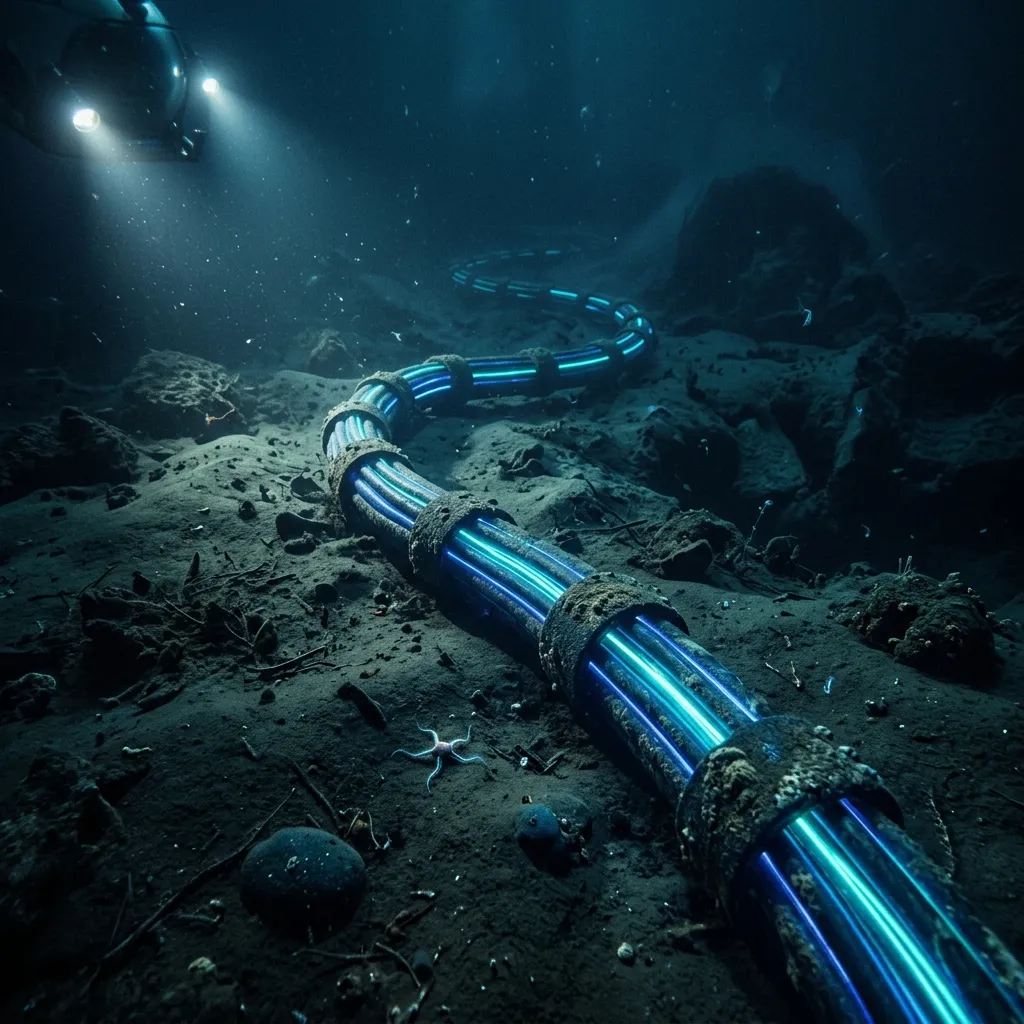 A breathtaking cinematic photograph looking deep into the ocean at thick, glowing fiber-optic cables resting on the sand
The Undersea Backbone
We tend to think of the internet as completely wireless because of our phones. But an incredible 99% of all international internet data travels entirely underwater.
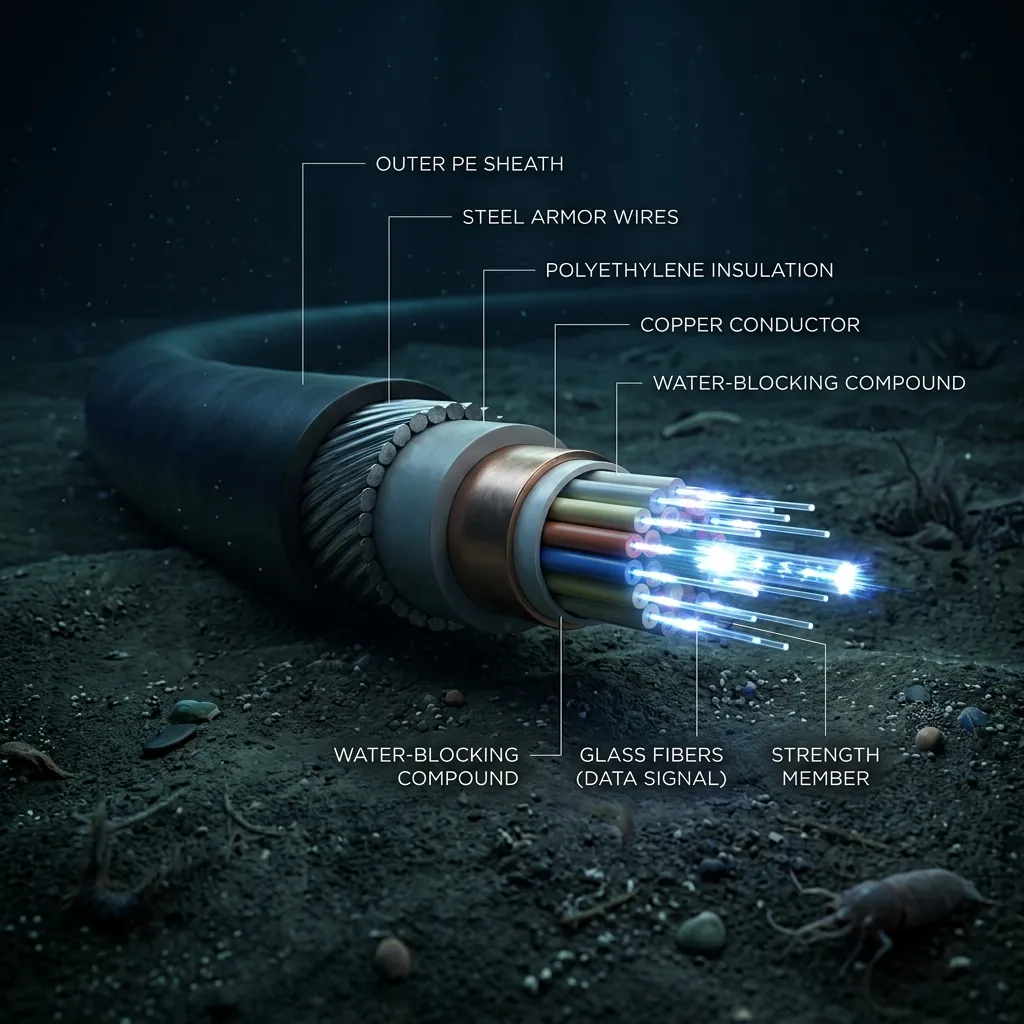
There are over 400 massive fiber-optic cables lying silently on the bottom of the ocean, connecting the continents like the veins of a global nervous system. These heavy cables are roughly the thickness of a garden hose. Inside them, incredibly pure strands of glass—each one thinner than a human hair—carry all of humanity's information as blindingly fast pulses of laser light.
- The Vulnerability: These vital cables are surprisingly fragile. Sharks occasionally bite them (scientists think they are attracted to the electromagnetic hum). Massive cargo ships drop heavy iron anchors on them. Deep-sea earthquakes violently snap them.
- The Repair: If a major cable is cut, entire countries can experience massive slowdowns or go completely dark. Specialized repair ships have to sail out into the ocean, drag a heavy grapple hook along the muddy bottom to blindly catch the broken ends, haul them up to the deck, and painstakingly splice the microscopic glass back together by hand.
The Backbone: A high-tech cutaway of a fiber-optic cable on the ocean floor
The Language of Packets
Computers do not send files in one massive, solid piece. If you tried to send an entire 4K movie to a friend all at once, it would clog the digital pipe and nothing else could get through. Instead, the internet uses a brilliant logistical system called Packet Switching.
Imagine trying to mail a 1,000-piece jigsaw puzzle to a friend, but you are forced to mail every single piece in its own separate envelope.
- The Chopper (TCP): When you send a photo, your computer chops the image into thousands of tiny digital envelopes called Packets. It slaps a sequence number on them (#1 of 500, #2 of 500...).
- The GPS (IP): It stamps your friend's exact destination address on every single packet.
- The Chaotic Route: The packets don't even take the same path! Packet #1 might travel through Paris because the line is clear. Packet #2 might get routed through Berlin to avoid a traffic jam. They dynamically navigate the globe, dodging broken cables and overloaded servers automatically.
- The Assembly: When the chaotic swarm of packets finally arrives at your friend's phone, the device quickly checks the sequence numbers and glues them back together in milliseconds to display the photo. If Packet #45 is missing, your computer simply shouts back across the ocean, "Hey, send #45 again!"
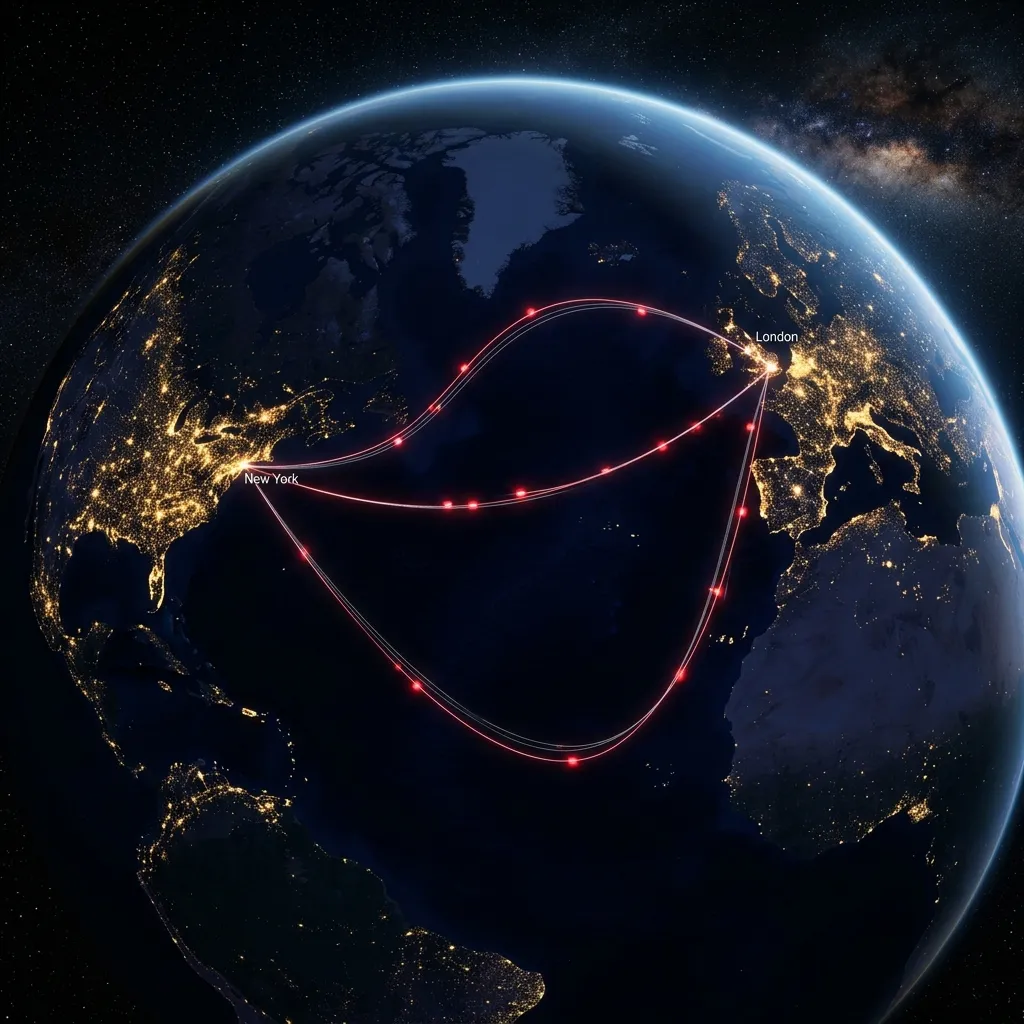 A cinematic map of the Earth at night showing glowing red packet paths across the Atlantic Ocean
The Phonebook: DNS
Computers do not speak English. They speak Math. To a computer, a name like "Google.com" doesn't exist. The real, physical address of Google's servers is a clunky string of numbers like 142.250.190.46 (known as an IP Address).
Since humans are terribly bad at memorizing long strings of random numbers, early internet pioneers invented the Domain Name System (DNS). It acts as the ultimate Phonebook of the Internet.
- The Process: When you type "YouTube.com" into your browser, your computer secretly sends a lightning-fast message to a DNS Server asking: "What is the actual phone number for YouTube?"
- The Answer: The server quickly flips through its massive digital directory and replies: "It is 208.65.153.238."
- The Call: Your browser then dials that exact number to load the video.
This entire conversation happens in milliseconds. Occasionally, if these global DNS servers crash, the internet appears to be completely "down." In reality, the cables and servers are completely fine; your computer just temporarily forgot everyone's phone number!
Can You Break the Internet?
Movie villains and hackers always threaten to "take down the internet." But could you actually destroy the entire network? No.
Why? Because the internet is profoundly Decentralized. The core architecture was originally designed by the US Military in the 1960s with a very specific, grim goal: survive a Nuclear War. It has no single center. There is no central headquarters or "Master Switch."
It is structured like an infinite spiderweb. If a terrible disaster destroys the main cables in New York City, the traffic doesn't stop; the routers simply notice the road is closed and automatically reroute the packets through Chicago or Atlanta. You can easily crash a single specific website by overloading it with traffic, but you cannot physically kill the network itself. It is the most robust, resilient, and self-healing machine humanity has ever built.