
How Do Tornadoes Form?
The Big Idea
Step into the eye of the storm to witness the violent collision of warm and cold air. Discover the terrifying atmospheric physics that create a rotating supercell and the birth of the most powerful winds on Earth.
Key Vocabulary & Concepts
Hands-On Observation Checklist
Teacher & Parent Discussion Starters
- Why is understanding how do tornadoes form? important in everyday real life?
- What variable or factor had the biggest impact when testing the simulation?
- How does this concept connect to another science topic you have learned about?
How Do Tornadoes Form?
Nature’s Fiercest Spiral
Imagine a warm, humid afternoon. The sky suddenly turns a strange, sickly shade of green. The air becomes eerily still, like the world is holding its breath. Then, a massive, rotating wall of dark clouds descends from the sky, and a terrifying roar, like a thousand freight trains, fills the air.
This is the birth of a Tornado—a violent, rotating column of air that reaches from a thunderstorm all the way to the ground. They are the most powerful and destructive winds on the surface of our planet, capable of lifting semi-trucks into the air and turning blades of grass into deadly arrows.
But how can invisible air turn into such a terrifying monster?
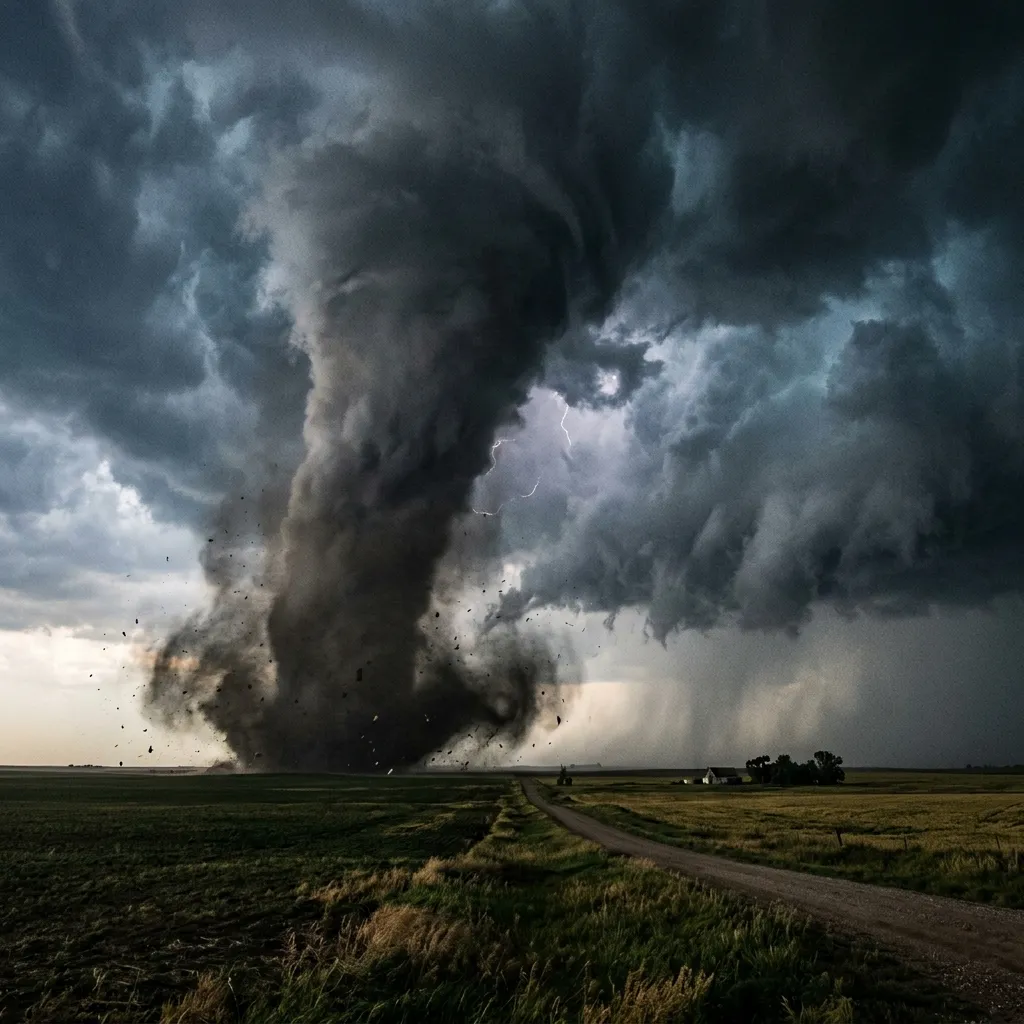 A breathtaking cinematic photograph of a massive dark tornado vortex touching down in a Kansas field
The Violent Collision
A tornado doesn't just appear out of nowhere; it requires a very specific and violent set of atmospheric conditions.
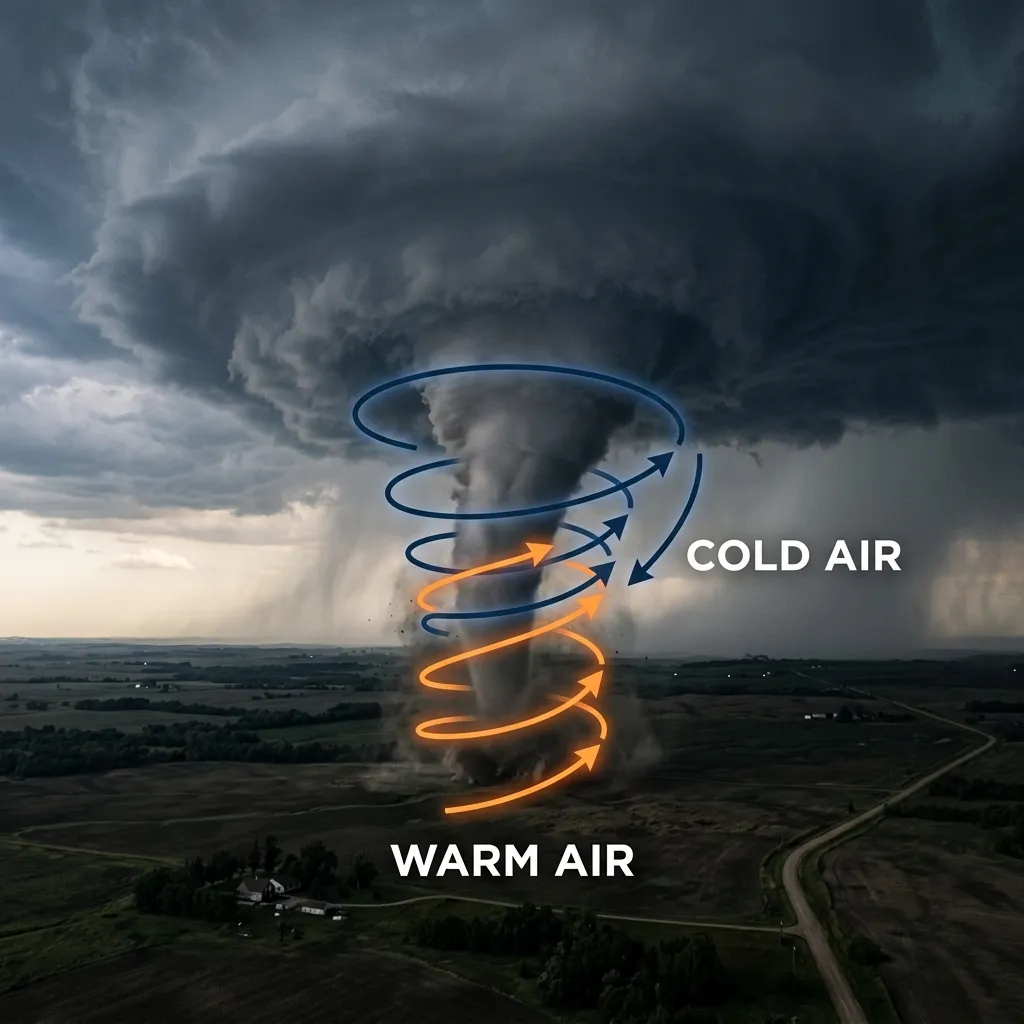
It almost always begins with a Supercell—a massive, rotating thunderstorm. These storms form when two completely different types of air violently collide:
- Warm, moist air (usually from the south/ocean)
- Cold, dry air (usually from the north/mountains)
When these two meet, the warm air is forced to rise incredibly fast. If the wind at the top of the storm is moving in a different direction and at a faster speed than the wind at the bottom (a process called Wind Shear), it starts to roll the air into an invisible, horizontal spinning tube.
Atmospheric Collision: How warm and cold air create a rotating vortex
The Vertical Flip
As the warm air continues to rush upward into the storm (the Updraft), it grabs that horizontal spinning tube and pulls it into a vertical position. Now, a massive section of the storm—miles wide—is spinning like a giant top. This rotating heart of the storm is called a Mesocyclone.
As the rotation gets tighter and faster, a funnel begins to stretch down toward the Earth. If it successfully touches the ground, it officially becomes a tornado.
The Invisible Funnel
The most surprising thing about a tornado is that the wind itself is actually invisible.
The dark, solid-looking funnel we see is actually a combination of two things:
- Condensation: The pressure inside the funnel is so incredibly low that the air cools down instantly, forcing water vapor to turn into a visible cloud.
- Debris: As the tornado touches the ground, it sucks up thousands of pounds of dust, dirt, wood, and anything else in its path, giving the funnel its scary, dark color.
A powerful tornado (an EF5) can have winds spinning at over 200 miles per hour. At those speeds, the physics of everyday objects completely change, demonstrating the terrifying and awesome power of the air we breathe every day.
If you are ever in the path of one, the only safe place is underground or in the center of a strong building, putting as many walls as possible between you and the spinning debris. Its beauty is best admired from a very, very safe distance.