
What Causes Auroras?
The Big Idea
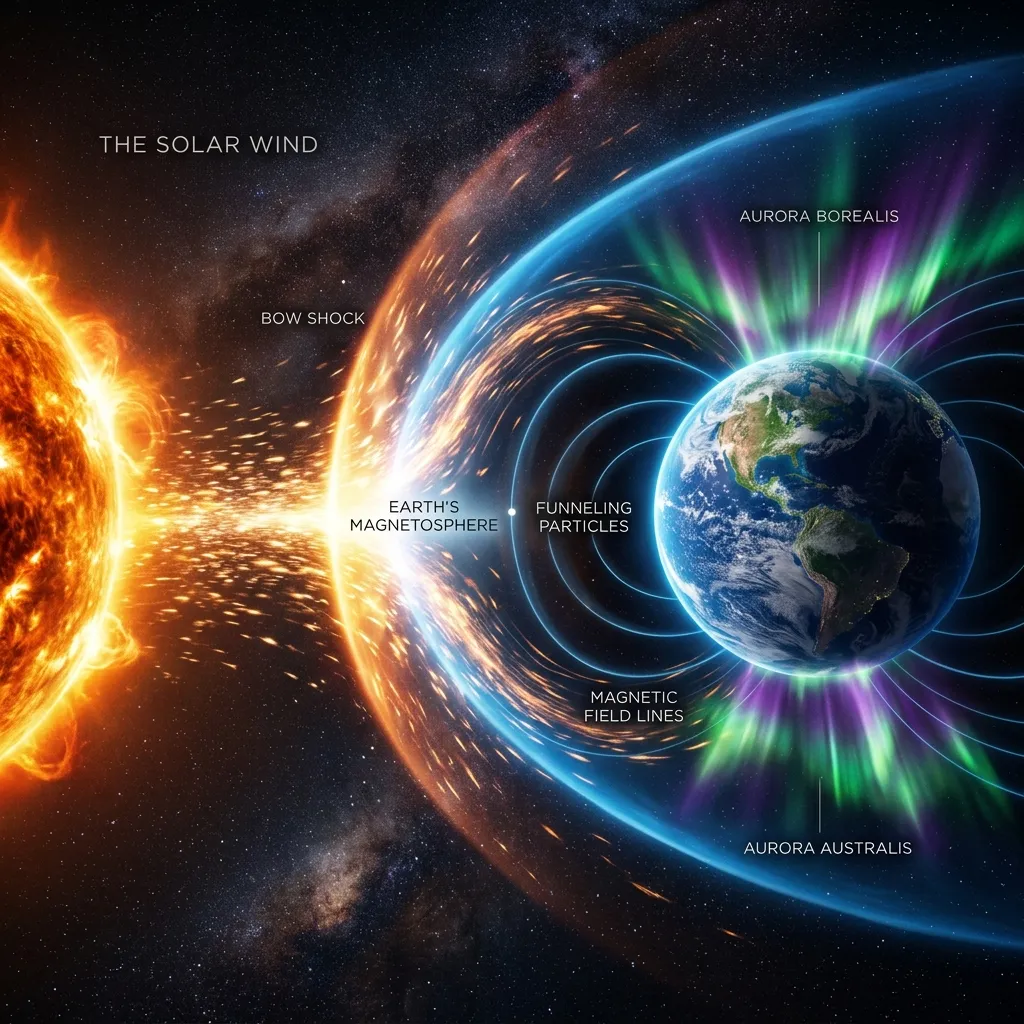
Witness the breathtaking light show of the Northern and Southern Lights. Discover how the Sun’s violent solar wind crashes into Earth’s magnetic shield, creating a glowing neon dance of colors in the night sky.
Key Vocabulary & Concepts
Hands-On Observation Checklist
Teacher & Parent Discussion Starters
- Why is understanding what causes auroras? important in everyday real life?
- What variable or factor had the biggest impact when testing the simulation?
- How does this concept connect to another science topic you have learned about?
What Causes Auroras?
If you venture into the sub-zero darkness of the Arctic Circle or the Antarctic coast on a clear winter night, you might witness one of the most mesmerizing spectacles in nature. Ghostly ribbons of emerald, violet, and crimson light ripple silently across the stars, curling and twisting like luminous curtains tossed by an invisible wind.
In the northern hemisphere, this celestial display is called the Aurora Borealis (the Northern Lights), while its twin in the south is known as the Aurora Australis (the Southern Lights).
Ancient Norse mythology believed these glowing bridges were the armor of the Valkyries guiding fallen warriors to Valhalla. But modern astrophysics reveals a reality that is even more thrilling: auroras are the glowing fallout of an invisible, high-energy cosmic collision between our Sun and Earth’s protective magnetic shield!
The Solar Cannon: 93 Million Miles Away
The story of every aurora begins at our local star. The Sun is not a solid sphere of burning rock, but a churning, roiling cauldron of superheated plasma governed by violent magnetic fields.
Constantly, the Sun hurls a turbulent stream of electrically charged particles—mostly protons and high-speed electrons—outward into the void of space at blistering speeds between 1 million and 2 million miles per hour (400 to 800 km/s).
During solar flares or coronal mass ejections (CMEs), billions of tons of this solar plasma detonate into interplanetary space, hurtling directly toward Earth.
If this radioactive solar wind slammed directly into our ground, it would strip away our atmosphere, boil our oceans, and irradiate all surface life. Fortunately, our planet possesses a colossal, invisible force field: the magnetosphere.
Generated deep inside Earth's core by the churning dynamo of molten iron, our magnetic field envelops the planet like an enormous teardrop-shaped bubble, deflecting the vast majority of the lethal solar storm safely into space.
The Polar Funnels: The Cosmic Neon Sign
However, Earth's magnetic armor has two natural "leaks." Near the North and South magnetic poles, our magnetic field lines curve sharply inward, plunging straight down toward the ground like giant cosmic funnels.
When incoming solar electrons hit this magnetic bend, they become trapped. Spiraling rapidly along the magnetic field lines, they accelerate downward toward the polar regions, crashing directly into Earth's upper atmosphere between 60 and 400 miles (100 to 600 km) above the ground.
Here, the atmosphere operates exactly like a giant neon sign.
When high-speed solar electrons smash into neutral atoms of atmospheric gas, they violently transfer their kinetic energy to the gas's electrons, kicking them into an "excited," higher-energy orbital state.
Atoms hate being unstable. Within microseconds to a few seconds, the excited electrons drop back down to their relaxed ground state. As they fall, they release that surplus energy as a single photon of pure, colored light!
Why Are Auroras Different Colors?
The color of the dancing aurora depends entirely on which gas is being struck and at what altitude the collision occurs:
- Emerald Green (Most Common): Produced when solar electrons strike atomic oxygen between 60 and 150 miles high. Human eyes are extremely sensitive to green light, which is why most auroral photographs glow with lime-green curtains.
- Deep Crimson Red: Produced by oxygen collisions high above 150 miles, where the atmosphere is hyper-thin and excited oxygen atoms have enough quiet time to radiate low-energy red photons.
- Electric Blue and Magenta: Produced when solar electrons collide with dense molecular nitrogen lower down in the atmosphere, often fringing the very bottom edge of fast-moving auroral curtains.
Fast Facts About Auroras
- Solar Maximum: The Sun follows an 11-year cycle of activity. During the "Solar Maximum," solar storms peak, pushing auroras so far toward the equator that they can sometimes be seen in southern Europe or the central United States!
- Alien Auroras: Earth is not alone! The Hubble Space Telescope has captured colossal auroras glowing on Jupiter and Saturn, where magnetic fields are hundreds of times stronger than ours.
- Do Auroras Make Sound? For centuries, Arctic travelers reported hearing faint crackling or hissing during intense displays. In 2012, acoustic researchers proved that electromagnetic inversions near the ground can indeed produce faint static clicks during major geomagnetic storms.
- The Carrington Event: In 1859, the largest recorded solar storm in history struck Earth, causing auroras so blindingly bright that gold miners in the Rocky Mountains woke up at 2 AM and began cooking breakfast, thinking it was dawn!
Related Wonders
 Space
Why Don't We Float Away?
Explore the invisible force of gravity that holds our world together. Discover how the Earth’s massive size creates a powerful pull that keeps us, our oceans, and our atmosphere firmly on the ground.
 Space
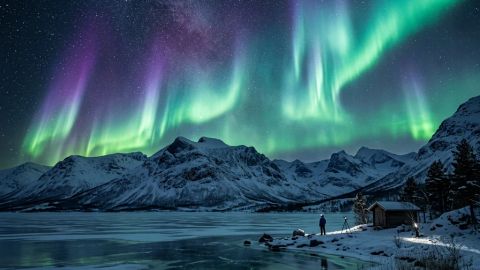
Northern Lights
Witness the spectacular neon light show of the polar skies. Discover how solar winds collide with the Earth's magnetic field to create the dancing, colorful curtains of light known as the Aurora Borealis and Aurora Australis.
 Space
How Do Rockets Work in Space?
If space is a total vacuum with no air to push against, how does a massive rocket ship actually move forward? Unlock the secrets of Newton's Third Law and the physics of fire that allow us to reach the stars.