
What Causes Brain Freeze?
The Big Idea
Understand the intense, short-lived sharp pain of a brain freeze. Discover how your trigeminal nerve gets confused by extreme cold on the roof of your mouth and learn the fastest biological trick to stop the freeze.
Key Vocabulary & Concepts
Hands-On Observation Checklist
Teacher & Parent Discussion Starters
- Why is understanding what causes brain freeze? important in everyday real life?
- What variable or factor had the biggest impact when testing the simulation?
- How does this concept connect to another science topic you have learned about?
What Causes Brain Freeze?
Understand the intense, short-lived sharp pain of a brain freeze. Discover how your trigeminal nerve gets confused by extreme cold on the roof of your mouth and learn the fastest biological trick to stop the freeze.
What Causes Brain Freeze?
It is a blistering ninety-degree afternoon in the middle of summer. You buy an ice-cold cherry slushie, stick in the straw, and gulp down three huge mouthfuls as fast as humanly possible.
For two glorious seconds, you feel total relief. Then, without warning, a savage, stabbing pain detonates directly behind your forehead and temples. You drop your cup, clutch your skull, squeeze your eyes shut, and groan in agony.
In casual conversation, we call this sudden ambush a brain freeze or an "ice cream headache."
If you want to impress your biology teacher, however, you can use its official twenty-six-letter medical name: sphenopalatine ganglioneuralgia (pronounced SFEE-no-pal-uh-tyne gang-glee-oh-noo-RAL-juh).
Despite what the sensation feels like, your brain is not actually freezing solid into a block of ice. In fact, your brain tissue cannot feel cold at all! So why does a spoonful of ice cream trigger such blinding head pain?
The Panic in the Roof of Your Mouth
The mystery begins on the roof of your mouth, specifically the soft, fleshy area toward the back of your throat called the posterior palate.
Running directly behind this palate is an intricate network of delicate blood vessels and nerve endings, including branches of the internal carotid artery—one of the primary superhighways delivering oxygen-rich blood straight into your brain.
Your brain is the most temperature-sensitive organ in your entire body. To function properly, it requires a steady core temperature of around 98.6°F (37°C). If cold blood chilled the delicate neurons in your cerebral cortex, it could impair your consciousness and coordination.
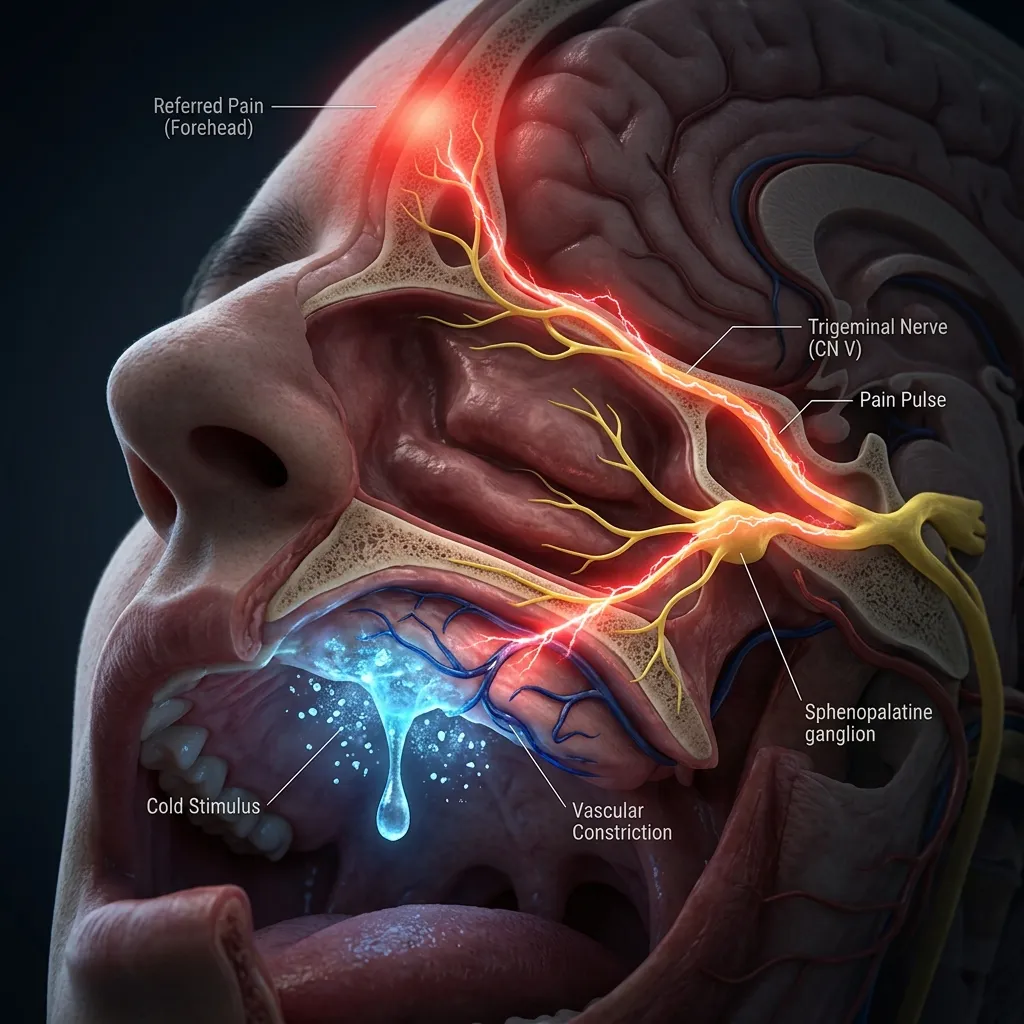
When you swallow an icy dessert too quickly, the freezing temperature violently chills the roof of your mouth. Sensing an immediate emergency, your body initiates a rapid two-step vascular reaction:
- Vasoconstriction: The blood vessels in your palate spasm and clamp tightly shut to prevent freezing blood from entering your head.
- Rapid Vasodilation: Sensed by the brain as a life-threatening chill, your cardiovascular system immediately rebounds, dilating those same blood vessels to maximum width to flood the area with warm blood.
This explosive, rapid ballooning of blood vessels stretches the vessel walls and triggers surrounding pain receptors, firing a frantic biological distress flare straight into your central nervous system.
The Crossed Wire: Referred Pain
Here is where the body’s wiring gets messy.
The pain signals from your palate travel along the trigeminal nerve (Cranial Nerve V), the massive communications cable responsible for transmitting sensations from your entire face—including your jaw, teeth, gums, eyes, and forehead.
All of these sensory wires merge at a central neural junction box located near your temples called the sphenopalatine ganglion.
Because your palate does not experience extreme cold very often, your brain gets completely confused by the deluge of emergency signals flooding the junction. Instead of recognizing that the distress call is coming from the roof of your mouth, the brain misinterprets the signal as coming from your upper forehead and eye sockets!
Neuroscientists call this phenomenon referred pain—when pain originated in one internal organ is felt in an entirely different part of the body.
The Instant Biological Hack
Now that you understand the mechanics, you don’t have to suffer through 30 seconds of misery. You can reverse engineer your body's reflexes with a simple physical hack:
- The Tongue Press: Instantly roll your tongue backward and press the warm, flat underside firmly against the roof of your mouth.
- Why it Works: The underside of your tongue is packed with warm capillary blood. Pressing it against your palate acts like a heating pad, rapidly warming the constricted vessels and switching off the trigeminal nerve's panic alarm within seconds!
Fast Facts About Brain Freeze
- The Brain Feels No Pain: The human brain has no pain receptors of its own. Neurosurgeons can perform brain surgery on patients while they are fully awake without causing them any pain! The agony of a brain freeze comes from surrounding nerves and dilated meningeal blood vessels.
- Migraine Clue: Scientists at Harvard Medical School study brain freezes to better understand migraines, as both conditions involve the exact same sudden dilation of cranial blood vessels.
- Pets Freeze Too: Cats and dogs that gulp down icy treats or frozen water can also experience brain freeze, often shaking their heads in comical confusion as their trigeminal nerves fire!
- Prevention Strategy: The simplest way to avoid brain freeze is to slow down: let cold food linger near the front of your tongue before swallowing so it warms up before touching the sensitive soft palate.
Related Wonders
 Human
How Do We Taste Food?
Discover the powerful chemical sensors living on your tongue. Learn how thousands of tiny taste buds work with your sense of smell to decode the flavors of your favorite foods and protect you from danger.
 Human
Why Does Our Stomach Growl?
Discover the noisy biological plumbing happening inside your digestive system. Learn why your stomach 'talks' when you're hungry, and how gas and fluid moving through your intestines create those iconic rumbling sounds.
 Human
Why Do We Sneeze?
Discover the violent, 100-mph biological explosion your body uses to protect your lungs. Learn how your brain triggers this high-speed air blast to aggressively eject microscopic invaders and dust from your sensitive airways.